

Trading
Explora una amplia gama de mercados con precios competitivos, liquidez profunda y herramientas de trading avanzadas.
Más información 
Plataforma
Opera sin interrupciones con la potente plataforma de TMGM, diseñada para ofrecer velocidad, precisión y una experiencia de trading superior.
Más información Plataforma de trading
Herramientas de trading
Academia
Aprende los fundamentos del trading con recursos ideales para principiantes, incluidas guías, seminarios web y análisis del mercado.
Más información Academia TMGM
Noticias y análisis
Obtén actualizaciones del mercado en tiempo real y análisis de expertos para adelantarte a las oportunidades de trading
Más información Noticias y análisis
Acerca de
Descubre qué distingue a TMGM: nuestra presencia global, solidez regulatoria y compromiso con la innovación en el trading.
Más información Por qué elegir TMGM
Crude Oil slips from a one-month high on Trump's Russia waiver
- WTI is set to end a seven-session winning streak within Friday's range.
- The waiver lifts tariffs of up to 100% on the biggest buyers of Russian energy.
- The EIA's US inventory count is due Wednesday after an 8.6 million barrel fall.
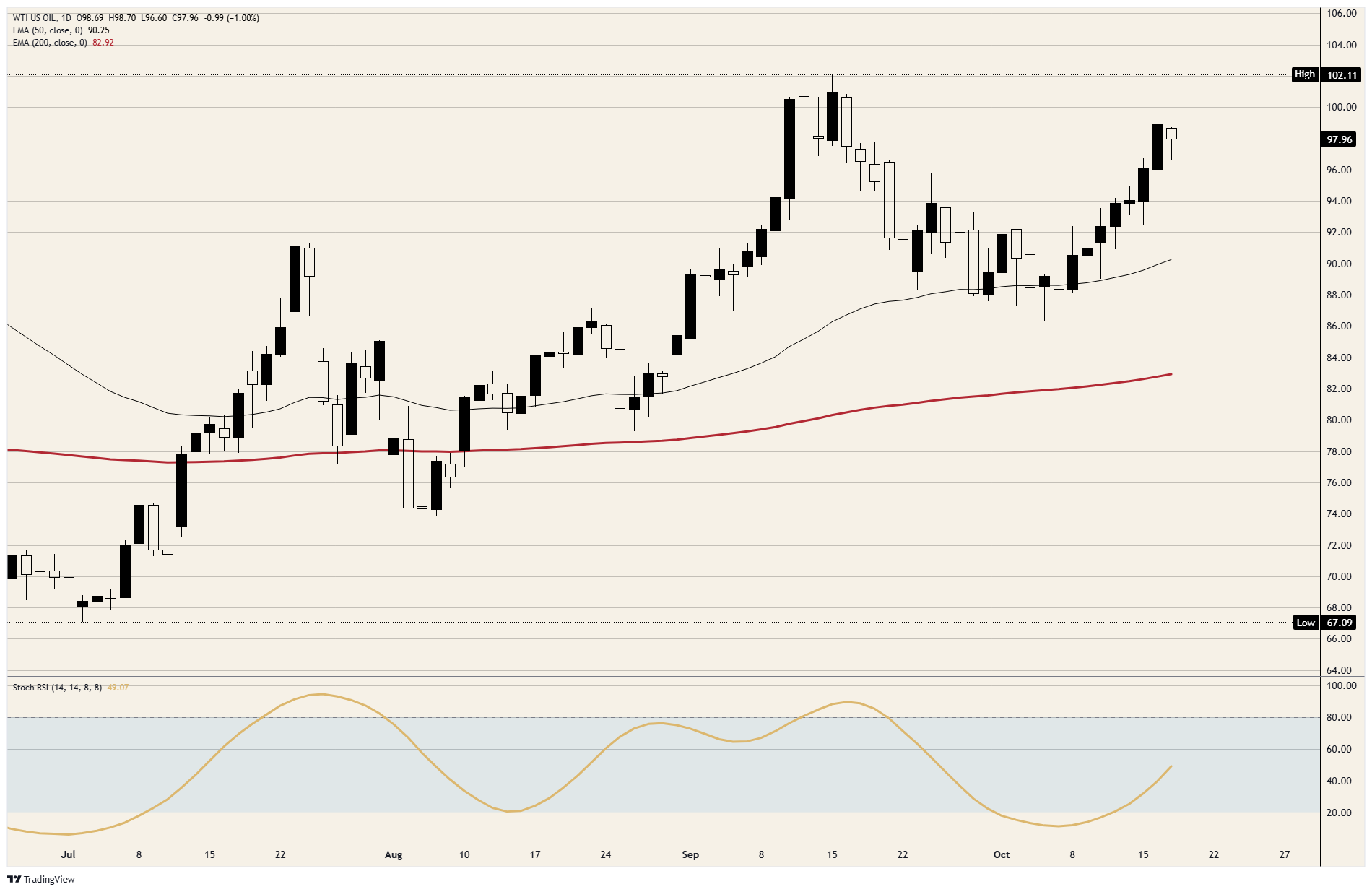
A waiver of new Russia sanctions has WTI on track for its first losing session in eight, though the price hasn't left Friday's range. Friday's high just above $99.00 was the highest since mid-September. The session low just above $96.50 gave back about a fifth of the seven-session climb, and the price is back near $98.00.

President Trump signed an order on Friday waiving the Russia sections of the Graham Act, including tariffs of up to 100% on the five biggest buyers of Russian Crude Oil. Russia supplied nearly half of India's Crude Oil imports earlier this year, and under the tariffs India would have had to replace them, US Crude Oil included. The act became law in September after an 86-11 Senate vote, and its Russia sections were waived before they came into force.
Kpler put the seven-day average of Gulf Crude Oil flows near 8.5 million barrels a day, from more than 20 million a week earlier. Iran's Revolutionary Guard said a tanker hit a mine in the southern Strait of Hormuz on Sunday. WTI loads at Texas ports, so a buyer short of Gulf cargoes can replace them with barrels that never go near the strait.
On the calendar
The American Petroleum Institute (API) publishes its US inventory count at 20:30 GMT on Tuesday, and the Energy Information Administration (EIA) follows at 14:30 GMT on Wednesday. The EIA's figures cover the week to October 16, the first US count since Gulf flows fell, after commercial stocks dropped 8.6 million barrels the week before.
Secretary of State Rubio meets Indian External Affairs Minister Jaishankar in Mumbai on Tuesday. He said on Monday that their trade deal, which he called very close, was one reason for Friday's waiver, and that the waived tariffs applied to India's Russian cargoes.
On the charts
The seven-session run began from a close just under the 50-day Exponential Moving Average (EMA) on October 7, and the average has risen to just above $90.00 since. At its Friday high the price had recovered more than four-fifths of the fall from the September 15 high just above $102.00 to the October 6 low near $86.50.
WTI spot daily chart
WTI Oil FAQs
WTI Oil is a type of Crude Oil sold on international markets. The WTI stands for West Texas Intermediate, one of three major types including Brent and Dubai Crude. WTI is also referred to as “light” and “sweet” because of its relatively low gravity and sulfur content respectively. It is considered a high quality Oil that is easily refined. It is sourced in the United States and distributed via the Cushing hub, which is considered “The Pipeline Crossroads of the World”. It is a benchmark for the Oil market and WTI price is frequently quoted in the media.
Like all assets, supply and demand are the key drivers of WTI Oil price. As such, global growth can be a driver of increased demand and vice versa for weak global growth. Political instability, wars, and sanctions can disrupt supply and impact prices. The decisions of OPEC, a group of major Oil-producing countries, is another key driver of price. The value of the US Dollar influences the price of WTI Crude Oil, since Oil is predominantly traded in US Dollars, thus a weaker US Dollar can make Oil more affordable and vice versa.
The weekly Oil inventory reports published by the American Petroleum Institute (API) and the Energy Information Agency (EIA) impact the price of WTI Oil. Changes in inventories reflect fluctuating supply and demand. If the data shows a drop in inventories it can indicate increased demand, pushing up Oil price. Higher inventories can reflect increased supply, pushing down prices. API’s report is published every Tuesday and EIA’s the day after. Their results are usually similar, falling within 1% of each other 75% of the time. The EIA data is considered more reliable, since it is a government agency.
OPEC (Organization of the Petroleum Exporting Countries) is a group of 12 Oil-producing nations who collectively decide production quotas for member countries at twice-yearly meetings. Their decisions often impact WTI Oil prices. When OPEC decides to lower quotas, it can tighten supply, pushing up Oil prices. When OPEC increases production, it has the opposite effect. OPEC+ refers to an expanded group that includes ten extra non-OPEC members, the most notable of which is Russia.
Artículos destacados
1Crude Oil slips from a one-month high on Trump's Russia waiver2Australian Dollar pushes higher on hawkish RBA signals, upbeat Chinese growth3Swiss Franc struggles as Fed-SNB policy divergence favours Greenback4British Pound clings to 1.3300 as UK inflation test threatens recovery5Bitcoin vs Gold Forecast: BTC edges up, XAU struggles below $4,200 as Fed decision stays in focus6Turkish Lira: Policy pause and MSCI risk weigh – Societe Generale7Euro: Bullish tone persists against US Dollar despite French risks - Scotiabank8Canadian Dollar: CPI weighs on outlook against US Dollar – TD Securities9Euro remains on the back foot as France unrest dents sentiment
COTIZACIONES EN VIVO


TODO SOBRE OIL
5 Best Oil Trading Platforms 2026 (Brent and WTI)
WTI vs Brent Crude
What Are Oil Futures: How They Work, Pros & Cons, How to Trade
Gold to Oil Ratio: How does Iran War affect Gold Prices?
How to Choose the Best Oil Trading Platform
Oil Trading Hours: Best Time to Trade Crude Oil (Brent and WTI)
8 Factors That Affect Oil Prices
What is Oil Trading: How It Works, Ways to Trade
What is WTI Oil: Importance, Purpose, How To Trade
¡Comience ahora!
Regístrese y acceda a los mercados globales en menos de 3 minutos

Conéctese con nosotros









Contactos
Teléfono: +61 2 8036 8388
Fax: +61 2 8036 8388
Correo electrónico: support@tmgm.com
Web: https://www.tmgm.com



La información proporcionada en este sitio web es únicamente de carácter general y no constituye asesoramiento financiero personal. Antes de actuar sobre cualquier información de este sitio web, debe considerar la idoneidad de la información en relación con sus objetivos, situación financiera y necesidades. Invertir en CFD y contratos de margen de FX conlleva riesgos significativos y no es adecuado para todos los inversores. Puede perder más que su depósito inicial. Usted no posee ni tiene ningún interés en el activo subyacente. Le recomendamos que busque asesoramiento independiente y se asegure de comprender plenamente los riesgos involucrados antes de operar. Es importante que lea y considere el documento de divulgación antes de adquirir cualquier producto listado en el sitio web. La información y los anuncios ofrecidos en este sitio web no están destinados al uso por parte de ninguna persona en ningún país o jurisdicción donde dicho uso sea contrario a las leyes y regulaciones locales. Los productos y servicios ofrecidos en este sitio web no están destinados a residentes de Estados Unidos, Malasia y Tailandia.
TMGM está autorizado y regulado en varias jurisdicciones.
Trademax Australia Limited, que opera como TMGM, está regulada por la Comisión Australiana de Valores e Inversiones (ASIC), AFSL n.º 436416, y está ubicada en Level 28, One International Tower, 100 Barangaroo Avenue, 2000 Sydney, NSW Australia.
Correo electrónico: support@tmgm.com.au
Trademax Global Limited, que opera como TMGM, está autorizada y regulada por la Comisión de Servicios Financieros de Vanuatu (VFSC), número de registro 40356, y está registrada en 1276, Kumul Highway, Port Vila, Vanuatu, República de Vanuatu.
Correo electrónico: support@tmgm.com
Trademax Global Markets (SE) Limited, que opera como TMGM, está autorizada y regulada por la Autoridad de Servicios Financieros (FSA) de Seychelles, con número de licencia SD224. La empresa está registrada en Office No 13, Providence Estate ABIS Centre, Mahe, Seychelles.
Correo electrónico: support@tmgm.com
Trademax Global Markets (International) Pty Ltd, que opera como TMGM, está autorizada y regulada por la Comisión de Servicios Financieros de Mauricio (FSC) con licencia n.º GB22201012, y está registrada en 33, Edith Cavell Street C/o IQ EQ Fund Services (Mauritius) Ltd Port Louis, 11324 Mauricio.
Correo electrónico: support@tmgm.com
Copyright © TMGM. Todos los derechos reservados