

Gold extends rally as markets await US PCE and Warsh’s Jackson Hole speech
- Gold extends last week’s strong rally and climbs to its highest level since May 15.
- Traders await US PCE inflation data and Fed Chair Kevin Warsh’s Jackson Hole speech later this week.
- XAU/USD keeps a bullish technical bias above key daily moving averages, though the RSI signals overbought conditions.
Gold (XAU/USD) extends its advance on Monday, building on the strong rally seen last week following the US Treasury’s buyback announcement. At the time of writing, XAU/USD trades around $4,644, up nearly 0.90% on the day, at levels last seen on May 15.

The Treasury’s decision to increase its liquidity-support buybacks for longer-dated government bonds weighed heavily on the Greenback, with the US Dollar Index (DXY) plunging to a three-month low. Gold received a double boost from the move, benefiting from a weaker USD while also attracting safe-haven demand as investors focused on concerns surrounding US fiscal policy and rising government debt.
Strategists at OCBC highlight that “USD debasement has re-emerged as a market theme” after the US Treasury unexpectedly expanded its long-end buyback programme, a move they say signals “discomfort with the recent rise in long-dated yields.” They add that the “resulting unwind of US steepener positions has likely reinforced other debasement trades, including a weaker USD, a rebound in gold and higher US inflation breakevens.”
However, long-term US Treasury yields remain elevated despite last week’s buyback announcement, which could put the brakes on Gold’s advance. The 30-year Treasury yield trades around 5.24%, close to its recent 19-year high of 5.33%. Higher yields can weigh on the non-yielding metal by increasing the opportunity cost of holding Gold.
The US Dollar is also firmer on Monday after last week’s sharp decline. The US Dollar Index (DXY), which tracks the Greenback's value against a basket of six major currencies, trades around 98.98, up about 0.13% on the day.
Market attention now turns to key US event risks later this week, with the July Personal Consumption Expenditures (PCE) Price Index due on Wednesday before Federal Reserve (Fed) Chair Kevin Warsh speaks at the Jackson Hole Symposium on Friday.
Investors will watch the PCE report closely to assess whether the recent moderation in inflation is enough for the Fed to leave interest rates unchanged again at its September meeting, with the CME FedWatch Tool showing around a 38% probability of a rate hike.
Still, energy-driven inflation risks remain in focus as tensions in the Middle East keep shipping through the Strait of Hormuz restricted. The United States is preparing to announce fresh sanctions against Iran on Monday, with US Treasury Secretary Scott Bessent due to unveil what he has described as “economic D-Day” measures against Tehran at 18:00 GMT.
Technical analysis: Buyers hold the upper hand as RSI turns overbought
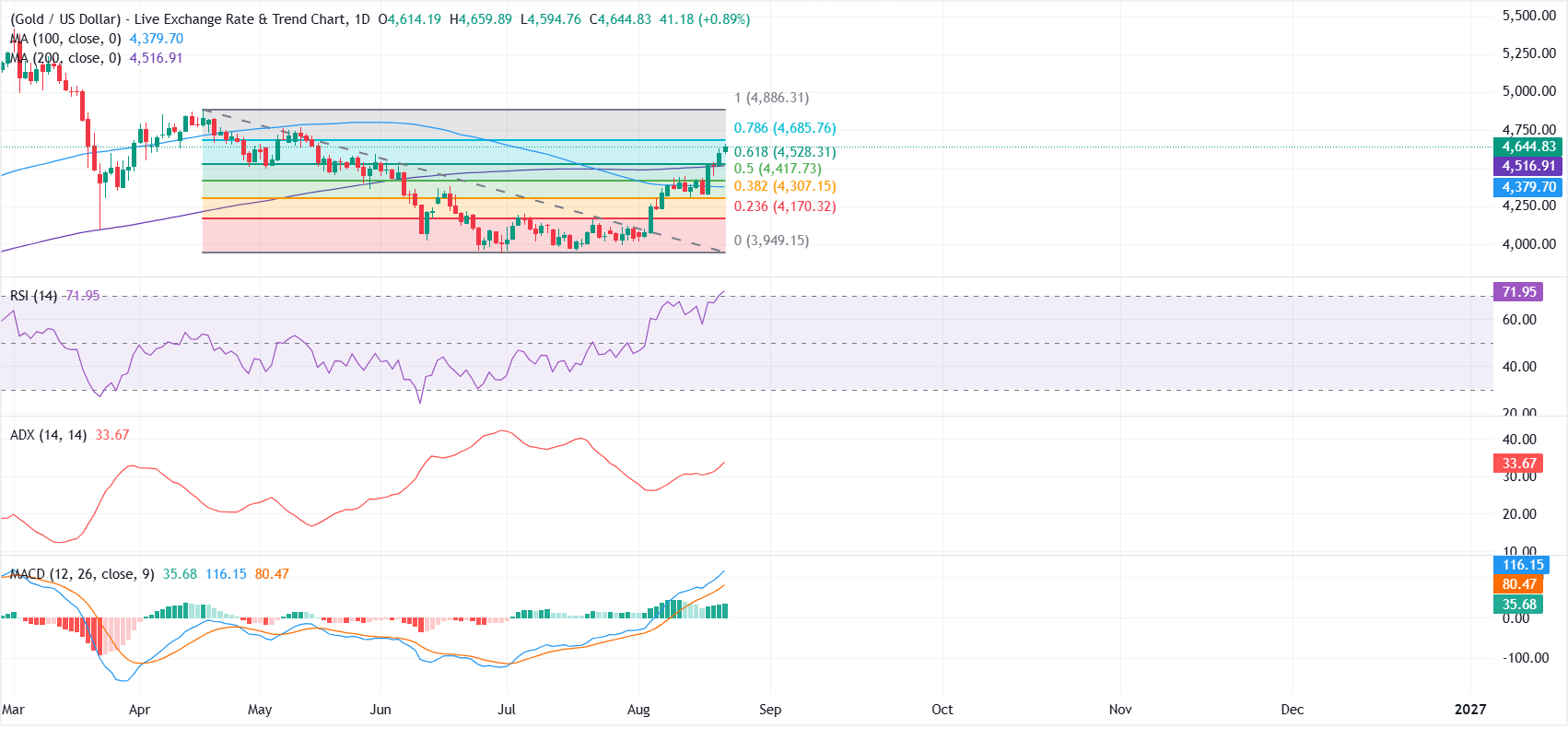
XAU/USD maintains a bullish near-term bias as price holds above both the 200-day simple moving average (SMA) and the 100-day SMA. The metal is advancing within a strong uptrend, supported by a moderately firm Average Directional Index at 33.67, while the Relative Strength Index (RSI) on the daily chart at 71 has entered overbought territory, hinting that upside momentum is stretched but still dominant.
A positive Moving Average Convergence Divergence (MACD) reinforces the constructive tone, with the broader structure favoring further gains as long as price stays above the key moving averages and upper Fibonacci supports.
On the topside, initial resistance is located at the 78.6% Fibonacci retracement at $4,685, followed by the cycle high anchor near the 100.0% retracement at $4,886. On the downside, first support is seen at the 61.8% retracement at $4,528, closely backed by the 200-day SMA at $4,516, forming a nearby demand cluster.
Deeper support levels emerge at the 50.0% retracement at $4,417 and the 100-day SMA at $4,379, with additional structural floors at the 38.2% retracement at $4,307 and the 23.6% retracement at $4,170, where buyers would likely attempt to defend the broader bullish trend if a corrective pullback unfolds.
(The technical analysis of this story was written with the help of an AI tool. Know more.)
Gold FAQs
Gold has played a key role in human’s history as it has been widely used as a store of value and medium of exchange. Currently, apart from its shine and usage for jewelry, the precious metal is widely seen as a safe-haven asset, meaning that it is considered a good investment during turbulent times. Gold is also widely seen as a hedge against inflation and against depreciating currencies as it doesn’t rely on any specific issuer or government.
Central banks are the biggest Gold holders. In their aim to support their currencies in turbulent times, central banks tend to diversify their reserves and buy Gold to improve the perceived strength of the economy and the currency. High Gold reserves can be a source of trust for a country’s solvency. Central banks added 1,136 tonnes of Gold worth around $70 billion to their reserves in 2022, according to data from the World Gold Council. This is the highest yearly purchase since records began. Central banks from emerging economies such as China, India and Turkey are quickly increasing their Gold reserves.
Gold has an inverse correlation with the US Dollar and US Treasuries, which are both major reserve and safe-haven assets. When the Dollar depreciates, Gold tends to rise, enabling investors and central banks to diversify their assets in turbulent times. Gold is also inversely correlated with risk assets. A rally in the stock market tends to weaken Gold price, while sell-offs in riskier markets tend to favor the precious metal.
The price can move due to a wide range of factors. Geopolitical instability or fears of a deep recession can quickly make Gold price escalate due to its safe-haven status. As a yield-less asset, Gold tends to rise with lower interest rates, while higher cost of money usually weighs down on the yellow metal. Still, most moves depend on how the US Dollar (USD) behaves as the asset is priced in dollars (XAU/USD). A strong Dollar tends to keep the price of Gold controlled, whereas a weaker Dollar is likely to push Gold prices up.













