

Trading
Explora una amplia gama de mercados con precios competitivos, liquidez profunda y herramientas de trading avanzadas.
Más información 
Plataforma
Opera sin interrupciones con la potente plataforma de TMGM, diseñada para ofrecer velocidad, precisión y una experiencia de trading superior.
Más información Plataforma de trading
Herramientas de trading
Academia
Aprende los fundamentos del trading con recursos ideales para principiantes, incluidas guías, seminarios web y análisis del mercado.
Más información Academia TMGM
Noticias y análisis
Obtén actualizaciones del mercado en tiempo real y análisis de expertos para adelantarte a las oportunidades de trading
Más información Noticias y análisis
Acerca de
Descubre qué distingue a TMGM: nuestra presencia global, solidez regulatoria y compromiso con la innovación en el trading.
Más información Por qué elegir TMGM
Gold pulls back as US yields recover after Treasury buyback
- Gold retreats as Treasury yields recover after buyback-driven slump.
- Solid jobless claims revive Fed hike bets.
- Bulls defend $4,500 as 200-day SMA remains pivotal.
Gold (XAU/USD) price retreats about 0.33% on Thursday as US Treasury yields trim some of their Wednesday losses, weighing on bullion, which is also pressured by the recovery of the US Dollar. The XAU/USD pair trades at $4,509, after hitting a daily high of $4,540.
XAU/USD holds above $4,500 as solid claims revive Fed caution

The yellow metal remains bullish-biased, despite the Greenback’s advance. The US Dollar Index (DXY), which tracks the performance of the American currency against six other currencies, is up 0.14% at 98.91, exerting downward pressure on XAU.
On Wednesday, the US Treasury Department announced an adjustment to its bond buyback program, focusing on the long end of the tenors, from 10- to 30-year bonds. The Treasury wrote that the objective is to provide liquidity in the 10- to 30-year bond market. Nevertheless, traders see this as some form of Yield Curve Control (YCC) aimed at impeding a jump in the 30-year yield.
Amid this backdrop, Gold soared sharply by over 4.35% and reclaimed the $4,500 figure. Still, solid US jobs data and higher US Treasury yields exacerbated the pullback towards the 200-day Simple Moving Average (SMA) at $4,512.
US Initial Jobless Claims for the week ending August 15 came in lower than anticipated at 206K, down from 212K and below the expected 210K. Meanwhile, the 4-week moving average rose by 5K, climbing from 199.75K to 204K.
Meanwhile, Fed officials hit the wires. St. Louis Fed President Alberto Musalem said the bond market is being affected by robust growth and capital expenditure. He further noted that although he favored rate hikes in July, he maintains an open mind regarding the upcoming September meeting.
San Francisco Fed's Mary Daly said rising long-term bond yields are a global concern, reducing their effectiveness as an indicator. She believes Fed credibility remains intact and that the short-term market mainly reacts to recent data.
On Wednesday, the Fed’s last meeting minutes revealed that some participants remained concerned about inflation, indicating that other policymakers besides Hammack, Kashkari, and Logan are open to raising interest rates if inflation remains high.
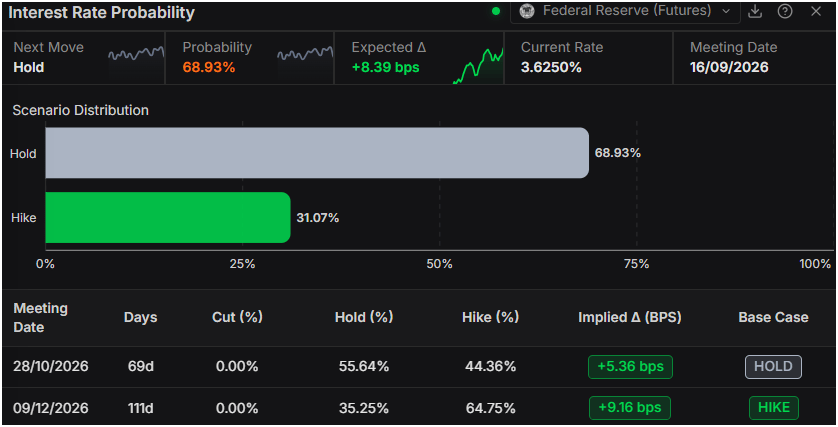
Money markets priced in a 68% chance that the Fed will hold rates unchanged at the September meeting, with odds of a 25-basis-point rate hike remaining near 32%, according to Prime Terminal.
On Friday, the US economic schedule will feature S&P Global Flash PMIs amid a sparse calendar.
XAU/USD technical outlook: Gold meanders near the 200-day SMA, above $4,500
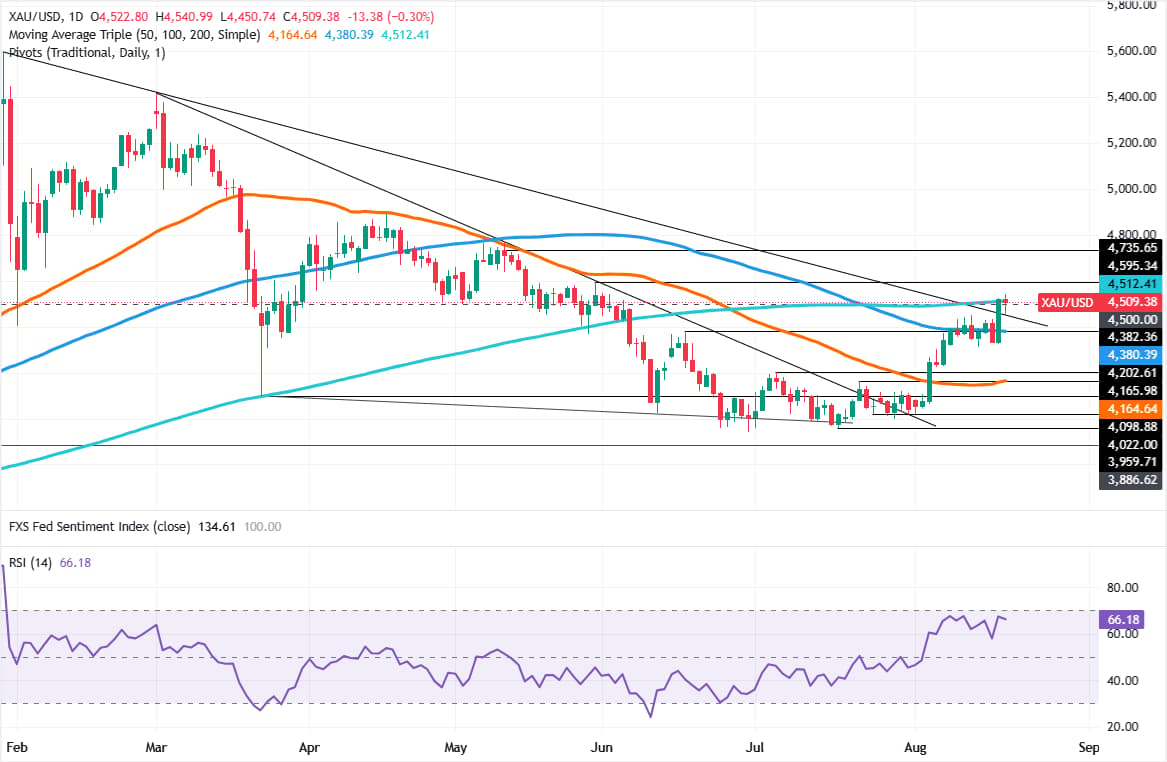
From a technical perspective, Gold remains upward-biased after reclaiming the 200-day SMA. Worth noting that on its way north, XAU/USD broke a five-month-old downward resistance trendline, drawn from all-time highs near $5,600, which could open the door for higher prices.
The Relative Strength Index (RSI) is bullish, though dipping modestly, indicating that traders are booking some profits before the uptrend resumes.
If Gold ends on a daily basis above $4,500, buyers could expect a test of May’s 20 daily high of $4,595 ahead of the psychological $4,600. The next area of interest is $4,700, with the May 12 daily high at $4,735, surrounded by a cluster of six candles.
Downwards, the first support is $4,500. A breach of the latter would expose the 100-day SMA at $4,380, ahead of $4,300. Below this area, the next support is the 50-day SMA at $4,164.
Gold FAQs
Gold has played a key role in human’s history as it has been widely used as a store of value and medium of exchange. Currently, apart from its shine and usage for jewelry, the precious metal is widely seen as a safe-haven asset, meaning that it is considered a good investment during turbulent times. Gold is also widely seen as a hedge against inflation and against depreciating currencies as it doesn’t rely on any specific issuer or government.
Central banks are the biggest Gold holders. In their aim to support their currencies in turbulent times, central banks tend to diversify their reserves and buy Gold to improve the perceived strength of the economy and the currency. High Gold reserves can be a source of trust for a country’s solvency. Central banks added 1,136 tonnes of Gold worth around $70 billion to their reserves in 2022, according to data from the World Gold Council. This is the highest yearly purchase since records began. Central banks from emerging economies such as China, India and Turkey are quickly increasing their Gold reserves.
Gold has an inverse correlation with the US Dollar and US Treasuries, which are both major reserve and safe-haven assets. When the Dollar depreciates, Gold tends to rise, enabling investors and central banks to diversify their assets in turbulent times. Gold is also inversely correlated with risk assets. A rally in the stock market tends to weaken Gold price, while sell-offs in riskier markets tend to favor the precious metal.
The price can move due to a wide range of factors. Geopolitical instability or fears of a deep recession can quickly make Gold price escalate due to its safe-haven status. As a yield-less asset, Gold tends to rise with lower interest rates, while higher cost of money usually weighs down on the yellow metal. Still, most moves depend on how the US Dollar (USD) behaves as the asset is priced in dollars (XAU/USD). A strong Dollar tends to keep the price of Gold controlled, whereas a weaker Dollar is likely to push Gold prices up.
Artículos destacados
1Ethereum L2 Blast shuts down as BLAST token crashes 99% from peak2Top 7 weekly crypto performers: QNT, NIGHT, PUMP and WLD lead gains3Silver Price Forecast: Bears crowd $60 after six-percent weekly rout4Ethereum Price Forecast: ETH erases gains as market discounts weak jobs report5Mexican Peso rebounds, but carry trade exodus still bites6United States CFTC Oil NC Net Positions: 109.5K vs previous 141.1K7United States CFTC Gold NC Net Positions dipped from previous $225.9K to $218.6K8Japan CFTC JPY NC Net Positions dipped from previous ¥72K to ¥55.4K9United States CFTC S&P 500 NC Net Positions fell from previous $-133.2K to $-142.5K
COTIZACIONES EN VIVO

TODO SOBRE GOLD & PRECIOUS METALS
6 Best Indicators for Gold Trading
Short-Term Gold Trading: How It Works, Strategies, How to Start
Gold Trading Leverage: How It Works, Pros and Cons, Risk Management
Gold Trading Signals: How They Work, Why Use Them, Where to Find
How to Trade Gold (XAUUSD) in Forex
Gold (XAUUSD) Trading Hours: Best Time to Trade Gold
How to Trade Gold
Why Invest in Gold CFD? A Beginner’s Guide to Smart Investing
7 Ways to Invest in Gold
¡Comience ahora!
Regístrese y acceda a los mercados globales en menos de 3 minutos

Conéctese con nosotros









Contactos
Teléfono: +61 2 8036 8388
Fax: +61 2 8036 8388
Correo electrónico: support@tmgm.com
Web: https://www.tmgm.com



La información proporcionada en este sitio web es únicamente de carácter general y no constituye asesoramiento financiero personal. Antes de actuar sobre cualquier información de este sitio web, debe considerar la idoneidad de la información en relación con sus objetivos, situación financiera y necesidades. Invertir en CFD y contratos de margen de FX conlleva riesgos significativos y no es adecuado para todos los inversores. Puede perder más que su depósito inicial. Usted no posee ni tiene ningún interés en el activo subyacente. Le recomendamos que busque asesoramiento independiente y se asegure de comprender plenamente los riesgos involucrados antes de operar. Es importante que lea y considere el documento de divulgación antes de adquirir cualquier producto listado en el sitio web. La información y los anuncios ofrecidos en este sitio web no están destinados al uso por parte de ninguna persona en ningún país o jurisdicción donde dicho uso sea contrario a las leyes y regulaciones locales. Los productos y servicios ofrecidos en este sitio web no están destinados a residentes de Estados Unidos, Malasia y Tailandia.
TMGM está autorizado y regulado en varias jurisdicciones.
Trademax Australia Limited, que opera como TMGM, está regulada por la Comisión Australiana de Valores e Inversiones (ASIC), AFSL n.º 436416, y está ubicada en Level 28, One International Tower, 100 Barangaroo Avenue, 2000 Sydney, NSW Australia.
Correo electrónico: support@tmgm.com.au
Trademax Global Limited, que opera como TMGM, está autorizada y regulada por la Comisión de Servicios Financieros de Vanuatu (VFSC), número de registro 40356, y está registrada en 1276, Kumul Highway, Port Vila, Vanuatu, República de Vanuatu.
Correo electrónico: support@tmgm.com
Trademax Global Markets (SE) Limited, que opera como TMGM, está autorizada y regulada por la Autoridad de Servicios Financieros (FSA) de Seychelles, con número de licencia SD224. La empresa está registrada en Office No 13, Providence Estate ABIS Centre, Mahe, Seychelles.
Correo electrónico: support@tmgm.com
Trademax Global Markets (International) Pty Ltd, que opera como TMGM, está autorizada y regulada por la Comisión de Servicios Financieros de Mauricio (FSC) con licencia n.º GB22201012, y está registrada en 33, Edith Cavell Street C/o IQ EQ Fund Services (Mauritius) Ltd Port Louis, 11324 Mauricio.
Correo electrónico: support@tmgm.com
Copyright © TMGM. Todos los derechos reservados