




Gold rallies as Iran-US deal seems closer ahead of NFP
- Gold breaks 50-day SMA, surging toward a seven-week high before NFP.
- Soft ADP jobs and weaker Dollar fuel bullion’s breakout momentum.
- Hawkish Fed voices and NFP risk may test Gold bulls.
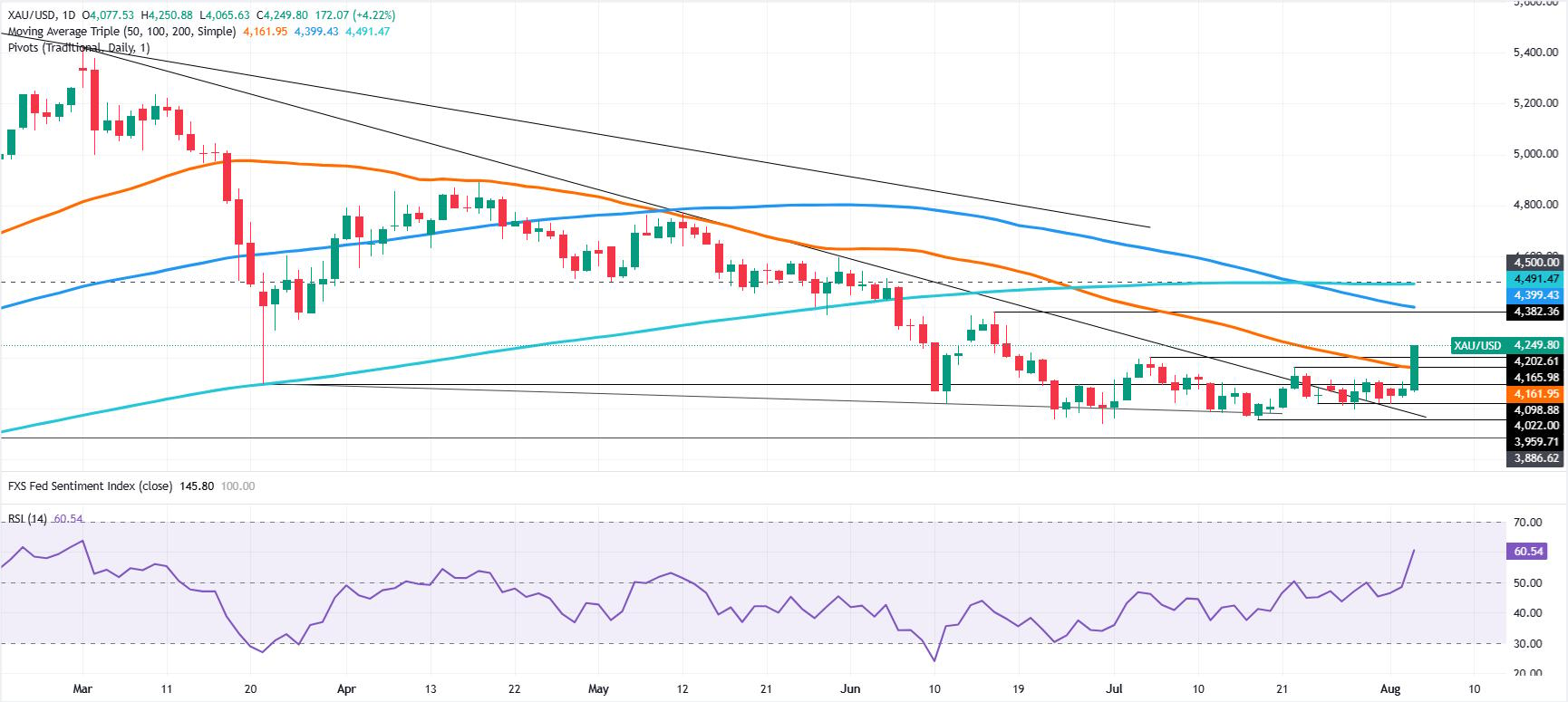
Gold (XAU/USD) price surges to its highest level in nearly seven weeks, gaining nearly 3.80% on Wednesday as the Greenback loses ground and US Treasury yields fail to gain traction. The XAU/USD pair trades at $4,232, its highest level since June 18, after bouncing off daily lows of $4,065.

Bullion clears $4,200 on USD weakness, soft ADP data and Hormuz deal hopes
The yellow metal strengthened sharply as it cleared the 50-day Simple Moving Average (SMA) at $4,161, clearing on its way north the $4,200 mark. The US Dollar Index (DXY), which tracks the buck’s performance against a basket of six currencies, is down 0.12% at 99.76.
The US economic docket is busy this week, with traders eyeing the release of the July Nonfarm Payrolls figures on Friday. Economists expect job creation of 80K and the Unemployment Rate to remain steady at around 4.2%.
Earlier, the July ADP Employment Change report was weaker than anticipated, dropping from 98K to 44K, below the forecast of 70K. The data indicated that education and health services increased their workforce by 36K, whereas leisure and hospitality decreased by 11K.
At the same time, business activity in the services sector remained strong in July, according to the Institute for Supply Management (ISM). The ISM Services PMI improved from 54 to 54.1, though it missed estimates by 0.4 points. The sub-components of employment and prices paid contracted and expanded, respectively. The Employment diffusion index dipped from 51.2 to 47.4, while the Prices Paid rose from 67.7 to 70.3, extending the trend to 110 months.
Fed Regional Bank Presidents remain hawkish amid a split FOMC
Minneapolis Federal Reserve (Fed) President Neel Kashkari stated that it is now appropriate to start gradually raising rates, emphasising moderate increases rather than dramatic hikes. Meanwhile, Jeffrey Schmid of the Kansas City Fed indicated that a strict monetary policy is necessary to address inflation considered "too high."
The de-escalation of the Gulf War is a tailwind for the non-yielding metal. Although crude prices are edging lower and easing inflationary pressures, investors remain skeptical of a positive outcome, as they expect a 25-basis-point rate hike by the Federal Reserve at the September meeting, according to Prime Terminal.
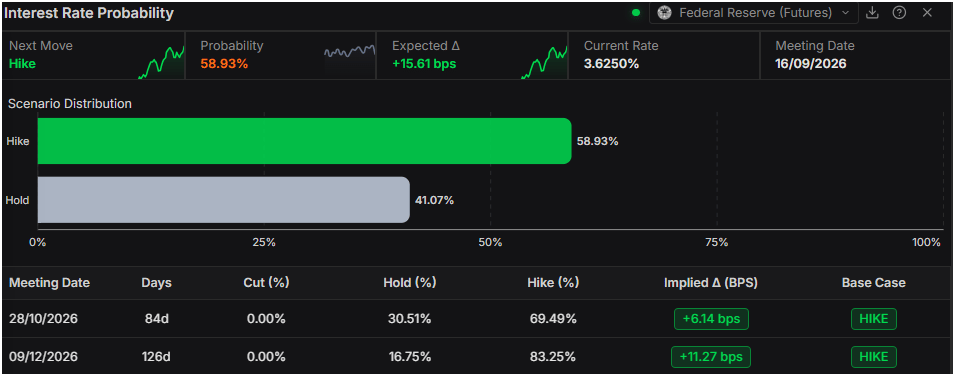
A report by N12, citing American officials, commented that the signing of an agreement to reopen the Strait of Hormuz would be possible as early as Wednesday.
XAU/USD technical outlook: Gold clears the latest cycle high, as market structure shifts neutral
Gold price has shifted to a neutral stance after the yellow metal surpassed the 50-day Simple Moving Average (SMA) at $4,161, opening the door for further gains. Momentum has shifted bullishly, as indicated by the Relative Strength Index (RSI), meaning that in the near term, the path of least resistance is upward.
XAU/USD’s first resistance is the $4,300 mark. Above lies the June 17 cycle high of $4,382, ahead of reaching the 100-day SMA at $4,499 near the psychological $4,500 mark.
On the flip side, the first support is the July 6 high, which turned into support at $4,202. A breach of the latter will expose the 50-day SMA, followed by the $4,100 mark. Beneath is the August 3 daily low of $4,019. Breaking that level could lead to a decline to $4,000.
Gold FAQs
Gold has played a key role in human’s history as it has been widely used as a store of value and medium of exchange. Currently, apart from its shine and usage for jewelry, the precious metal is widely seen as a safe-haven asset, meaning that it is considered a good investment during turbulent times. Gold is also widely seen as a hedge against inflation and against depreciating currencies as it doesn’t rely on any specific issuer or government.
Central banks are the biggest Gold holders. In their aim to support their currencies in turbulent times, central banks tend to diversify their reserves and buy Gold to improve the perceived strength of the economy and the currency. High Gold reserves can be a source of trust for a country’s solvency. Central banks added 1,136 tonnes of Gold worth around $70 billion to their reserves in 2022, according to data from the World Gold Council. This is the highest yearly purchase since records began. Central banks from emerging economies such as China, India and Turkey are quickly increasing their Gold reserves.
Gold has an inverse correlation with the US Dollar and US Treasuries, which are both major reserve and safe-haven assets. When the Dollar depreciates, Gold tends to rise, enabling investors and central banks to diversify their assets in turbulent times. Gold is also inversely correlated with risk assets. A rally in the stock market tends to weaken Gold price, while sell-offs in riskier markets tend to favor the precious metal.
The price can move due to a wide range of factors. Geopolitical instability or fears of a deep recession can quickly make Gold price escalate due to its safe-haven status. As a yield-less asset, Gold tends to rise with lower interest rates, while higher cost of money usually weighs down on the yellow metal. Still, most moves depend on how the US Dollar (USD) behaves as the asset is priced in dollars (XAU/USD). A strong Dollar tends to keep the price of Gold controlled, whereas a weaker Dollar is likely to push Gold prices up.













