

Trading
Explora una amplia gama de mercados con precios competitivos, liquidez profunda y herramientas de trading avanzadas.
Más información 
Plataforma
Opera sin interrupciones con la potente plataforma de TMGM, diseñada para ofrecer velocidad, precisión y una experiencia de trading superior.
Más información Plataforma de trading
Herramientas de trading
Academia
Aprende los fundamentos del trading con recursos ideales para principiantes, incluidas guías, seminarios web y análisis del mercado.
Más información Academia TMGM
Noticias y análisis
Obtén actualizaciones del mercado en tiempo real y análisis de expertos para adelantarte a las oportunidades de trading
Más información Noticias y análisis
Acerca de
Descubre qué distingue a TMGM: nuestra presencia global, solidez regulatoria y compromiso con la innovación en el trading.
Más información Por qué elegir TMGM
Indian Rupee declines to two-month low as US-Iran diplomacy hopes recede
- The Indian Rupee extends its decline against the US Dollar amid firm energy prices.
- Financial markets expect the RBI to intervenes again as USD/INR breaks above the 96 mark.
- The Fed is expected to hike interest rates again in October.
The Indian Rupee (INR) slides to a fresh two-month low against the US Dollar (USD) on Tuesday, with the USD/INR pair jumping to near 96.13. The pair strengthens as the Indian currency underperforms due to fears of persistent energy supply disruption.

Oil prices have gained significantly on Tuesday as United States (US) President Donald Trump has pushed back hopes of near-term diplomacy with Iran.
In the opening trade, the MCX Crude Oil contract expiring on October 19 is up 2% to near Rs. 9,020.
Currencies from economies, such as India, which rely heavily on oil imports to meet their energy needs, tend to underperform in a high-oil-price environment.
Trump rejects claims of sanctions relief for Iran
On Monday, the oil price came under pressure after a report from Axios showed that Washington has agreed to roll back sanctions on Iran and release frozen Iranian funds in return for concrete Iranian steps on the nuclear program.
However, US President Donald Trump has denied the report through a post on Truth.Social. “I offered them NOTHING,” Trump wrote, adding that the story is a “Hoax”.
Meanwhile, Iran's Foreign Minister Abbas Araghchi has confirmed that proposals for the reopening of the Strait of Hormuz and a complete peace with the US are being discussed with Qatari mediators and Washington’s response will be received only through them. Araghchi added that the conditions stressed by Iran's Supreme Leader must be implemented for the Strait of Hormuz to reopen.
RBI will likely intervene again to support INR
According to a Reuters report, the Reserve Bank of India (RBI) may be reluctant to see the INR break past the psychologically important 96-per-dollar mark and could intensify its intervention, having been a near-daily presence in the market in recent weeks, market participants said.
The report further added that analysts have noted that the RBI has greater firepower to do so following the recent build-up in foreign exchange reserves through Foreign Currency Non-Resident (FCNR) deposits.
US JOLTS Job Openings data awaited
Financial markets remaining increasingly confident that the Federal Reserve (Fed) will deliver more interest rate hikes this year is another key concern for the Indian currency. According to the CME FedWatch tool, there is an almost 70% chance that the Fed will hike interest rates at the October meeting.
Later in the day, investors will focus on the US JOLTS Job Openings data for August, which will be published at 14:00 GMT. The data will likely have a meaningful influence on the Fed’s interest rate expectations.
The Job Openings report is expected to show that employers posted 7.23 million fresh jobs, marginally lower than the 7.271 million in July.
USD/INR Technical Analysis
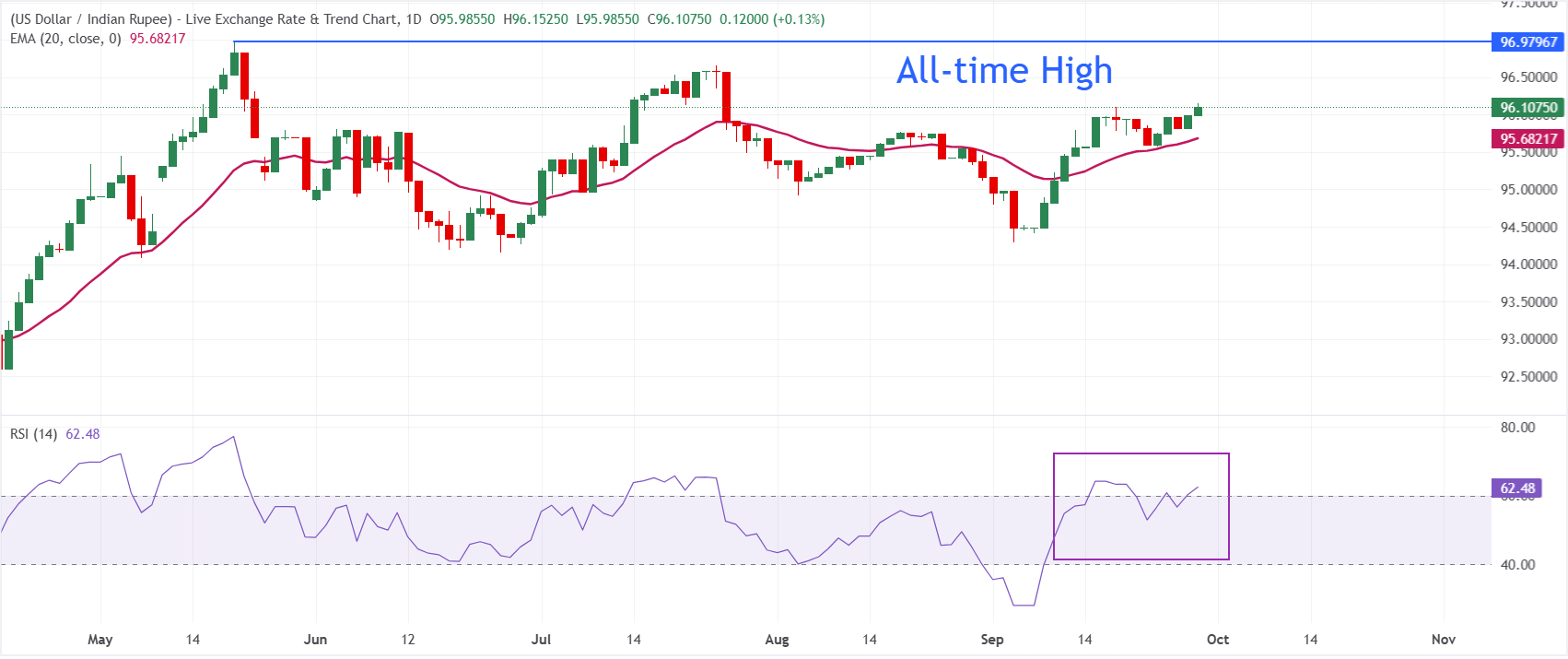
In the daily chart, USD/INR trades at 96.10, holding above the 20-day exponential moving average (EMA) at 95.68, which suggests a constructive near-term bias. The pair is consolidating near recent highs, and the Relative Strength Index (RSI) at 62.5 stays in bullish territory without yet signaling overbought conditions, hinting that upside pressure could persist while the price remains supported above the short-term EMA.
On the downside, immediate support is seen at the 20-day EMA near 95.68. As long as spot defends this underlying demand zone, buyers are likely to retain control, while any decisive break beneath the EMA would signal a deeper corrective phase toward lower recent closes. On the upside, the pair aims to revisit the all-time high at around 97.00.
(The technical analysis of this story was written with the help of an AI tool. Know more.)
Indian Rupee FAQs
The Indian Rupee (INR) is one of the most sensitive currencies to external factors. The price of Crude Oil (the country is highly dependent on imported Oil), the value of the US Dollar – most trade is conducted in USD – and the level of foreign investment, are all influential. Direct intervention by the Reserve Bank of India (RBI) in FX markets to keep the exchange rate stable, as well as the level of interest rates set by the RBI, are further major influencing factors on the Rupee.
The Reserve Bank of India (RBI) actively intervenes in forex markets to maintain a stable exchange rate, to help facilitate trade. In addition, the RBI tries to maintain the inflation rate at its 4% target by adjusting interest rates. Higher interest rates usually strengthen the Rupee. This is due to the role of the ‘carry trade’ in which investors borrow in countries with lower interest rates so as to place their money in countries’ offering relatively higher interest rates and profit from the difference.
Macroeconomic factors that influence the value of the Rupee include inflation, interest rates, the economic growth rate (GDP), the balance of trade, and inflows from foreign investment. A higher growth rate can lead to more overseas investment, pushing up demand for the Rupee. A less negative balance of trade will eventually lead to a stronger Rupee. Higher interest rates, especially real rates (interest rates less inflation) are also positive for the Rupee. A risk-on environment can lead to greater inflows of Foreign Direct and Indirect Investment (FDI and FII), which also benefit the Rupee.
Higher inflation, particularly, if it is comparatively higher than India’s peers, is generally negative for the currency as it reflects devaluation through oversupply. Inflation also increases the cost of exports, leading to more Rupees being sold to purchase foreign imports, which is Rupee-negative. At the same time, higher inflation usually leads to the Reserve Bank of India (RBI) raising interest rates and this can be positive for the Rupee, due to increased demand from international investors. The opposite effect is true of lower inflation.
Artículos destacados
1US Dollar Index Price Forecast: Likely revisit yearly high at around 101.802Australian Dollar: RBA hike reinforces hawkish stance – Deutsche Bank3Australian Dollar: RBA’s hawkish hike caps upside – Commerzbank4Chainlink Price Forecast: LINK trims gains after CCIP 2.0 launch, Swift ledger integration5Australian Dollar dips to fresh lows sub-0.7000 despite hawkish RBA Bullock6USD/JPY Price Forecast: Tests nine-day EMA support after falling below 157.507Dogecoin Price Forecast: DOGE tests key 200-day EMA support as bulls seek recovery8GBP/USD Price Forecast: Fresh downside leg likely below 1.32009Indian Rupee declines to two-month low as US-Iran diplomacy hopes recede
COTIZACIONES EN VIVO

TODO SOBRE OIL
5 Best Oil Trading Platforms 2026 (Brent and WTI)
WTI vs Brent Crude
What Are Oil Futures: How They Work, Pros & Cons, How to Trade
Gold to Oil Ratio: How does Iran War affect Gold Prices?
How to Choose the Best Oil Trading Platform
Oil Trading Hours: Best Time to Trade Crude Oil (Brent and WTI)
8 Factors That Affect Oil Prices
What is Oil Trading: How It Works, Ways to Trade
What is WTI Oil: Importance, Purpose, How To Trade
¡Comience ahora!
Regístrese y acceda a los mercados globales en menos de 3 minutos

Conéctese con nosotros









Contactos
Teléfono: +61 2 8036 8388
Fax: +61 2 8036 8388
Correo electrónico: support@tmgm.com
Web: https://www.tmgm.com



La información proporcionada en este sitio web es únicamente de carácter general y no constituye asesoramiento financiero personal. Antes de actuar sobre cualquier información de este sitio web, debe considerar la idoneidad de la información en relación con sus objetivos, situación financiera y necesidades. Invertir en CFD y contratos de margen de FX conlleva riesgos significativos y no es adecuado para todos los inversores. Puede perder más que su depósito inicial. Usted no posee ni tiene ningún interés en el activo subyacente. Le recomendamos que busque asesoramiento independiente y se asegure de comprender plenamente los riesgos involucrados antes de operar. Es importante que lea y considere el documento de divulgación antes de adquirir cualquier producto listado en el sitio web. La información y los anuncios ofrecidos en este sitio web no están destinados al uso por parte de ninguna persona en ningún país o jurisdicción donde dicho uso sea contrario a las leyes y regulaciones locales. Los productos y servicios ofrecidos en este sitio web no están destinados a residentes de Estados Unidos, Malasia y Tailandia.
TMGM está autorizado y regulado en varias jurisdicciones.
Trademax Australia Limited, que opera como TMGM, está regulada por la Comisión Australiana de Valores e Inversiones (ASIC), AFSL n.º 436416, y está ubicada en Level 28, One International Tower, 100 Barangaroo Avenue, 2000 Sydney, NSW Australia.
Correo electrónico: support@tmgm.com.au
Trademax Global Limited, que opera como TMGM, está autorizada y regulada por la Comisión de Servicios Financieros de Vanuatu (VFSC), número de registro 40356, y está registrada en 1276, Kumul Highway, Port Vila, Vanuatu, República de Vanuatu.
Correo electrónico: support@tmgm.com
Trademax Global Markets (SE) Limited, que opera como TMGM, está autorizada y regulada por la Autoridad de Servicios Financieros (FSA) de Seychelles, con número de licencia SD224. La empresa está registrada en Office No 13, Providence Estate ABIS Centre, Mahe, Seychelles.
Correo electrónico: support@tmgm.com
Trademax Global Markets (International) Pty Ltd, que opera como TMGM, está autorizada y regulada por la Comisión de Servicios Financieros de Mauricio (FSC) con licencia n.º GB22201012, y está registrada en 33, Edith Cavell Street C/o IQ EQ Fund Services (Mauritius) Ltd Port Louis, 11324 Mauricio.
Correo electrónico: support@tmgm.com
Copyright © TMGM. Todos los derechos reservados