

Japanese Yen remains near two-week low against US Dollar despite hawkish BoJ bets
- The Japanese Yen holds onto two-week losses near 159.50 against the US Dollar.
- The BoJ is highly anticipated to raise interest rates in the September policy meeting.
- Investors await FOMC minutes, which will be released on Wednesday.
The Japanese Yen (JPY) trades close to its two-week low against the US Dollar (USD) in the Asian trading session on Tuesday at around 159.50. The USD/JPY pair is under pressure even as financial markets are confident about a Bank of Japan (BoJ) interest rate hike in the September meeting.

Yen outlook steadies as MUFG flags elevated BoJ hike odds
Analysts at MUFG highlight that market expectations for further BoJ tightening remain robust, with “the pricing for a 25bp hike at the next meeting in September remains elevated, implying around an 80% probability of a hike.” They argue that this firm rate-hike pricing, set against the backdrop of softer US data, should help limit renewed Yen selling in the near term despite Japan’s weaker-than-expected GDP.
In the latest BoJ Summary of Opinions (SoP), several board members favored further monetary tightening in the near term after leaving interest rates unchanged at 1%. One board member said that the central bank should increase the monetary tightening pace, citing upside inflation risks.
Meanwhile, Japan’s preliminary Q2 Gross Domestic Product (GDP) data has come in weaker-than-expected, an event that could act as headwind for firm BoJ hawkish bets.
Japan growth disappoints as net exports and government spending prop up GDP
Brown Brothers Harriman’s Elias Haddad notes that Japan’s Q2 performance was weaker than expected, with "real GDP rose 0.3% q/q (consensus: 0.5%) vs. 0.5% in Q1" and growth largely reliant on external and public sector support. He points out that the expansion was "driven by net exports (+0.5ppt), government consumption (+0.3ppt), and private inventories (+0.3ppt)," underscoring how net exports and fiscal spending are offsetting softer underlying domestic demand.
On the US Dollar front, the currency is expected to trade sideways as Federal Open Market Committee (FOMC) minutes of the July policy meeting takes the centre stage, which will be released on Wednesday.
In the policy meeting, the Fed left interest rates unchanged in the range of 3.50%-3.75%, as expected and didn’t deliver any forward-guidance on policy rates.
Investors will pay attention to FOMC minutes to get fresh cues regarding inflation and the economic outlook.
USD/JPY Technical Analysis
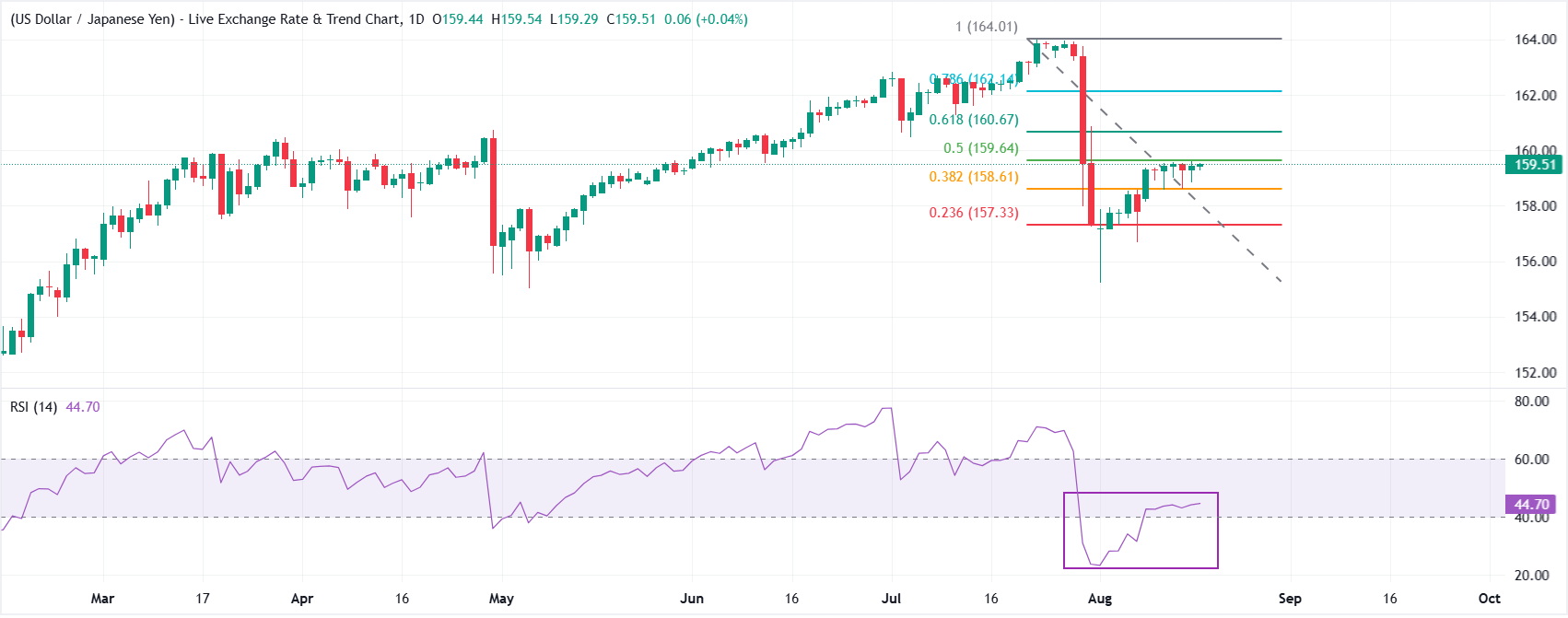
In the daily chart, USD/JPY trades at 159.51, holding below a dense Fibonacci retracement cluster that keeps the pair capped in the near term. Price sits under the 50.0% retracement at 159.64 and the 61.8% level at 160.67, suggesting topside attempts are vulnerable while these barriers remain intact.
The Relative Strength Index (14) at 44.70 is below the midline, hinting at waning bullish momentum and reinforcing a cautious, mildly bearish bias as the market consolidates after the recent pullback.
On the topside, immediate resistance is located at the 50.0% Fibonacci retracement at 159.64, followed by the 61.8% level at 160.67. Above there, the 78.6% retracement at 162.14 and the cycle high area marked by the 100.0% level at 164.01 define the next barriers. On the downside, initial support emerges at the 38.2% retracement at 158.61 ahead of the 23.6% level at 157.33, with deeper structural support anchored much lower by the extended Fibonacci projection near -46.01, which serves more as a distant reference than a practical downside target.
(The technical analysis of this story was written with the help of an AI tool. Know more.)
Economic Indicator
Gross Domestic Product (QoQ)
The Gross Domestic Product (GDP), released by Japan’s Cabinet Office on a quarterly basis, is a measure of the total value of all goods and services produced in Japan during a given period. The GDP is considered as the main measure of Japan’s economic activity. The QoQ reading compares economic activity in the reference quarter to the previous quarter. Generally, a high reading is seen as bullish for the Japanese Yen (JPY), while a low reading is seen as bearish.
Read more.Last release: Sun Aug 16, 2026 23:50 (Prel)
Frequency: Quarterly
Actual: 0.3%
Consensus: 0.5%
Previous: 0.5%
Source: Japanese Cabinet Office













