

Trading
Explora una amplia gama de mercados con precios competitivos, liquidez profunda y herramientas de trading avanzadas.
Más información 
Plataforma
Opera sin interrupciones con la potente plataforma de TMGM, diseñada para ofrecer velocidad, precisión y una experiencia de trading superior.
Más información Plataforma de trading
Herramientas de trading
Academia
Aprende los fundamentos del trading con recursos ideales para principiantes, incluidas guías, seminarios web y análisis del mercado.
Más información Academia TMGM
Noticias y análisis
Obtén actualizaciones del mercado en tiempo real y análisis de expertos para adelantarte a las oportunidades de trading
Más información Noticias y análisis
Acerca de
Descubre qué distingue a TMGM: nuestra presencia global, solidez regulatoria y compromiso con la innovación en el trading.
Más información Por qué elegir TMGM
Top 3 Price Prediction: Bitcoin, Ethereum, Ripple – BTC heading to $85,000, ETH awaits breakout, XRP holds $1.50
- Bitcoin nears the key $85,000 level on Friday after modest gains so far this week.
- Ethereum consolidates around $2,700 as traders await the next directional move.
- XRP steadies around $1.500 on Friday, recovering losses from earlier this week.
Bitcoin (BTC) approaches the key resistance zone near $85,000 on Friday after posting modest gains so far this week. Ethereum (ETH) consolidates around $2,700 as traders await its next directional move. Meanwhile, Ripple (XRP) steadies around $1.500 after recovering losses from earlier this week. The price action of these top three cryptocurrencies faces key technical hurdles that could determine their next directional move.

Bitcoin could extend rebound if it breaks above $85,000 resistance
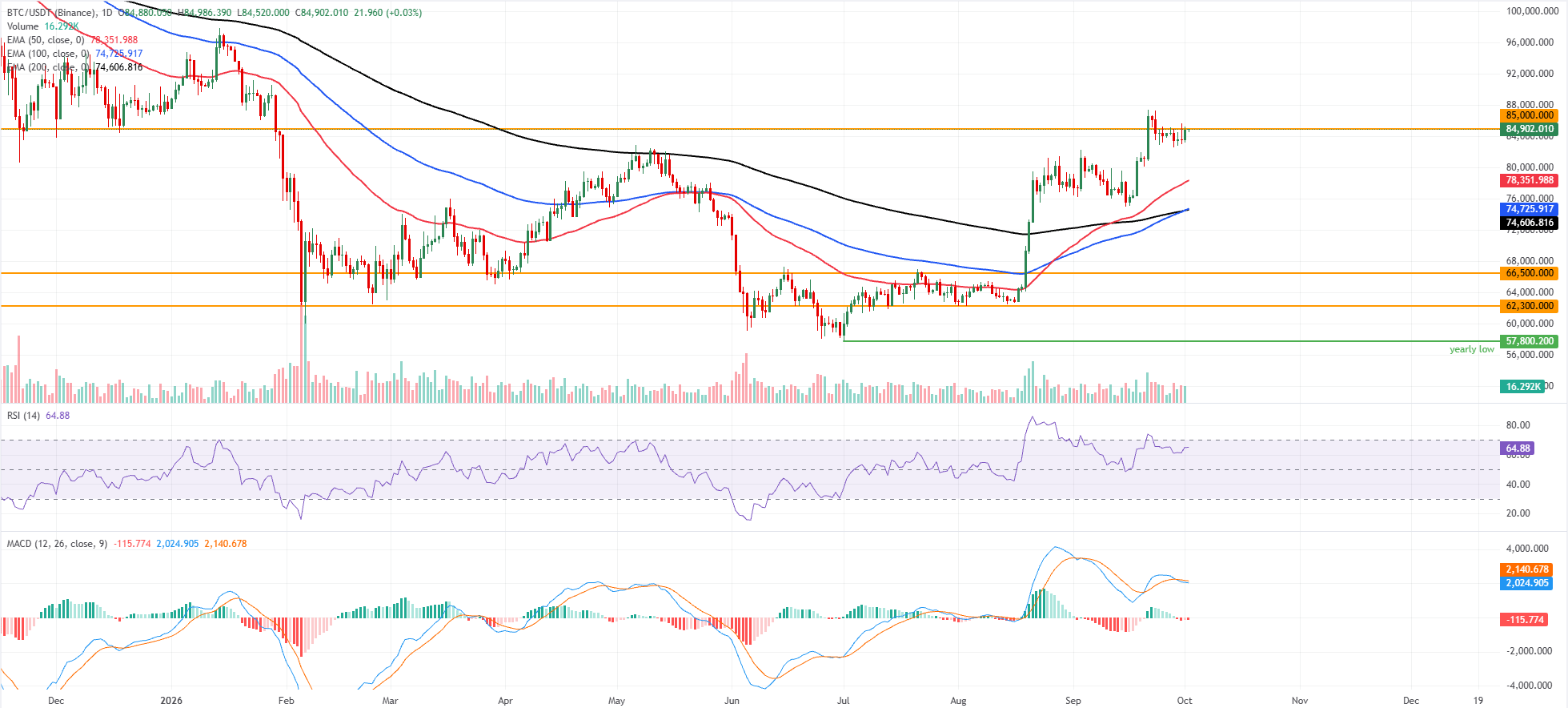
Bitcoin price trades at $84,902 on Friday after rebounding 1.5% the previous day. BTC maintains a bullish bias as it holds well above the 50-day, 100-day and 200-day Exponential Moving Averages (EMAs), clustered in the mid-$74,000 to upper-$78,000 range.
The Relative Strength Index (RSI) at 64 sits in bullish territory but shy of overbought. At the same time, the Moving Average Convergence Divergence (MACD) indicator has slipped back into negative territory, suggesting upside momentum is losing steam even as the broader structure remains supported.
On the topside, immediate resistance is the horizontal barrier at $85,000, just above the current price and the next hurdle for bulls.
On the downside, initial support is seen at the 50-day EMA near $78,351, followed by the 100-day EMA around $74,725 and the 200-day EMA at $74,606, which together underpin the prevailing uptrend; deeper pullbacks would expose the previously drawn horizontal supports at $66,500 and $62,300.
Ethereum consolidates near $2,700 mark
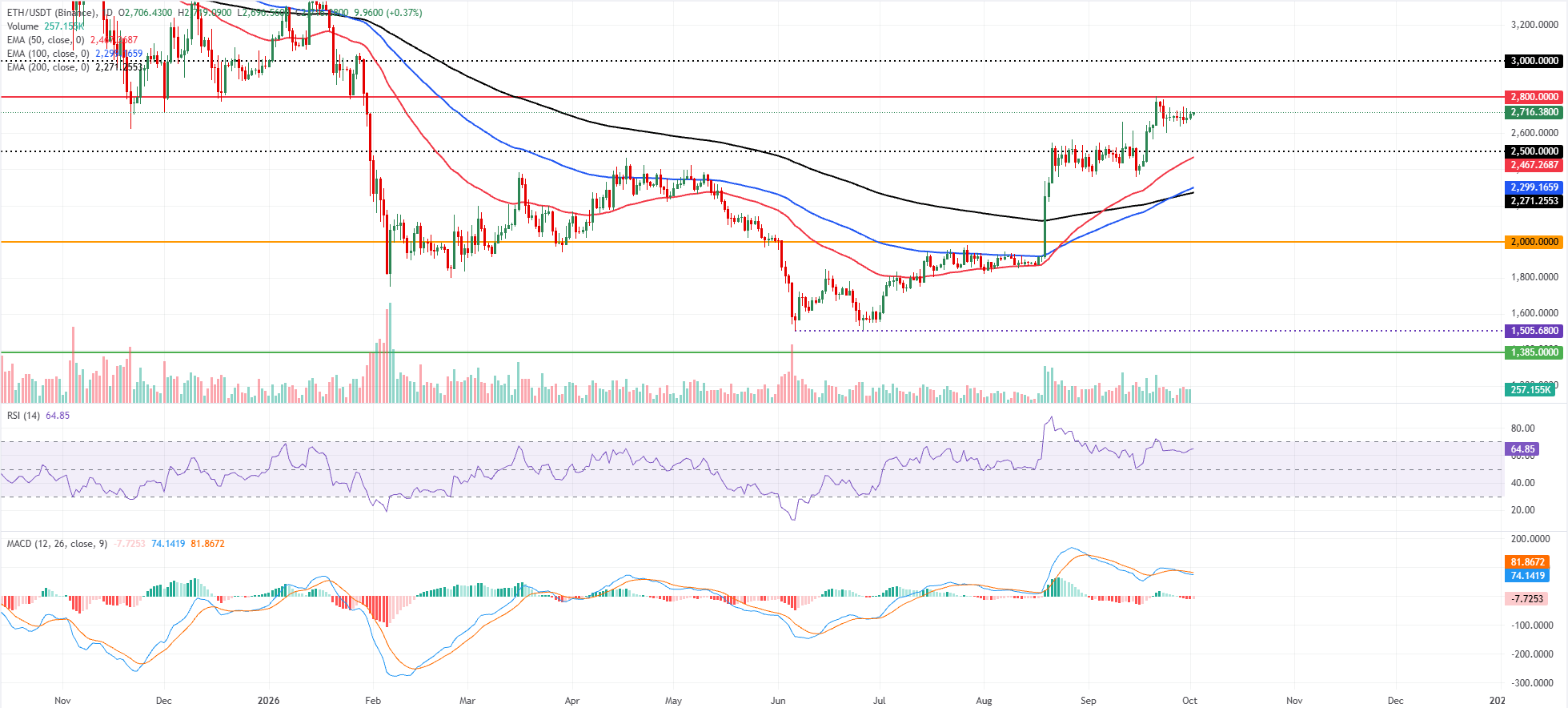
Ethereum price trades at $2,716 on Friday, extending its ongoing recovery. ETH maintains a bullish near-term bias as it holds well above the 50-day EMA at $2,467 and the longer-term 100-day and 200-day EMAs at $2,299 and $2,271, respectively.
The RSI reads around 64, suggesting firm but not extreme bullish momentum. At the same time, the MACD indicator shows the line slipping deeper below zero, hinting that upside momentum may be losing some traction despite the constructive trend structure.
On the downside, immediate support is at the recent horizontal level around $2,500, backed by the 50-day EMA at $2,467, with deeper demand clustered near the 100-day and 200-day EMAs just above $2,270, then the more distant floors at $2,000 and $1,385.
On the topside, initial resistance aligns at $2,800, ahead of the psychological barrier at $3,000, where a clear daily close above would reinforce the bullish bias and open the way for a fresh leg higher.
XRP bulls hold key support
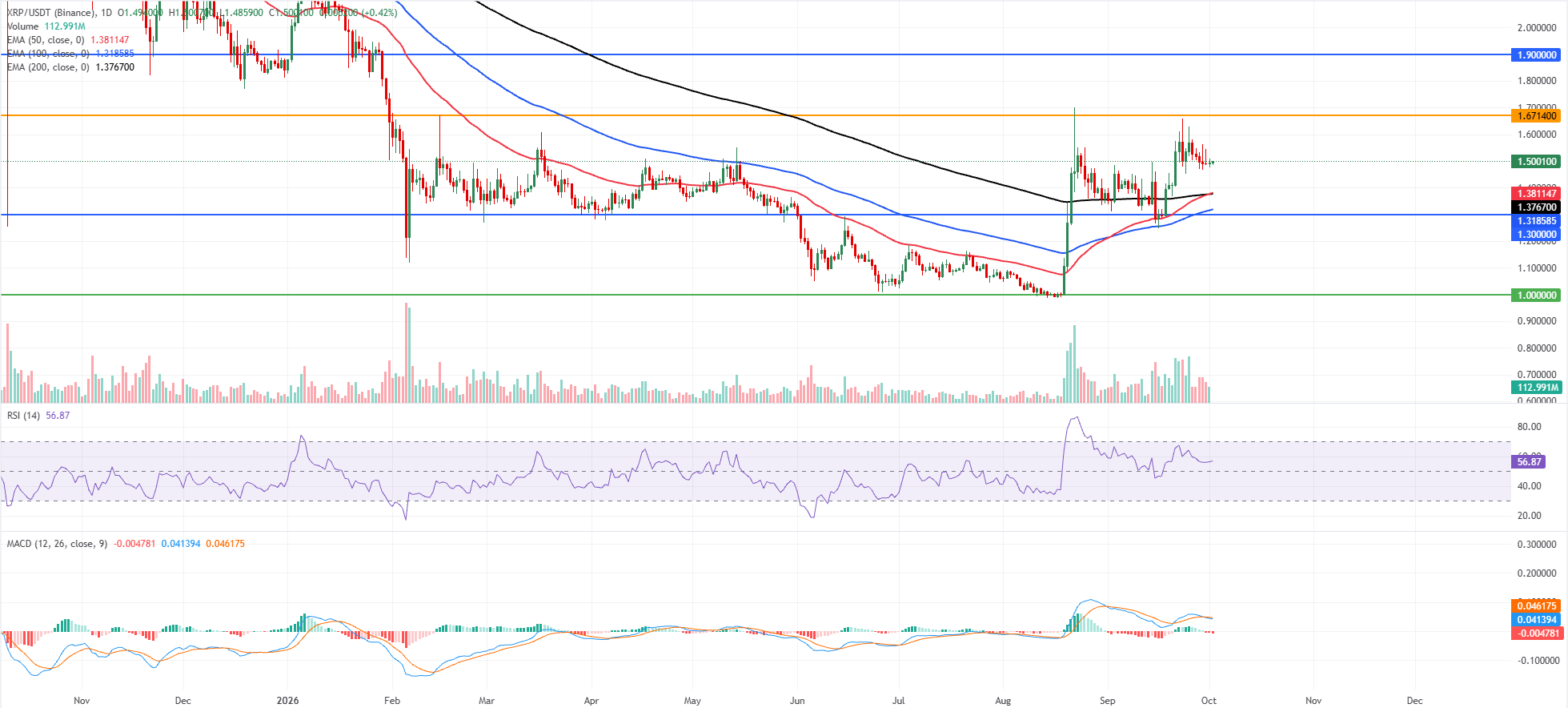
XRP price trades at $1.500 on Friday, keeping a bullish near-term bias as it holds above the 50-day EMA at $1.381 and the 200-day EMA at $1.376. The 100-day EMA at $1.318 sits well below the market, reinforcing an underlying constructive trend, while the RSI around 57 suggests positive but not overextended momentum. The MACD indicator has slipped marginally negative, hinting at a mild loss of upside pace rather than a full reversal.
On the topside, initial resistance sits at $1.671, ahead of a stronger barrier near $1.900.
On the downside, immediate support comes from the 50-day EMA cluster near $1.381 and the 200-day EMA at $1.376, with a more distant floor at the prior horizontal support around $1.300. A daily close above $1.671 would likely reopen the path toward $1.900, while a drop back through the EMA cluster near $1.380 would signal that the current bullish tone is fading.
(The technical analysis of this story was written with the help of an AI tool. Know more.)
Cryptocurrency prices FAQs
Token launches influence demand and adoption among market participants. Listings on crypto exchanges deepen the liquidity for an asset and add new participants to an asset’s network. This is typically bullish for a digital asset.
A hack is an event in which an attacker captures a large volume of the asset from a DeFi bridge or hot wallet of an exchange or any other crypto platform via exploits, bugs or other methods. The exploiter then transfers these tokens out of the exchange platforms to ultimately sell or swap the assets for other cryptocurrencies or stablecoins. Such events often involve an en masse panic triggering a sell-off in the affected assets.
Macroeconomic events like the US Federal Reserve’s decision on interest rates influence crypto assets mainly through the direct impact they have on the US Dollar. An increase in interest rate typically negatively influences Bitcoin and altcoin prices, and vice versa. If the US Dollar index declines, risk assets and associated leverage for trading gets cheaper, in turn driving crypto prices higher.
Halvings are typically considered bullish events as they slash the block reward in half for miners, constricting the supply of the asset. At consistent demand if the supply reduces, the asset’s price climbs.
Artículos destacados
1India Gold price today: Gold rises, according to FXStreet data2Swiss Franc gains as US Dollar eases amid easing Fed rate hike odds3Japanese Yen draws support from hot Tokyo CPI as USD bulls await US NFP report4GBP/USD Price Forecast: Likely retest YTD low near 1.31405Gold struggles to lure buyers amid bullish USD; eye US NFP for Fed rate cues6Top 3 Price Prediction: Bitcoin, Ethereum, Ripple – BTC heading to $85,000, ETH awaits breakout, XRP holds $1.50 7Euro flattens against the Japanese Yen in countdown to Eurozone HICP data8Pepe Price Forecast: PEPE sustains mild recovery on firm retail support9Australian Dollar loses as US Dollar receives support from persistent inflation concerns
COTIZACIONES EN VIVO


TODO SOBRE TECHNICAL
Support and Resistance: Meaning, Types, How to Draw Levels & Trading Strategies
What Is Liquidity? Meaning in Trading and Financial Markets
Liquidity Sweep: Meaning, Examples & Trading Strategy
Market Structure in Trading: The Complete Guide (Bullish, Bearish, Sideways)
Change of Character (CHoCH): Definition, Examples & Strategy
What Is the Bullish Kicker Pattern and How to Trade It?
What Is a Dragonfly Doji Candlestick and How Do You Trade It?
What Is an Inverted Hammer Candlestick Pattern and How Do You Trade It?
What Is a Bullish Abandoned Baby Pattern and How Do You Trade It?
¡Comience ahora!
Regístrese y acceda a los mercados globales en menos de 3 minutos

Conéctese con nosotros









Contactos
Teléfono: +61 2 8036 8388
Fax: +61 2 8036 8388
Correo electrónico: support@tmgm.com
Web: https://www.tmgm.com



La información proporcionada en este sitio web es únicamente de carácter general y no constituye asesoramiento financiero personal. Antes de actuar sobre cualquier información de este sitio web, debe considerar la idoneidad de la información en relación con sus objetivos, situación financiera y necesidades. Invertir en CFD y contratos de margen de FX conlleva riesgos significativos y no es adecuado para todos los inversores. Puede perder más que su depósito inicial. Usted no posee ni tiene ningún interés en el activo subyacente. Le recomendamos que busque asesoramiento independiente y se asegure de comprender plenamente los riesgos involucrados antes de operar. Es importante que lea y considere el documento de divulgación antes de adquirir cualquier producto listado en el sitio web. La información y los anuncios ofrecidos en este sitio web no están destinados al uso por parte de ninguna persona en ningún país o jurisdicción donde dicho uso sea contrario a las leyes y regulaciones locales. Los productos y servicios ofrecidos en este sitio web no están destinados a residentes de Estados Unidos, Malasia y Tailandia.
TMGM está autorizado y regulado en varias jurisdicciones.
Trademax Australia Limited, que opera como TMGM, está regulada por la Comisión Australiana de Valores e Inversiones (ASIC), AFSL n.º 436416, y está ubicada en Level 28, One International Tower, 100 Barangaroo Avenue, 2000 Sydney, NSW Australia.
Correo electrónico: support@tmgm.com.au
Trademax Global Limited, que opera como TMGM, está autorizada y regulada por la Comisión de Servicios Financieros de Vanuatu (VFSC), número de registro 40356, y está registrada en 1276, Kumul Highway, Port Vila, Vanuatu, República de Vanuatu.
Correo electrónico: support@tmgm.com
Trademax Global Markets (SE) Limited, que opera como TMGM, está autorizada y regulada por la Autoridad de Servicios Financieros (FSA) de Seychelles, con número de licencia SD224. La empresa está registrada en Office No 13, Providence Estate ABIS Centre, Mahe, Seychelles.
Correo electrónico: support@tmgm.com
Trademax Global Markets (International) Pty Ltd, que opera como TMGM, está autorizada y regulada por la Comisión de Servicios Financieros de Mauricio (FSC) con licencia n.º GB22201012, y está registrada en 33, Edith Cavell Street C/o IQ EQ Fund Services (Mauritius) Ltd Port Louis, 11324 Mauricio.
Correo electrónico: support@tmgm.com
Copyright © TMGM. Todos los derechos reservados