

Euro wavers amid mixed Eurozone data, rising geopolitical tensions
- EUR/USD hesitates below 1.1660 and remains trapped within the last two weeks' range.
- Eurozone data confirms a slowdown in manufacturing activity in May, with unemployment steady.
- Rising US-Iran tensions are undermining the appetite for risk on Monday
The Euro (EUR) holds marginal losses against the US Dollar (USD) on Monday, although the EUR/USD pair remains steady right below the top of the last two weeks' range, at the 1.1660 area. Mixed Eurozone data and the rising tensions in the Middle East are weighing on risk appetite and acting as headwinds for the common currency.
The US and Iran exchanged strikes earlier on Monday, adding strain to an already frail ceasefire, while Israel ramped up its operations in Lebanon, complicating the situation further.
The US President Donald Trump is still due to sign a memorandum of understanding that would extend the ceasefire for 60 days. In Iran, the Parliament Speaker Mohammad Bagher Ghalibaf threatened retaliation in a post on X to “clear evidence of US noncompliance with the ceasefire.”

In Europe, the HCOB Manufacturing Purchasing Managers’ Index (PMI) was revised up to 51.6 in May from the previously estimated 51.4, although it remains below April’s 52.2 level. Later on, Eurostat data revealed that the Unemployment Rate remained unchanged at 6.3% in April, against expectations of a decline to 6.2%.
In the US, the ISM PMI is expected to show levels consistent with the healthy expansion of the sector’s activity. The main focus this week, however, will be on a string of employment releases, including Friday’s Nonfarm Payrolls report, which are likely to provide further insight into the US Federal Reserve’s (Fed) monetary policy.
Technical Analysis: Still below the 1.1660 range top
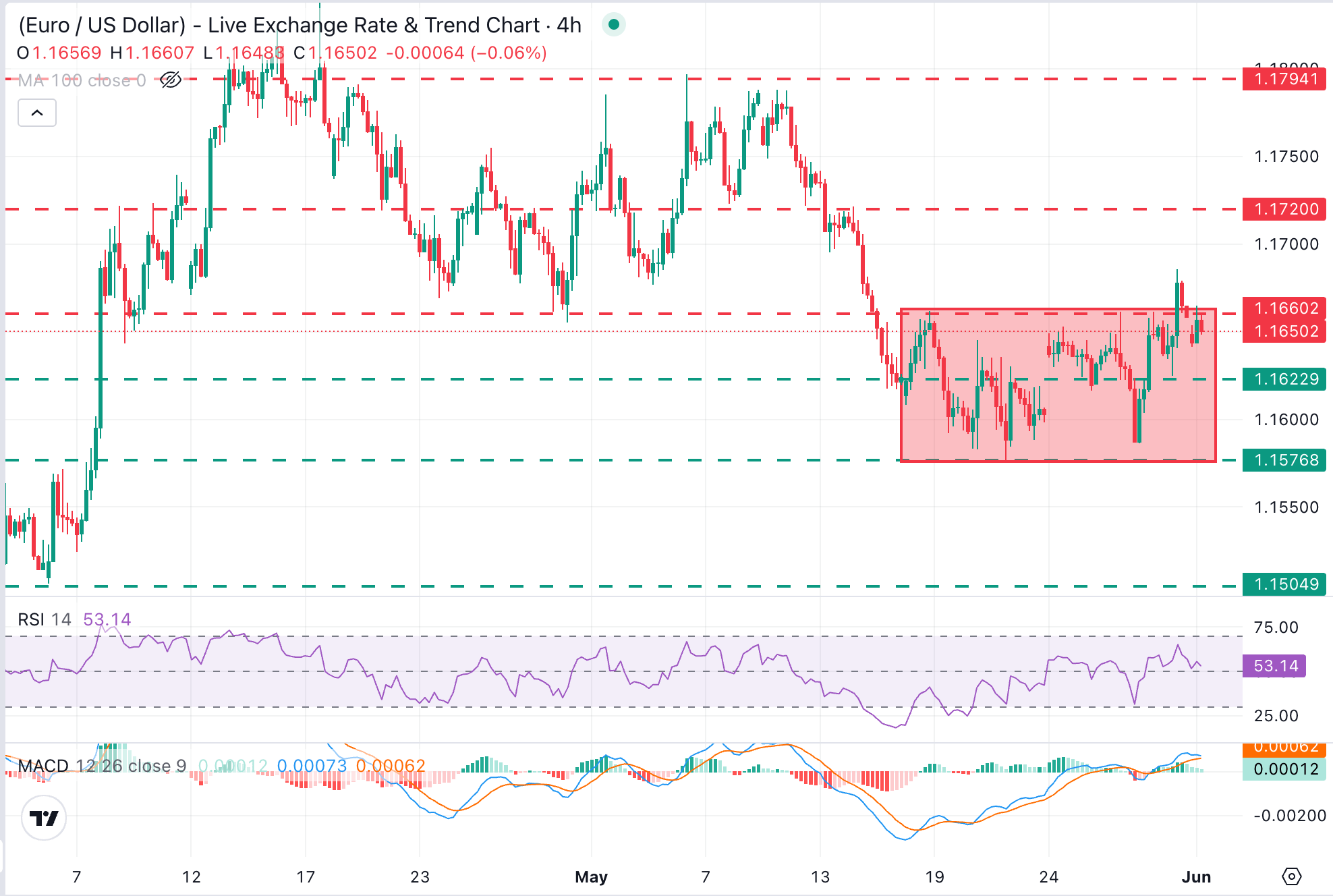
EUR/USD trades at 1.1650, holding a constructive near-term bullish bias, but still trapped within the last two weeks' range. The 4-hour Relative Strength Index (RSI) is hovering in neutral-to-positive territory, and the Moving Average Convergence Divergence (MACD) line is clinging to slightly positive ground, both hinting that buyers retain modest control.
On the topside, the May 18, 27, and 28 highs at 1.1660 keep holding bulls despite last week's fake break. Above here, the May 14 high, at 1.1720, and May's peak, in the 1.1790 area, emerge as the next targets.
Downside attempts are likely to be contained at Friday's lows, at 1,1625 ahead of the range bottom, in the 1.1575 area.
(The technical analysis of this story was written with the help of an AI tool.)
Economic Indicator
Unemployment Rate
The Unemployment Rate released by the Eurostat is the percentage of unemployed workers in the total civilian labor force. It is a leading indicator for the economy of the European Union. If the rate goes up, it indicates a lack of expansion within the European labor market and a weakening of the economy. Generally speaking, a decrease of the figure is seen as bullish for the Euro (EUR), while an increase is seen as bearish.
Read more.Last release: Mon Jun 01, 2026 09:00
Frequency: Monthly
Actual: 6.3%
Consensus: 6.2%
Previous: 6.2%
Source: Eurostat
Economic Indicator
HCOB Manufacturing PMI
The Manufacturing Purchasing Managers Index (PMI), released on a monthly basis by S&P Global and Hamburg Commercial Bank (HCOB), is a leading indicator gauging business activity in the Eurozone manufacturing sector. The data is derived from surveys of senior executives at private-sector companies from the manufacturing sector. Survey responses reflect the change, if any, in the current month compared to the previous month and can anticipate changing trends in official data series such as Gross Domestic Product (GDP), industrial production, employment and inflation. The index varies between 0 and 100, with levels of 50.0 signaling no change over the previous month. A reading above 50 indicates that the manufacturing economy is generally expanding, a bullish sign for the Euro (EUR). Meanwhile, a reading below 50 signals that activity among goods producers is generally declining, which is seen as bearish for EUR.
Read more.Last release: Mon Jun 01, 2026 08:00
Frequency: Monthly
Actual: 51.6
Consensus: 51.4
Previous: 51.4
Source: S&P Global














