

Indian Rupee ticks up on RBI’s intervention, downside remains favored
- The Indian Rupee opens slightly higher, following the RBI’s intervention.
- Fears of further decline in the global oil supply would keep INR’s upside limited.
- Easing hawkish Fed bets will likely keep the US Dollar under pressure.
The Indian Rupee (INR) opens marginally higher against the US Dollar (USD) while entering the weekend. The USD/INR pair ticks down to near 96.30 as the Indian currency rises, following Reserve Bank of India’s intervention.
According to a Reuters report, the Indian central bank likely intervened to limit the Indian Rupee's fall. The report also showed that the central bank has been intervening almost daily in both the spot and non-deliverable forward markets to support the currency; however, the scale of intervention has been relatively measured considering the intensity of the pressure on the rupee.
However, the support regained by the Indian currency after underperforming the entire week could prove to be short-lived amid fears of further escalation in global energy supply disruption.
In the opening trade, the MCX Crude Oil contract expiring on July 20 is up 1.16% to near Rs. 7,700, close to its monthly high of Rs. 7,832 posted on Tuesday.
Currencies from economies, such as India, which rely heavily on oil imports to meet their energy needs, tend to underperform in a high-oil-price environment.
Iran threatens the closure of Red Sea if US attacks Iranian infrastructure
Earlier in the day, Iran asked Yemen’s Houthi militia to stand ready to close the Red Sea oil route if the United States (US) strikes Iranian power infrastructure, Reuters reported. Such a scenario would trim the already-low global oil supply, which could further accelerate fears of high inflation globally.
The threat from Iran is a response to remarks from US President Donald Trump, in an interview with Fox News, in which he said that military forces would be authorized to attack Iranian bridges and power plants if the nation doesn’t come to the table for negotiations.
US Dollar gains on risk-off mood
An improvement in the demand for safe-haven assets amid intensifying military aggression between the US and Iran has boosted the appeal of the US Dollar. At press time, the US Dollar Index (DXY), which gauges the Greenback’s value against six major currencies, trades 0.1% higher to near 100.80.
However, the Greenback will likely conclude the week on a negative note, as traders have trimmed Federal Reserve (Fed) interest rate hike bets, following the release of the soft US Consumer Price Index (CPI) report of June on Tuesday.
According to the CME FedWatch tool, the odds of the Fed delivering an interest rate hike in the meeting later this month have dropped significantly to 10.2% from 24.6% recorded a week ago.
Technical Analysis: USD/INR remains on track to revisit all-time high around 97.10
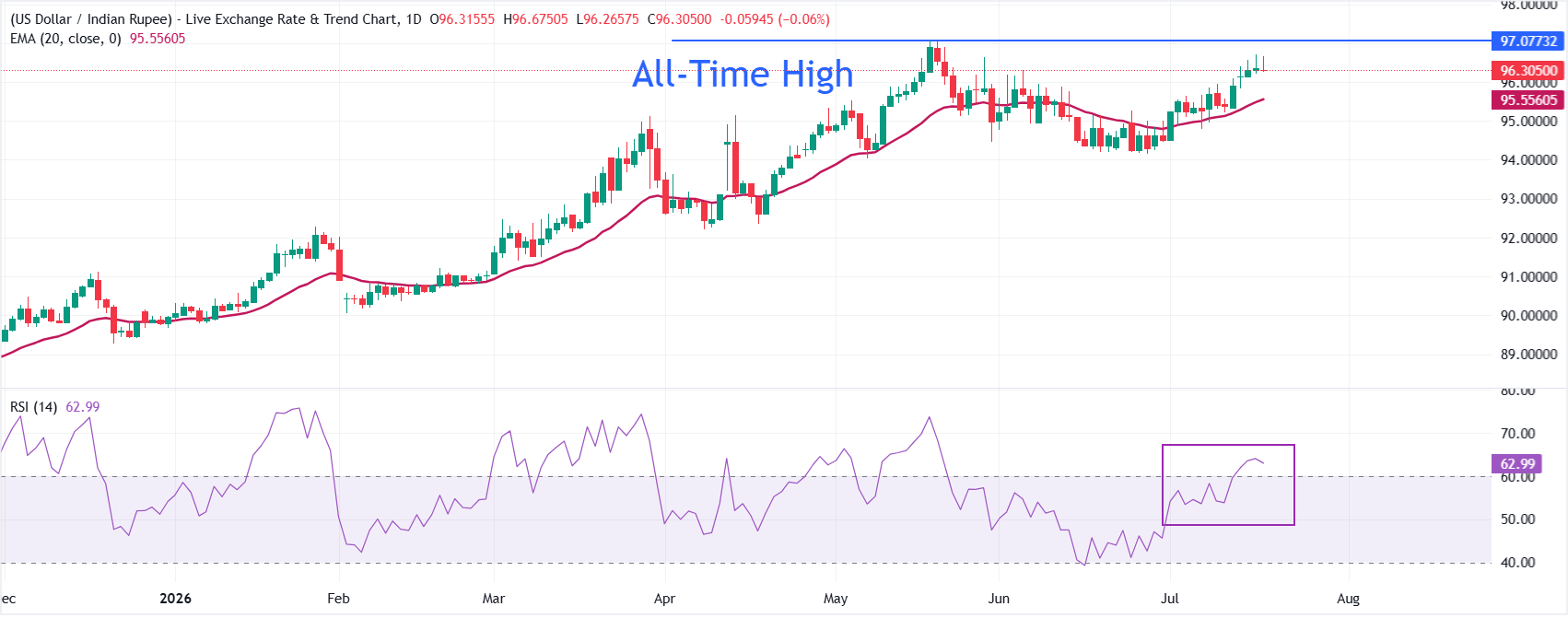
USD/INR trades at around 96.30, maintaining a bullish near-term bias as it holds above the 20-day Exponential Moving Average (EMA) at 95.55. The pair extends its advance after reclaiming the short-term trend indicator, while the Relative Strength Index (14) at 62.99 stays in positive territory, hinting that upside momentum remains constructive but not yet overbought.
On the downside, immediate support is seen at the 20-day EMA at 95.55, which reinforces the underlying bullish structure as long as it holds. Looking up, the all-time high at around 97.10 will be the key barrier for the pair.
(The technical analysis of this story was written with the help of an AI tool. Know more.)
Indian Rupee FAQs
The Indian Rupee (INR) is one of the most sensitive currencies to external factors. The price of Crude Oil (the country is highly dependent on imported Oil), the value of the US Dollar – most trade is conducted in USD – and the level of foreign investment, are all influential. Direct intervention by the Reserve Bank of India (RBI) in FX markets to keep the exchange rate stable, as well as the level of interest rates set by the RBI, are further major influencing factors on the Rupee.
The Reserve Bank of India (RBI) actively intervenes in forex markets to maintain a stable exchange rate, to help facilitate trade. In addition, the RBI tries to maintain the inflation rate at its 4% target by adjusting interest rates. Higher interest rates usually strengthen the Rupee. This is due to the role of the ‘carry trade’ in which investors borrow in countries with lower interest rates so as to place their money in countries’ offering relatively higher interest rates and profit from the difference.
Macroeconomic factors that influence the value of the Rupee include inflation, interest rates, the economic growth rate (GDP), the balance of trade, and inflows from foreign investment. A higher growth rate can lead to more overseas investment, pushing up demand for the Rupee. A less negative balance of trade will eventually lead to a stronger Rupee. Higher interest rates, especially real rates (interest rates less inflation) are also positive for the Rupee. A risk-on environment can lead to greater inflows of Foreign Direct and Indirect Investment (FDI and FII), which also benefit the Rupee.
Higher inflation, particularly, if it is comparatively higher than India’s peers, is generally negative for the currency as it reflects devaluation through oversupply. Inflation also increases the cost of exports, leading to more Rupees being sold to purchase foreign imports, which is Rupee-negative. At the same time, higher inflation usually leads to the Reserve Bank of India (RBI) raising interest rates and this can be positive for the Rupee, due to increased demand from international investors. The opposite effect is true of lower inflation.














