

GBP/USD Price Forecast: Bearish bias persists as pair tests Symmetrical Triangle breakdown zone
- The British Pound trades lower against the US Dollar amid uncertainty regarding the UK fiscal policy outlook.
- UK PM Starmer resigns and pledges an orderly handover of responsibilities.
- The Symmetrical Triangle breakdown backs a fresh downside leg ahead.
The British Pound (GBP) trades slightly lower against its major currency peers during the European trading session on Tuesday, but remains firm against Asia-Pacific currencies. The GBP/USD pair drops 0.1% to near 1.3237 as investors seek clarity regarding how the United Kingdom (UK) fiscal policy will shape up after the leadership transition triggered by the resignation of Prime Minister Keir Starmer.
Pound Sterling Price Today
The table below shows the percentage change of British Pound (GBP) against listed major currencies today. British Pound was the weakest against the US Dollar.
| USD | EUR | GBP | JPY | CAD | AUD | NZD | CHF | |
|---|---|---|---|---|---|---|---|---|
| USD | 0.03% | 0.09% | 0.05% | 0.11% | 0.54% | 0.32% | 0.05% | |
| EUR | -0.03% | 0.04% | 0.00% | 0.06% | 0.48% | 0.28% | 0.01% | |
| GBP | -0.09% | -0.04% | -0.02% | 0.03% | 0.46% | 0.23% | -0.02% | |
| JPY | -0.05% | 0.00% | 0.02% | 0.05% | 0.49% | 0.27% | -0.01% | |
| CAD | -0.11% | -0.06% | -0.03% | -0.05% | 0.44% | 0.23% | -0.05% | |
| AUD | -0.54% | -0.48% | -0.46% | -0.49% | -0.44% | -0.19% | -0.47% | |
| NZD | -0.32% | -0.28% | -0.23% | -0.27% | -0.23% | 0.19% | -0.29% | |
| CHF | -0.05% | -0.01% | 0.02% | 0.00% | 0.05% | 0.47% | 0.29% |
The heat map shows percentage changes of major currencies against each other. The base currency is picked from the left column, while the quote currency is picked from the top row. For example, if you pick the British Pound from the left column and move along the horizontal line to the US Dollar, the percentage change displayed in the box will represent GBP (base)/USD (quote).
On Monday, Starmer announced his resignation from the premiership and ensured an orderly handover of responsibilities. Starmer’s resignation has cleared the way for Greater Manchester Mayor Andy Burnham’s leadership bid or a wider contest among potential candidates over the summer.
Burnham has been recognized as a potential replacement for UK PM Starmer since the Labour Party suffered a major defeat in local elections in May. The odds of Burnham replacing Starmer increased after he rejoined Parliament by winning a by-election in northern England’s Makerfield last week.
No major volatility has been observed in the British Pound and UK gilt yields, so far, as UK PM Starmer has promised a smooth leadership change, and investors lack knowledge regarding how Andy Burnham or any other new leader will operate the fiscal policy under his leadership.
Market experts also believe that the medium-term reaction in the British Pound and especially in UK gilt yields will be influenced by remarks on the fiscal policy,
"The market is watching gilts more than the pound, and that looks quiet. The medium-term reaction is that the market is going to get nervous at some point about fiscal policy,” analysts at Societe Generale said.
Meanwhile, investors await the UK flash S&P Global PMI data for June, which will be published at 08:30 GMT. The Services PMI is expected to improve to 50.0, a figure above 50.0 indicates that business activity expanded, from 49.3 in May.
GBP/USD technical analysis
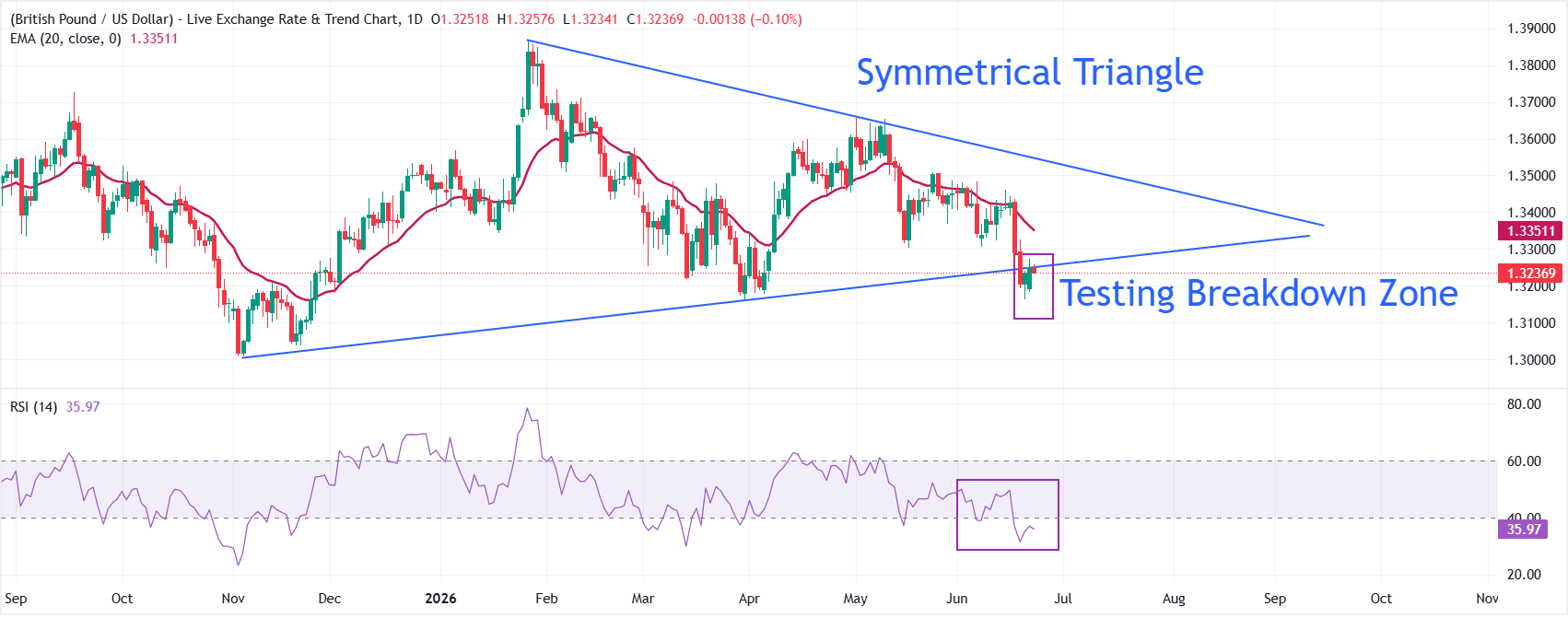
Bias: GBP/USD trades lower at around 1.3237 with a bearish near-term bias as it sits under the 20-day Exponential Moving Average (EMA) at 1.3351. The pair tests the breakdown zone of the Symmetrical Triangle formation, which generally leads to a fresh downside leg.
Momentum: The Relative Strength Index (RSI) at 36 hovers just above oversold territory, hinting at persistent downside momentum rather than an imminent bullish reversal.
Support: Looking down, major support zones are the November 25 low at 1.3096, followed by the psychological level of 1.3000, which could be touched if the pair slides below the June 19 low at 1.3163.
Resistance: On the topside, initial resistance is located at the broken uptrend line around 1.3251, and a daily close back above this area would be needed to ease immediate downside pressure. Beyond that, the 20-day EMA at 1.3351 is the next significant barrier before the broader descending trend-line resistance near 1.3547 comes back into focus.
(The technical analysis of this story was written with the help of an AI tool.)
Pound Sterling FAQs
The Pound Sterling (GBP) is the oldest currency in the world (886 AD) and the official currency of the United Kingdom. It is the fourth most traded unit for foreign exchange (FX) in the world, accounting for 12% of all transactions, averaging $630 billion a day, according to 2022 data. Its key trading pairs are GBP/USD, also known as ‘Cable’, which accounts for 11% of FX, GBP/JPY, or the ‘Dragon’ as it is known by traders (3%), and EUR/GBP (2%). The Pound Sterling is issued by the Bank of England (BoE).
The single most important factor influencing the value of the Pound Sterling is monetary policy decided by the Bank of England. The BoE bases its decisions on whether it has achieved its primary goal of “price stability” – a steady inflation rate of around 2%. Its primary tool for achieving this is the adjustment of interest rates. When inflation is too high, the BoE will try to rein it in by raising interest rates, making it more expensive for people and businesses to access credit. This is generally positive for GBP, as higher interest rates make the UK a more attractive place for global investors to park their money. When inflation falls too low it is a sign economic growth is slowing. In this scenario, the BoE will consider lowering interest rates to cheapen credit so businesses will borrow more to invest in growth-generating projects.
Data releases gauge the health of the economy and can impact the value of the Pound Sterling. Indicators such as GDP, Manufacturing and Services PMIs, and employment can all influence the direction of the GBP. A strong economy is good for Sterling. Not only does it attract more foreign investment but it may encourage the BoE to put up interest rates, which will directly strengthen GBP. Otherwise, if economic data is weak, the Pound Sterling is likely to fall.
Another significant data release for the Pound Sterling is the Trade Balance. This indicator measures the difference between what a country earns from its exports and what it spends on imports over a given period. If a country produces highly sought-after exports, its currency will benefit purely from the extra demand created from foreign buyers seeking to purchase these goods. Therefore, a positive net Trade Balance strengthens a currency and vice versa for a negative balance.














