

The Japanese Yen has a second buyer nobody will name
- USD/JPY has round-tripped close to three Yen between 158.00 and 161.00.
- The US Treasury warned banks through the New York Fed to stand ready Friday.
- Three consecutive days count as one operation, so Friday costs Tokyo nothing.
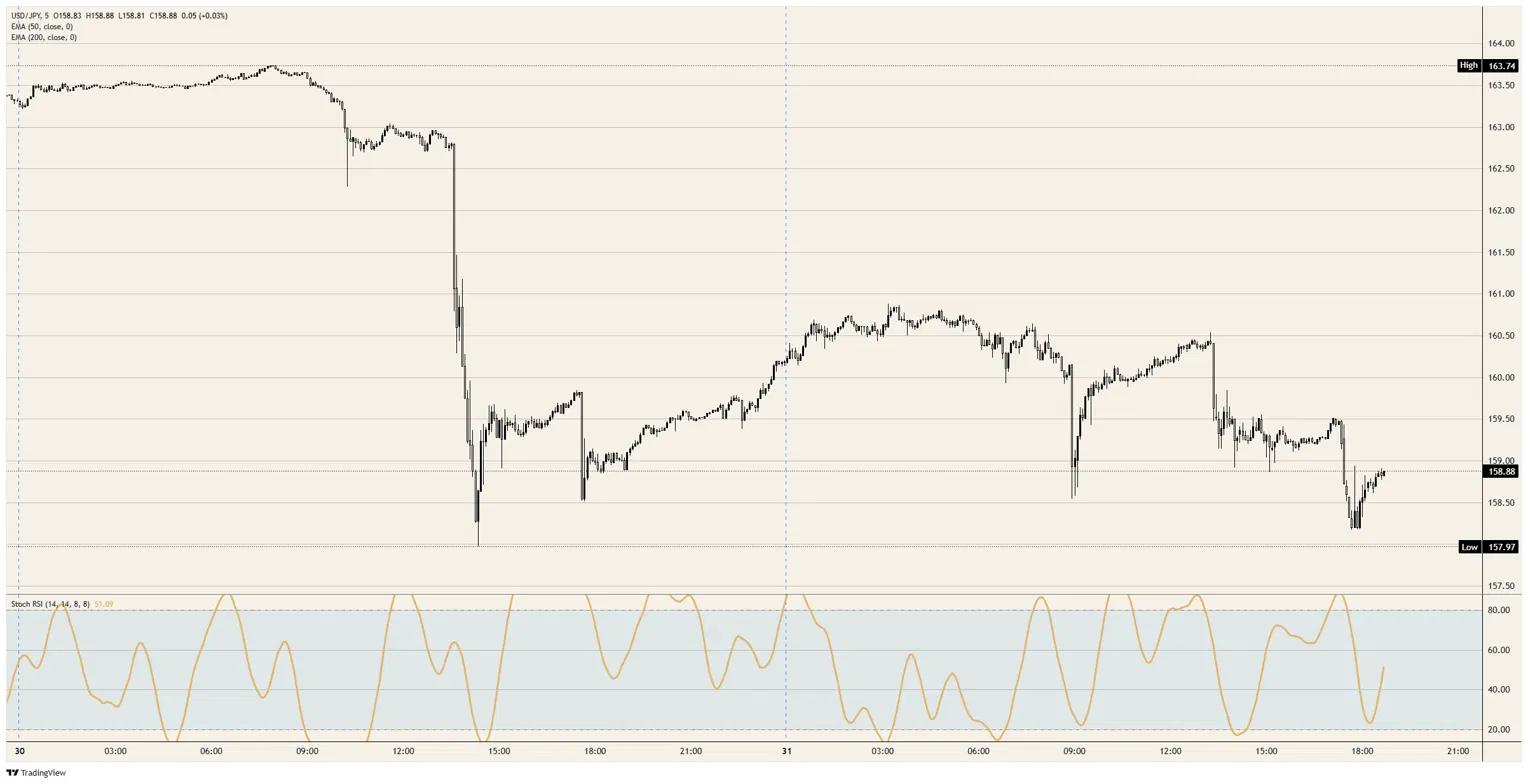
Thursday's record Yen defence is the story everyone has written. Friday is the one that matters, because the Dollar has been sold in three separate lurches since the Tokyo morning, nobody has claimed any of them, and the US Treasury has told a number of banks through the New York Fed that it may enter the market and they should stand ready for further action. USD/JPY trades just under 159.00 late in the session, a Yen and a half beneath where the day began.
The second round is the cheap one
The pattern reads like an operation rather than a market. The London morning took the Dollar down to the 158.50 area in minutes and it was bought straight back; a second lurch landed around 13:15 GMT as the Treasury headline crossed; the session low near 158.00 printed hours later in the New York afternoon. Desks could not separate an operation from a liquidation.
That confusion is not a communication failure. It is the product. Having spent a record sum on Thursday to break the book, Tokyo can now hold the level with a fraction of the money, or with none at all, because every air pocket is deniable and traders have to price the possibility rather than the fact.
Three days count as one
International Monetary Fund (IMF) guidelines treat up to three episodes of intervention in six months as consistent with a free-floating exchange rate, and three consecutive days of operations count as a single episode. Finance ministry officials said in May that two windows remained before November once the April campaign was counted. Thursday and Friday are the second, and they are the same one, which means today's activity is free on the only meter Tokyo is watching.
Reserves are not the binding constraint either. Japan holds roughly 1.4 trillion Dollars, a little under 1.2 trillion of that in foreign currency assets, and the April to May campaign ran about 74 billion Dollars across a month without denting the pile. What is scarce is the permission rather than the ammunition, and one window is left.
The desk is American, the policy is not
The rate check that preceded Thursday's move came from the Federal Reserve Bank of New York acting as fiscal agent for the Treasury, not from the Federal Reserve on its own account. Participation by the central bank itself would require separate authorization from the Federal Open Market Committee (FOMC), and none has been granted. The coordination running through this episode is fiscal, and it stops at the border of the interest rate that created the problem.
The gesture is still the largest in fifteen years. The Treasury Secretary called the Yen badly undervalued on Thursday and said currency markets tend to overshoot, and the last direct American operation in this pair was March 2011, one billion Dollars split between the Exchange Stabilization Fund (ESF) and the central bank's own portfolio, aimed at weakening the currency rather than supporting it.
Scale is what keeps the enthusiasm in proportion. The ESF's net position at the end of 2025 was 43.6 billion Dollars, less than Tokyo spent in an hour on Thursday. American money is a signal, and the signal is the point.
What Thursday actually bought
The operation itself is estimated near 53 billion Dollars from central bank account data, which would make it the largest single day Tokyo has ever run. It took the Dollar from the 163.00 handle to just under 158.00 inside an hour, sixty minutes after a Gross Domestic Product (GDP) print of 1.5% annualised against a 2.1% consensus had knocked it off balance, into a book carrying net short Yen positions worth 11.65 billion Dollars.
Twelve hours later the Bank of Japan (BoJ) held at 1.00% on an 8-1 vote, one member preferring a quarter point more, while warning that underlying inflation could run above target. A 3.75% upper bound in Washington against 1.00% in Tokyo, a war that keeps Japan's energy import bill denominated in Dollars, and a government elected on spending, together make a machine that manufactures Yen sellers faster than any operation can retire them.
The week that decides it
Monday brings the first hard read on Thursday's size when the operation clears into central bank account data, alongside the manufacturing survey at 14:00 GMT with a consensus of 54. Wednesday carries private payrolls at 75K from 98K. Confirmation from the finance ministry itself does not arrive until its monthly figure late in August, which is exactly why the ambiguity is worth more to Tokyo than the reserves are.
Friday 7 August at 12:30 GMT is the release that matters. Nonfarm payrolls are seen at 91K against 57K prior, unemployment at 4.3% from 4.2% and average hourly earnings at 0.3% MoM. There is no FOMC meeting in August, so two payroll reports land before 16 September, where futures still price at least one increase at roughly 59%.
Levels and bias
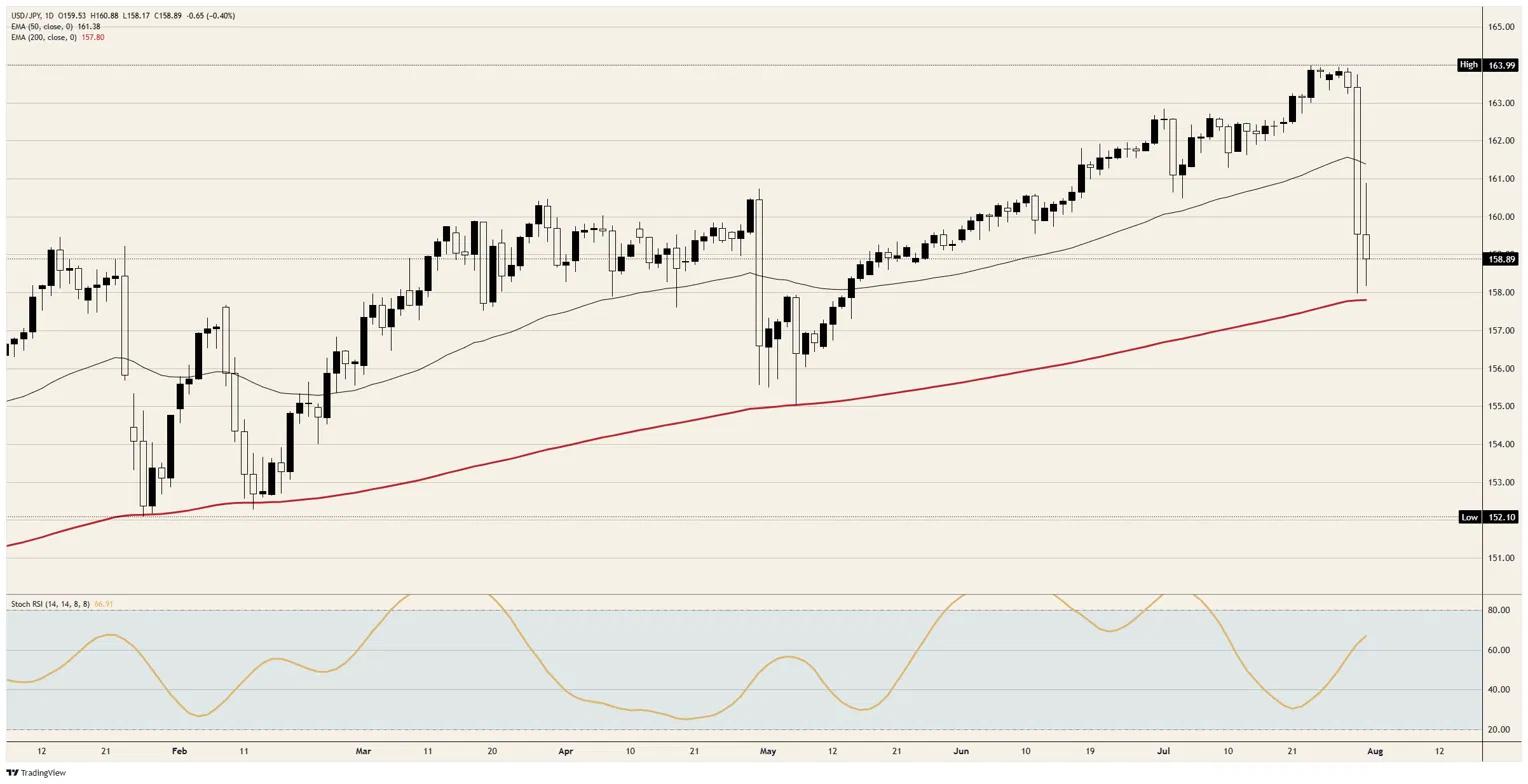
Resistance: The 50-day Exponential Moving Average (EMA) just under 161.50 capped Friday's rebound near 161.00 and stands as the first line. Above it sit 163.00 and the four-decade high short of 164.00.
Support: The 200-day EMA near 158.00 has been tested twice in two sessions, by Thursday's flush just beneath it and by Friday's low just above. Under that lie the 155.00 area and the year's base near 152.00.
Bias: Bearish while the 50-day EMA caps rallies and an unnamed bidder with an American co-signer is live in the market. A daily close beneath 158.00 opens the 155.00 area. A daily close back above 161.50 invalidates the call and says the market has counted Tokyo's remaining windows and found them wanting.
USD/JPY 5-minute chart
USD/JPY daily chart
Japanese Yen FAQs
The Japanese Yen (JPY) is one of the world’s most traded currencies. Its value is broadly determined by the performance of the Japanese economy, but more specifically by the Bank of Japan’s policy, the differential between Japanese and US bond yields, or risk sentiment among traders, among other factors.
One of the Bank of Japan’s mandates is currency control, so its moves are key for the Yen. The BoJ has directly intervened in currency markets sometimes, generally to lower the value of the Yen, although it refrains from doing it often due to political concerns of its main trading partners. The BoJ ultra-loose monetary policy between 2013 and 2024 caused the Yen to depreciate against its main currency peers due to an increasing policy divergence between the Bank of Japan and other main central banks. More recently, the gradually unwinding of this ultra-loose policy has given some support to the Yen.
Over the last decade, the BoJ’s stance of sticking to ultra-loose monetary policy has led to a widening policy divergence with other central banks, particularly with the US Federal Reserve. This supported a widening of the differential between the 10-year US and Japanese bonds, which favored the US Dollar against the Japanese Yen. The BoJ decision in 2024 to gradually abandon the ultra-loose policy, coupled with interest-rate cuts in other major central banks, is narrowing this differential.
The Japanese Yen is often seen as a safe-haven investment. This means that in times of market stress, investors are more likely to put their money in the Japanese currency due to its supposed reliability and stability. Turbulent times are likely to strengthen the Yen’s value against other currencies seen as more risky to invest in.














