

US Treasuries lost their crown: Why central banks are betting on Gold
- Gold accounts for 27% of all global central bank reserves, outpacing US Treasuries as the top reserve asset.
- The rise in Gold reserves follows steady central bank purchases of the precious metal, whose price has rallied over the past year.
- The change reflects efforts from central banks to seek an alternative to the US Dollar, reinforcing the narrative of the “debasement trade.”
Gold has become the top reserve asset in global central banks’ vaults, surpassing US Treasuries, suggesting that the precious metal is becoming the main choice for monetary authorities seeking protection against geopolitical uncertainty.

The share of Gold in total official foreign reserves increased to 27% at the end of 2025, up from 20% a year earlier, according to data from the European Central Bank (ECB). This is higher than the share of US Treasuries, which fell from 25% to 22%, and the Euro, which remained stable at 15%. This major change in the global reserve system was first reported by the Financial Times.
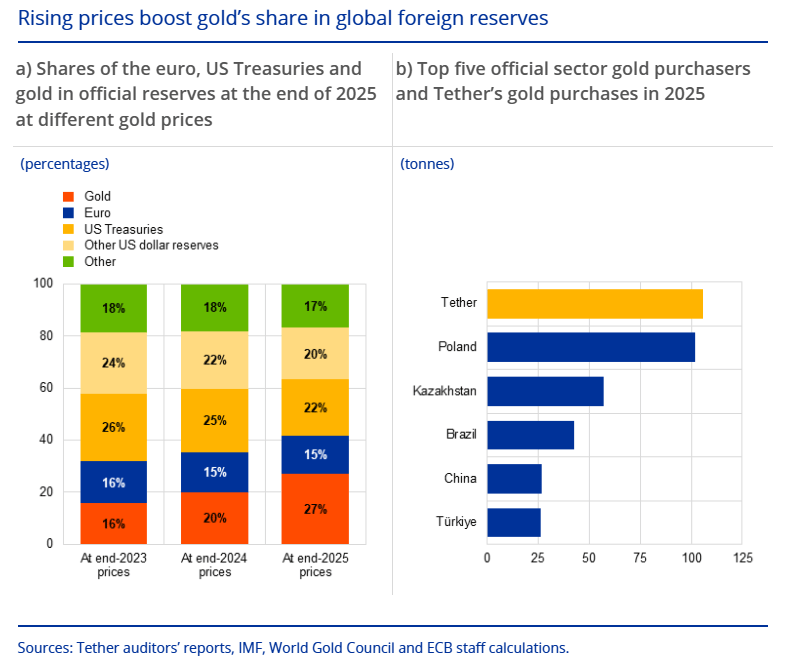
The ECB suggests that the increase in Gold’s share is mainly due to valuation effects: Gold’s price rally during 2025 mechanically increased the share. Actually, in terms of quantity, central bank purchases of the precious metal slowed to around 850 tonnes in 2025 compared with the over 1,000 tonnes seen every year between 2022 and 2024.
Still, the report also highlights that purchases of the precious metal could also be due to efforts by some central banks to strengthen their balance sheets. “Survey data suggest that central banks hold Gold not only for diversification but also as a hedge against geopolitical risk,” the report notes.
By country, Poland was the largest purchaser among central banks in 2025 with 100 tonnes, followed by Kazakhstan, Brazil, China and Türkiye. Beyond central banks, the report highlights that stablecoin issuer Tether bought more than 100 tonnes of Gold in 2025.
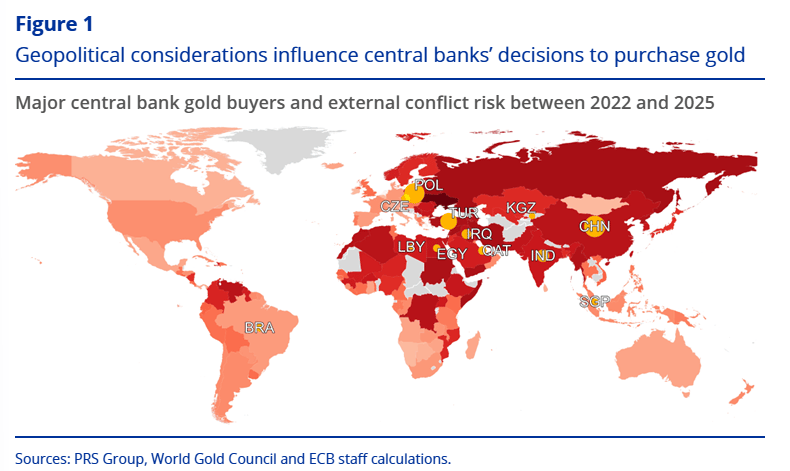
While the data only covers 2025, the report highlights that some of these central banks have offloaded some of their Gold reserves this year to mitigate the economic fallout from the Iran war. The Turkish central bank, for example, sold or loaned around 130 tonnes of Gold to defend the Lira, in what the ECB describes as “one of the largest reserve drawdowns in recent years”.
Central bank buying is a key catalyst for Gold prices and one of the reasons behind its stunning rally in 2025. The changing mix of reserve assets shows that many countries are trying to reduce their dependence on the US Dollar, which remains the world’s dominant reserve currency.













