Is the Market No Longer Rewarding Earnings Beats? Nvidia’s Results Signal a New Phase for the AI Rally
Wall Street remains bullish on Nvidia, but market sentiment has clearly shifted. Investors are no longer satisfied with simple earnings beats. Instead, the market is now demanding near-perfect and continuously accelerating growth — and that is becoming a new source of pressure for the broader AI trade. Investors are no longer focused solely on whether Nvidia can exceed expectations. Instead, attention has shifted toward another question: can the company continue outperforming expectations that have already been pushed to extreme levels? This shift in sentiment is becoming one of the most important turning points in the current AI market cycle.

Over the past two years, Nvidia has effectively become synonymous with the entire AI expansion story. Major AI model developers such as OpenAI and Meta remain heavily dependent on Nvidia’s chips. As global technology companies aggressively build AI data centers, Nvidia rapidly grew into the world’s most valuable publicly traded company. However, as the company becomes larger and larger, market expectations are also beginning to change. A US venture capital firm recently noted that Nvidia now accounts for approximately 8% of the S&P 500 Index. At such a massive scale, markets are finding it increasingly difficult to continue assigning unlimited optimism to the stock. Even when Nvidia continues delivering exceptionally strong results, investors are beginning to question how long this explosive growth can realistically continue.
What investors are demanding now is ultra-high growth acceleration — and that is precisely why selling pressure emerged after earnings were released. Another challenge facing Nvidia is that markets had already largely priced in strong results well before earnings day. Leading into the report, capital had continuously flowed into AI and semiconductor stocks, causing some investors to lock in profits once the results were officially released. This created a classic “buy the rumor, sell the news” market reaction. For Nvidia — the flagship company of the AI industry — markets have already become accustomed to extraordinarily strong earnings reports. Simply beating expectations is no longer sufficient to drive major upside moves in the stock price.
Despite the relatively muted short-term market reaction, most institutions remain optimistic on Nvidia. Citigroup stated that AI demand remains extremely strong, while Nvidia’s data center business continues driving overall growth. The bank maintained its “Buy” rating and US$300 price target.
As Microsoft, Google, Amazon, and other cloud computing giants continue expanding AI-related capital expenditures, they are simultaneously accelerating development of their own in-house AI chips in hopes of reducing dependence on Nvidia. This has led some investors to worry that competition within the data center market could intensify significantly over time.
Nevertheless, Nvidia management is clearly attempting to downplay those concerns. CEO Jensen Huang emphasized during the earnings call that the era of Agentic AI has already arrived — and that this transition will further accelerate demand for AI infrastructure. He stated that demand is already showing “explosive growth.” The company also forecast that by the end of this decade, global annual spending on AI infrastructure could eventually reach between US$3 trillion and US$4 trillion per year.
Market Analysis:
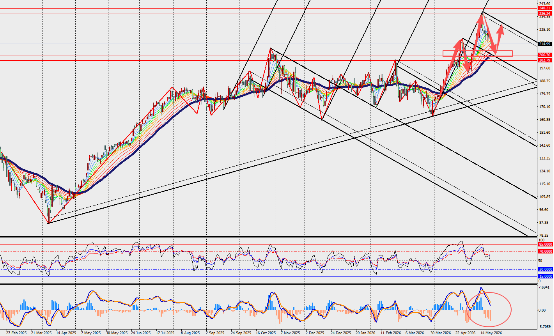
For markets, the truly important question is no longer simply how much Nvidia earned this quarter. Instead, investors are now asking whether the broader AI cycle itself remains in an expansion phase. At this stage, Wall Street’s answer still appears broadly optimistic. However, as markets increasingly begin pricing in perfection, the future direction of Nvidia shares will no longer depend solely on one quarter’s results. What matters now is whether Nvidia can continue proving that the AI boom remains far from reaching its peak.