

Indian Rupee opens strongly as oil prices return to pre-war levels
- The Indian Rupee trades higher against the US Dollar as oil prices fall further.
- RBI Governor Malhotra pushes back fears of interest rate hikes.
- The US Dollar ticks lower ahead of the US PCE Inflation data for May.
The Indian Rupee (INR) opens on a strong note against the US Dollar (USD) on Thursday. The USD/INR pair declines to near 94.30 as the Indian currency strengthens due to a further decline in oil prices.
The WTI Oil price has returned close to the pre-Middle East war levels as traffic through the Strait of Hormuz, a critical chokepoint to almost 20% of global energy supply, has started normalizing, following the Memorandum of Understanding (MoU) signing and an improvement in technical talks towards the nuclear deal between the United States (US) and Iran.
At press time, the WTI Oil price trades 0.75% lower to near $69.25. The MCX Crude Oil contract expiring on July 20 is down 1.6% to near 6,563.
Currencies from economies, such as India, which rely heavily on oil imports to meet their energy needs appreciate when oil prices fall significantly.
Slightly lower US Dollar also weighs on USD/INR
In the Asian session, the US Dollar demonstrates a subdued performance while investors await the US Personal Consumption Expenditure Price Index (PCE) data for May, which will be published at 12:30 GMT.
At press time, the US Dollar Index (DXY), which tracks the Greenback’s value against six major currencies, trades marginally lower around 101.52, but is still close to its over-a-year high at 101.80 posted on Wednesday.
Investors will pay close attention to the US PCE inflation data as it is expected to influence market expectations toward the Federal Reserve’s (Fed) monetary policy outlook. The US core PCE inflation, which is the Fed’s preferred inflation gauge, is expected to arrive higher at 3.4% Year-on-Year (YoY) from 3.3% in April.
Signs of price pressures accelerating would further boost hawkish Fed prospects. Currently, the CME FedWatch tool shows that the odds of the Fed hiking interest rates this year are almost 82%. While the possibility of at least two interest rate hikes is 42.2%.
FIIs continue to maintain distance from Indian stock market
The lack of interest by overseas investors towards the Indian stock market remains intact despite oil prices having returned close to pre-war levels and the Reserve Bank of India pushing back fears of interest rate hikes in the near term.
On Wednesday, Foreign Institutional Investors (FIIs) offloaded their stake worth Rs. 1,843.40 crore in the Indian stock market. The same day, RBI Governor Sanjay Malhotra said, while speaking to ET Now, that it is “premature” to consider interest rate hikes, citing that the central bank doesn’t see signs of energy crisis-led inflation generalizing. "If we wanted to prepare the market for rate hikes, we would have changed stance from neutral to restrictive,” Malhotra added.
Technical Analysis: USD/INR faces selling pressure above 20-day EMA
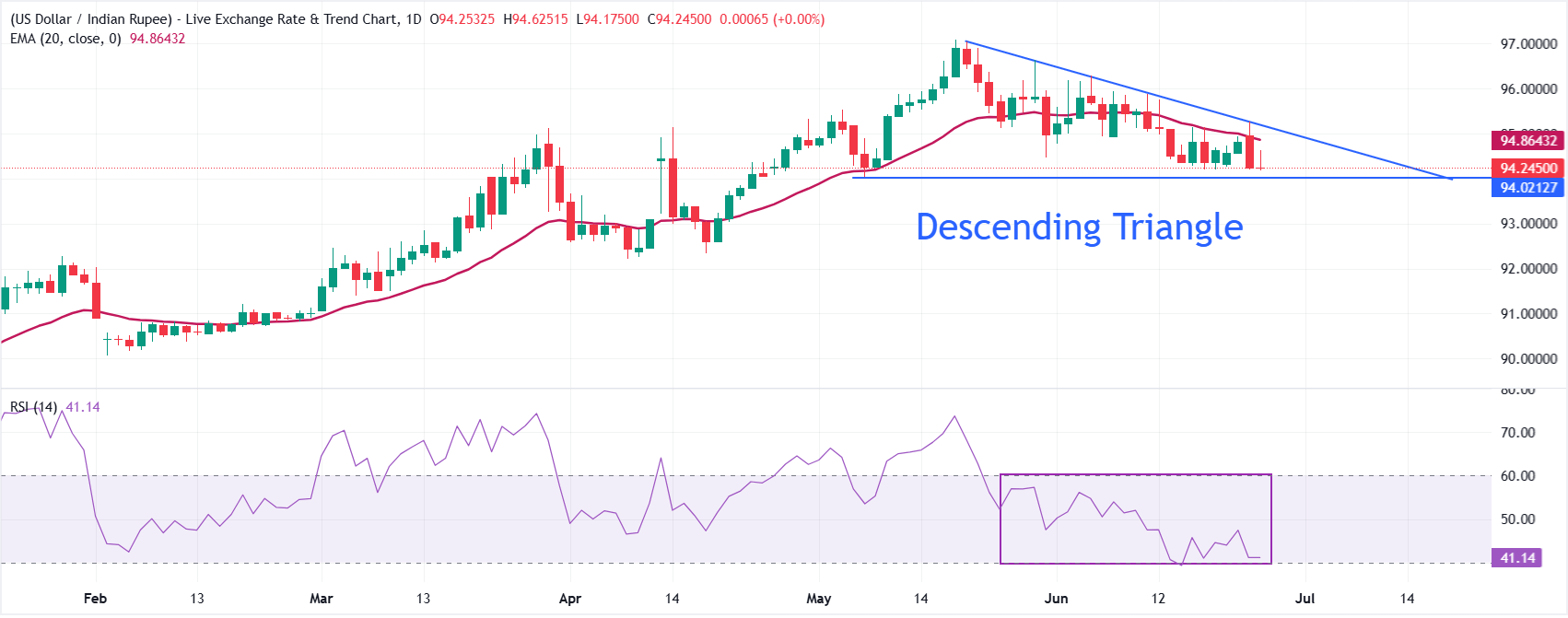
USD/INR trades lower at around 94.25 at press time, keeping a bearish near-term tone as spot holds decisively under the 20-day Exponential Moving Average (EMA) at 94.86.
The Relative Strength Index (14) around 41 suggests lingering downside pressure but without reaching oversold extremes, hinting that sellers still have the upper hand while leaving room for further extension before exhaustion signals emerge.
On the topside, initial resistance is provided by the 20-day EMA at 94.86, with the downward border of the Descending Triangle formation near 95.23 acting as the next cap, ahead of a more distant barrier around 97.0541 from the trend-line’s origin. Looking down, the pair would be exposed to the April 15 high at 93.67 if it extends its decline below the May 7 low at 94.03.
(The technical analysis of this story was written with the help of an AI tool.)
Indian Rupee FAQs
The Indian Rupee (INR) is one of the most sensitive currencies to external factors. The price of Crude Oil (the country is highly dependent on imported Oil), the value of the US Dollar – most trade is conducted in USD – and the level of foreign investment, are all influential. Direct intervention by the Reserve Bank of India (RBI) in FX markets to keep the exchange rate stable, as well as the level of interest rates set by the RBI, are further major influencing factors on the Rupee.
The Reserve Bank of India (RBI) actively intervenes in forex markets to maintain a stable exchange rate, to help facilitate trade. In addition, the RBI tries to maintain the inflation rate at its 4% target by adjusting interest rates. Higher interest rates usually strengthen the Rupee. This is due to the role of the ‘carry trade’ in which investors borrow in countries with lower interest rates so as to place their money in countries’ offering relatively higher interest rates and profit from the difference.
Macroeconomic factors that influence the value of the Rupee include inflation, interest rates, the economic growth rate (GDP), the balance of trade, and inflows from foreign investment. A higher growth rate can lead to more overseas investment, pushing up demand for the Rupee. A less negative balance of trade will eventually lead to a stronger Rupee. Higher interest rates, especially real rates (interest rates less inflation) are also positive for the Rupee. A risk-on environment can lead to greater inflows of Foreign Direct and Indirect Investment (FDI and FII), which also benefit the Rupee.
Higher inflation, particularly, if it is comparatively higher than India’s peers, is generally negative for the currency as it reflects devaluation through oversupply. Inflation also increases the cost of exports, leading to more Rupees being sold to purchase foreign imports, which is Rupee-negative. At the same time, higher inflation usually leads to the Reserve Bank of India (RBI) raising interest rates and this can be positive for the Rupee, due to increased demand from international investors. The opposite effect is true of lower inflation.














