

NZD/USD Price Forecast: Struggles to sustain above 61.8% Fibo retracement at around 0.5940
- NZD/USD edges down to near 0.5935 amid uncertainty surrounding the Trump-Xi meeting outcome.
- The odds of the Fed raising interest rates this year have increased due to accelerating price pressures.
- NZD/USD continues to face selling pressure above 61.8% Fibonacci retracement at 0.5938.
The NZD/USD pair trades marginally under pressure around 0.5935 during the late Asian trading session on Thursday. The Kiwi pair reflects subduedness as broader market sentiment appears to be slightly cautious, with investors awaiting the outcome of the meeting between United States (US) President Donald Trump and Chinese leader Xi Jinping.

At the press time, Asian stock markets are mostly down, with Nikkei 225 falling 0.3% to near 63,070. The US Dollar Index (DXY), which tracks the Greenback’s value against six major currencies, trades firmly near 98.50. The DXY is close to its weekly high of 98.60 posted on Wednesday.
The impact of the Trump-Xi meeting outcome will also be significant on the New Zealand Dollar (NZD), given that New Zealand is a key trading partner of China.
In the US, rising inflationary pressures due to elevated energy prices have prompted expectations of an interest rate hike by the Federal Reserve (Fed) this year.
According to the CME FedWatch tool, the odds of the Fed delivering at least one interest rate hike this year is 32.2%, which were almost nil a month ago.
NZD/USD technical analysis
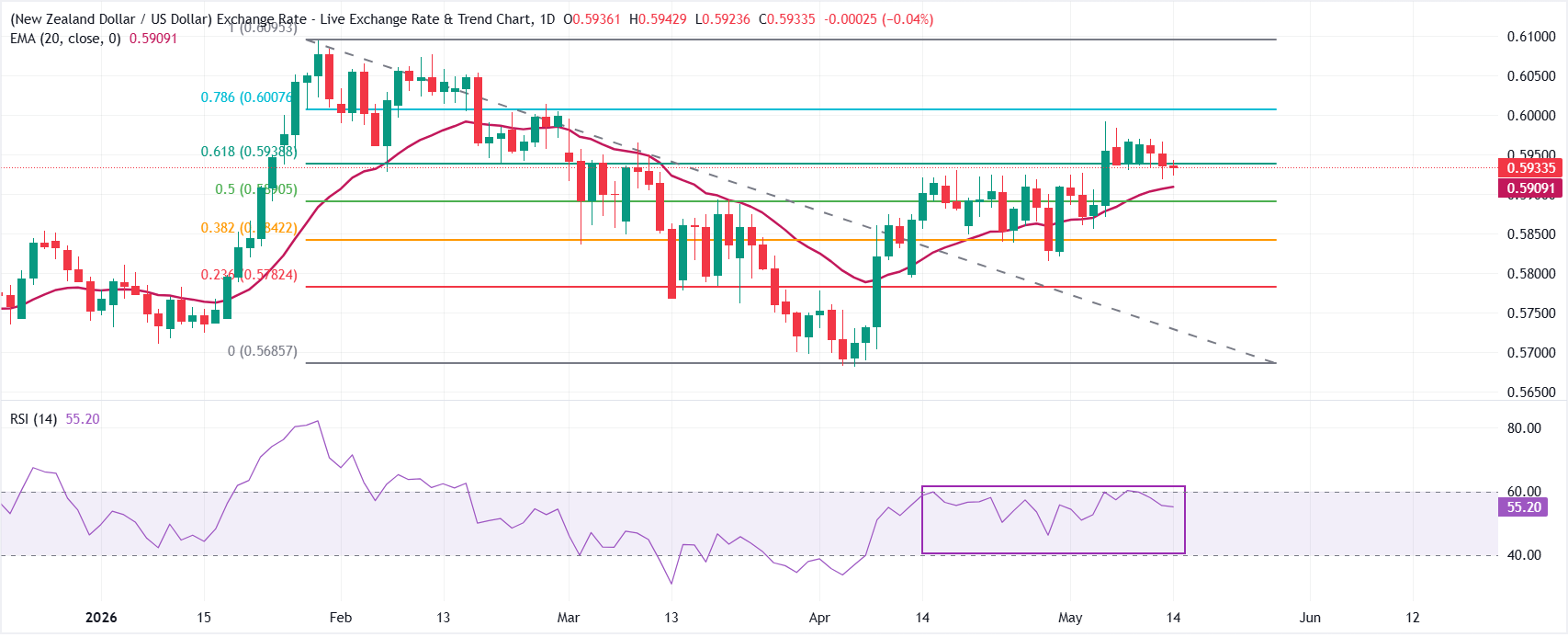
NZD/USD trades marginally lower at around 0.5935 at the press time. However, the pair holds a mild bullish bias as it trades above the 20-day Exponential Moving Average (EMA) at 0.5909 and above the 50.0% Fibonacci retracement at 0.5890, while pressing into a cluster of overhead retracements.
The Relative Strength Index (14) around 55 suggests constructive but not overstretched momentum, hinting that dips could remain supported as long as price stays above the nearby moving average base.
On the topside, immediate resistance emerges at the 61.8% Fibonacci retracement at roughly 0.5939, followed by the 78.6% level at 0.6008 and then the recent swing high region marked by the 100.0% retracement at 0.6095. On the downside, initial support is seen at the 20-day EMA near 0.5909, ahead of the 50.0% retracement at 0.5890; a deeper pullback would expose the 38.2% level at 0.5842 and the 23.6% retracement at 0.5782, with the 0.5686 anchor acting as a more distant structural floor.
(The technical analysis of this story was written with the help of an AI tool.)
Risk sentiment FAQs
In the world of financial jargon the two widely used terms “risk-on” and “risk off'' refer to the level of risk that investors are willing to stomach during the period referenced. In a “risk-on” market, investors are optimistic about the future and more willing to buy risky assets. In a “risk-off” market investors start to ‘play it safe’ because they are worried about the future, and therefore buy less risky assets that are more certain of bringing a return, even if it is relatively modest.
Typically, during periods of “risk-on”, stock markets will rise, most commodities – except Gold – will also gain in value, since they benefit from a positive growth outlook. The currencies of nations that are heavy commodity exporters strengthen because of increased demand, and Cryptocurrencies rise. In a “risk-off” market, Bonds go up – especially major government Bonds – Gold shines, and safe-haven currencies such as the Japanese Yen, Swiss Franc and US Dollar all benefit.
The Australian Dollar (AUD), the Canadian Dollar (CAD), the New Zealand Dollar (NZD) and minor FX like the Ruble (RUB) and the South African Rand (ZAR), all tend to rise in markets that are “risk-on”. This is because the economies of these currencies are heavily reliant on commodity exports for growth, and commodities tend to rise in price during risk-on periods. This is because investors foresee greater demand for raw materials in the future due to heightened economic activity.
The major currencies that tend to rise during periods of “risk-off” are the US Dollar (USD), the Japanese Yen (JPY) and the Swiss Franc (CHF). The US Dollar, because it is the world’s reserve currency, and because in times of crisis investors buy US government debt, which is seen as safe because the largest economy in the world is unlikely to default. The Yen, from increased demand for Japanese government bonds, because a high proportion are held by domestic investors who are unlikely to dump them – even in a crisis. The Swiss Franc, because strict Swiss banking laws offer investors enhanced capital protection.














