

SOL slides despite Solana Foundation onboarding Mastercard, Western Union for AI platform
- Solana declines toward $90.00, reflecting growing headwinds amid persistent risk-off in the broader crypto market.
- SOL protocol launches the AI-ready Solana Developer Platform, enabling enterprises to create stablecoins, real-world assets and process payments.
- Mastercard, Western Union and Worldpay are among the enterprises building financial products using the platform.
Solana (SOL) is trading around $90.00 at the time of writing on Tuesday after falling from its daily high of $92.22. The broader crypto market remains on edge amid uncertainty driven by the Middle East war.

Despite United States (US) President Donald Trump’s optimistic remarks on talks with Iran on Monday, Israel and the Iranian regime are continuing with attacks, undermining global Oil supplies and risk assets. Iran has refuted Trump’s claim that talks are underway and the nation is ready to make a deal.
Meanwhile, Solana’s upside potential appears limited and risks extending its correction below $90.00.
Solana Foundation launches AI platform SDP
The Solana Foundation has announced the launch of the Solana Development Platform (SDP) to support enterprises in building and launching financial products on the protocol. SDP integrates artificial intelligence (AI) into the development environment, creating a unified issuance module that enables enterprises to tokenise deposits, launch GENIUS-compliant stablecoins, or tokenize real-world assets (RWAs).
Businesses have access to a payments module that supports fiat and deposit flows, including on-ramp, off-ramp and on-chain transactions. The payments module enables users to support unique financial flows such as atomic swaps, vaults and on-chain FX.
Mastercard, Western Union, and Worldpay are among the early adopters of the platform, deploying products including stablecoin settlement, merchant payments, and cross-border payments.
Catherine Gu, Head of Product, Digital Assets at Solana Foundation, stated that SDP “is entirely API-based, removing the technical and operational barriers that enterprise developers may encounter. SDP aggregates the latest protocol features on the Solana network, such as token extensions for permissioning and privacy, and directly connects with Solana’s rich developer ecosystem.”
Technical outlook: Solana struggles as headwinds intensify
Solana is trading around $90.00 amid a cautiously bullish bias. The price holds above the rising support trend line that originates near $67.40, keeping the broader advance intact despite recent pullbacks. The 50-day, 100-day and 200-day Exponential Moving Averages (EMAs) remain clustered above spot and trend lower, which may cap rebounds.
Momentum readings appear mixed with the Moving Average Convergence Divergence (MACD) indicator holding slightly above its signal line on the daily chart. Muted histogram bars hint at modest bullish pressure but fading follow-through, while the Relative Strength Index (RSI) around 51 on the same chart reinforces a balanced tone after the early-March overextension.
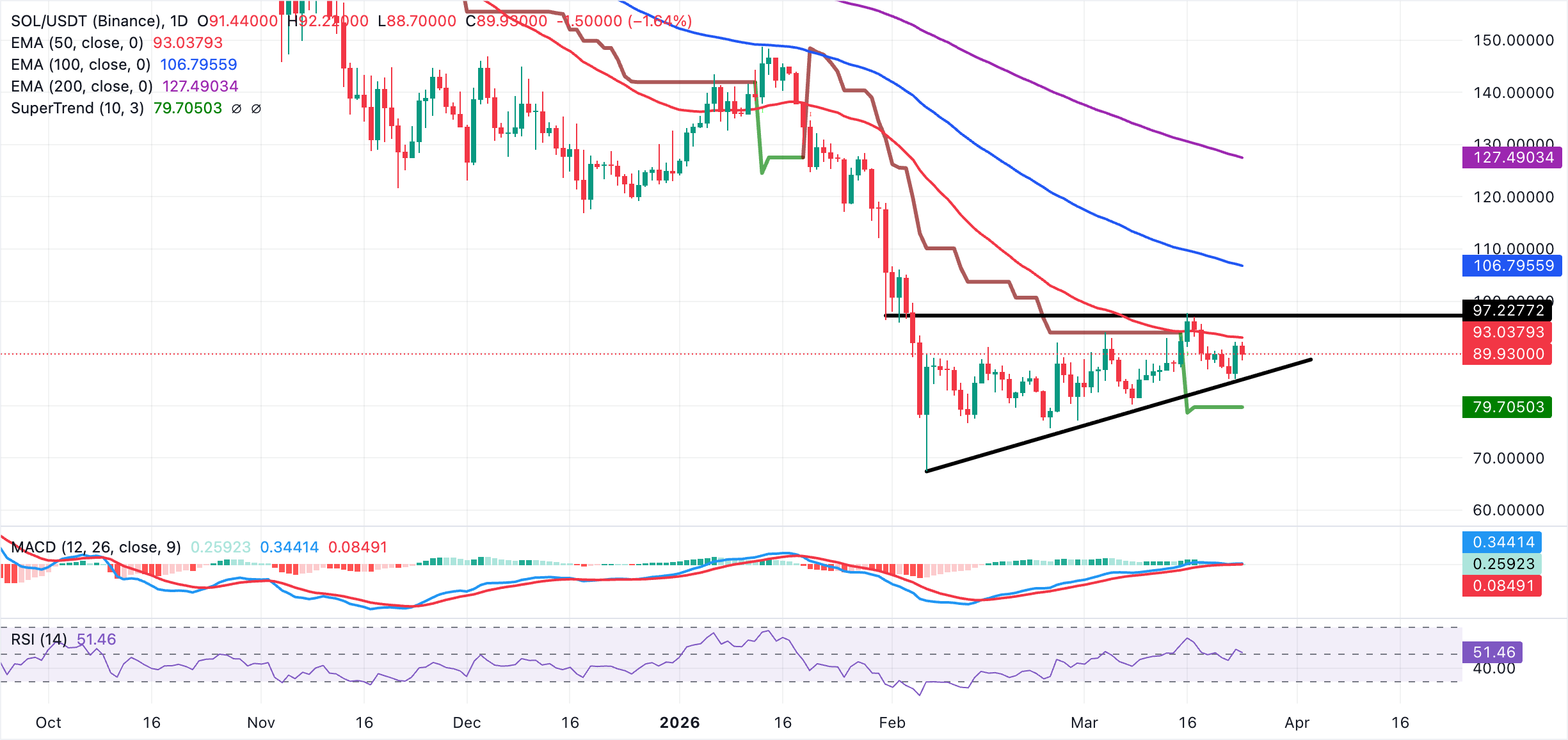
Immediate resistance lies near $92.22, SOL's daily high, followed by the 50-day EMA at $93.04 and then the $97.22 peak that capped the last rally. A sustained move above $97.22 would reopen the path toward the psychological $100.00 area.
On the downside, initial support is seen around $88.00, where multiple recent closes congregate, with stronger demand expected closer to $86.20 and then the $81.60–$83.20 band, which corresponds to prior reaction lows along the ascending trend line.
Ripple FAQs
Ripple is a payments company that specializes in cross-border remittance. The company does this by leveraging blockchain technology. RippleNet is a network used for payments transfer created by Ripple Labs Inc. and is open to financial institutions worldwide. The company also leverages the XRP token.
XRP is the native token of the decentralized blockchain XRPLedger. The token is used by Ripple Labs to facilitate transactions on the XRPLedger, helping financial institutions transfer value in a borderless manner. XRP therefore facilitates trustless and instant payments on the XRPLedger chain, helping financial firms save on the cost of transacting worldwide.
XRPLedger is based on a distributed ledger technology and the blockchain using XRP to power transactions. The ledger is different from other blockchains as it has a built-in inflammatory protocol that helps fight spam and distributed denial-of-service (DDOS) attacks. The XRPL is maintained by a peer-to-peer network known as the global XRP Ledger community.
XRP uses the interledger standard. This is a blockchain protocol that aids payments across different networks. For instance, XRP’s blockchain can connect the ledgers of two or more banks. This effectively removes intermediaries and the need for centralization in the system. XRP acts as the native token of the XRPLedger blockchain engineered by Jed McCaleb, Arthur Britto and David Schwartz.
(The technical analysis of this story was written with the help of an AI tool.)














