

Swiss Franc sinks by design, not by peace
- USD/CHF broke to a fresh high for the year as the Franc slid against every major peer.
- The Franc was no safe haven in this war; it lost ground throughout as the SNB leaned against any strength.
- De-escalation and a softer SNB intervention line this week simply removed the last prop under the Franc.
The Swiss Franc is the weakest major into the weekly close, dragging USD/CHF to a fresh high for the year. The tidy explanation is a wartime safe-haven bid unwinding now that the US and Iran have struck a deal; the trouble is that the Franc was never much of a haven in this war. It spent the conflict on the back foot. What looks like a haven unwinding is really the removal of the last excuse for the Franc to be anything but weak.
The haven that never showed up
Look back to the war's opening days in early March: the Franc did flicker, spiking against the Euro to its strongest in more than a decade as money fled to safety. The flicker lasted about a session. The Swiss National Bank (SNB) leaned on it at once with intervention warnings; even on day one the Franc was losing against the US Dollar, whose own haven bid and yield edge proved stronger. From there it only softened. By late March the Franc sat at multi-month lows against the Dollar, with analysts openly tagging it a war loser rather than a refuge. Two things drove that: near-zero Swiss inflation, which let the country absorb an energy-price surge without tightening, and an SNB that kept selling Francs to cap any strength.
A central bank that wants it weak
That same SNB gave the move its blessing on Thursday, not that it would phrase it that way. The bank held its policy rate at 0% as universally expected and nudged its near-term inflation forecast only a touch higher. The tell was the currency language: after months of warning it stood ready to intervene against a too-strong Franc, the SNB this week qualified that warning with an "if necessary" caveat. Pressed on whether the softer wording meant less urgency now that the Middle East is calming, the chair declined to confirm the bank's resolve was any greater than before, pointing instead to the rate gap with the European Central Bank (ECB) and offering no pushback on the slide. For a central bank thought to have sold some $3 billion of Francs in March to keep a lid on strength, that reads as quiet contentment with a cheaper Franc; traders took it as licence to keep selling.
Still the cleanest funding leg
Strip out the haven question and the structural case for a soft Franc is intact. At 0% the Franc is among the cleanest funding currencies in the market, the natural short leg whenever volatility falls and carry trades come back on. Both of those are happening as the war premium drains out of markets. The tell that this is Franc-specific rather than a blanket risk rally is the Yen, its usual partner in the funding and haven trade, holding broadly firm on the day rather than sinking alongside it. When the two classic funding havens diverge this sharply, the story is about the Franc itself: a currency its own central bank has spent months trying to weaken, finally cooperating.
The peace is already fraying
The peace doing the talking is shakier than the price action implies. The memorandum was rushed to signing midweek, two days early, with Trump signing at a Versailles dinner while his Iranian counterpart signed remotely; the planned Geneva ceremony was then scrapped as redundant. The negotiations meant to give the deal substance never started. Talks due to open Friday in Switzerland were postponed within two days as fighting flared again between Israel and Hezbollah in Lebanon, with no firm restart on the calendar. The Franc is being sold on a signature even as the diplomacy behind it stalls on day two.
The break is real but stretched
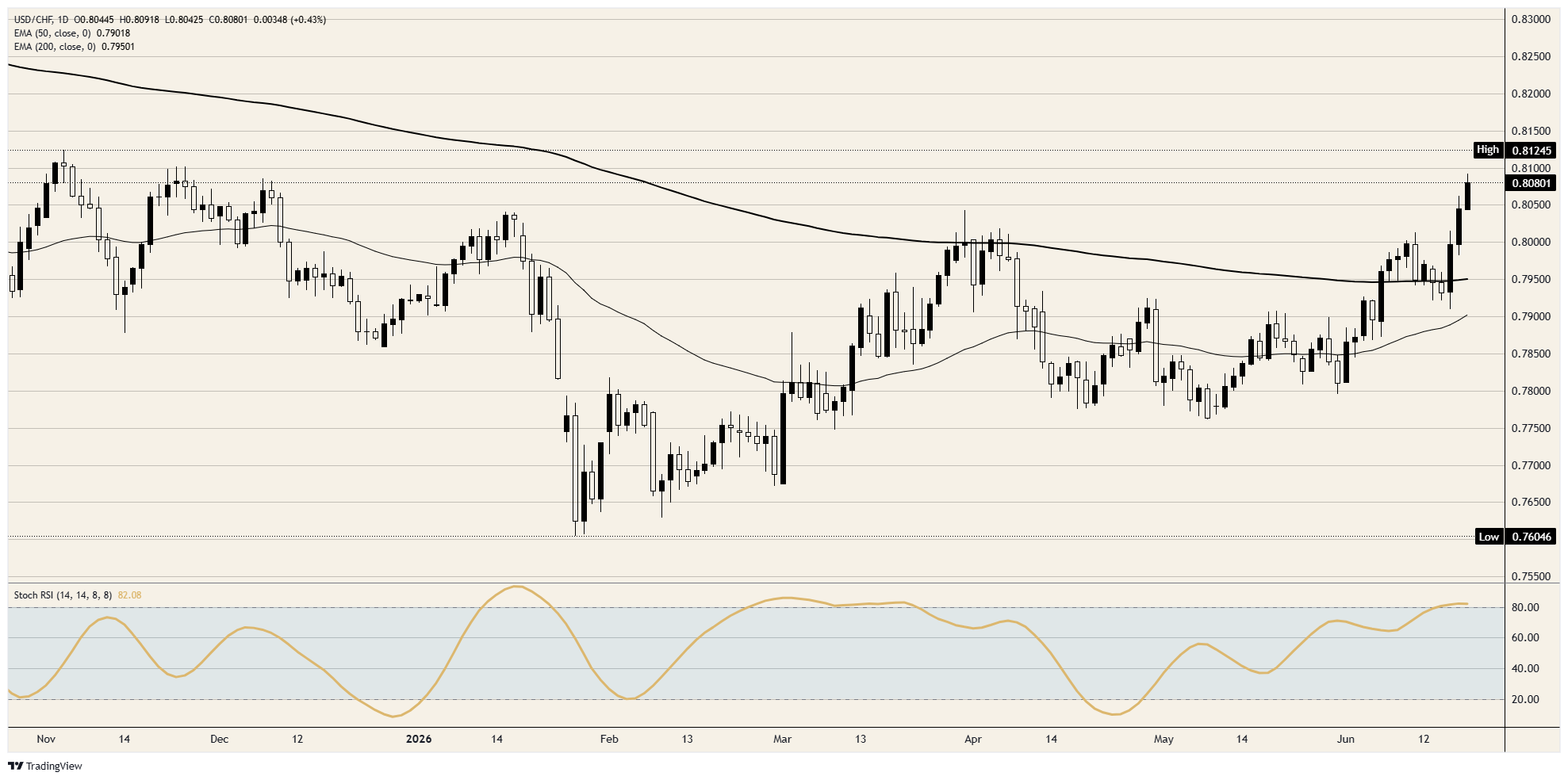
On the daily chart USD/CHF has done real technical damage to the downtrend. The pair spent most of 2026 capped by its 200-period Exponential Moving Average (EMA) near 0.7950 and has now closed decisively above it, clearing the 0.8000 handle and the 50 EMA on the way. The catch is momentum: the Stochastic Relative Strength Index (Stoch RSI) sits deep in overbought territory above 80, with price pressing a fresh high and little overhead structure to lean on. That is a confirmed break running on fumes, exposed to a snap-back if the Lebanon flare-up reignites haven demand or the SNB's intervention bias re-fires.
Resistance: The immediate ceiling is the year's high near 0.8100; a sustained push through it opens largely clear air toward 0.8150, untravelled in 2026.
Support: First support is the 0.8000 handle, with the former 200 EMA cap around 0.7950 the next shelf once it flips to support; below that, the 50 EMA close to 0.7900 marks where the breakout would start to look suspect.
Bias: Lower Franc, higher USD/CHF while the pair holds above 0.7950, with the year's high near 0.8100 and then 0.8150 the upside targets. The conviction here is structural rather than narrative: the move rests on a central bank that wants a weaker Franc and a funding role reasserting itself, not on a haven unwind the war never delivered. A daily close back beneath 0.7950 would void the break; the clearest trigger for that is the Lebanon fighting dragging the ceasefire back into doubt and reviving the haven bid the Franc never got to enjoy.
Swiss Franc Price Today
The table below shows the percentage change of Swiss Franc (CHF) against listed major currencies today. Swiss Franc was the strongest against the Canadian Dollar.
| CHF | EUR | GBP | JPY | CAD | AUD | NZD | USD | |
|---|---|---|---|---|---|---|---|---|
| CHF | -0.48% | -0.54% | -0.50% | -0.11% | -0.36% | -0.13% | -0.44% | |
| EUR | 0.48% | -0.05% | -0.02% | 0.38% | 0.10% | 0.35% | 0.06% | |
| GBP | 0.54% | 0.05% | 0.02% | 0.42% | 0.17% | 0.43% | 0.09% | |
| JPY | 0.50% | 0.02% | -0.02% | 0.39% | 0.14% | 0.38% | 0.06% | |
| CAD | 0.11% | -0.38% | -0.42% | -0.39% | -0.23% | -0.01% | -0.32% | |
| AUD | 0.36% | -0.10% | -0.17% | -0.14% | 0.23% | 0.24% | -0.07% | |
| NZD | 0.13% | -0.35% | -0.43% | -0.38% | 0.01% | -0.24% | -0.31% | |
| USD | 0.44% | -0.06% | -0.09% | -0.06% | 0.32% | 0.07% | 0.31% |
The heat map shows percentage changes of major currencies against each other. The base currency is picked from the left column, while the quote currency is picked from the top row. For example, if you pick the Swiss Franc from the left column and move along the horizontal line to the US Dollar, the percentage change displayed in the box will represent CHF (base)/USD (quote).
USD/CHF daily chart
Swiss Franc FAQs
The Swiss Franc (CHF) is Switzerland’s official currency. It is among the top ten most traded currencies globally, reaching volumes that well exceed the size of the Swiss economy. Its value is determined by the broad market sentiment, the country’s economic health or action taken by the Swiss National Bank (SNB), among other factors. Between 2011 and 2015, the Swiss Franc was pegged to the Euro (EUR). The peg was abruptly removed, resulting in a more than 20% increase in the Franc’s value, causing a turmoil in markets. Even though the peg isn’t in force anymore, CHF fortunes tend to be highly correlated with the Euro ones due to the high dependency of the Swiss economy on the neighboring Eurozone.
The Swiss Franc (CHF) is considered a safe-haven asset, or a currency that investors tend to buy in times of market stress. This is due to the perceived status of Switzerland in the world: a stable economy, a strong export sector, big central bank reserves or a longstanding political stance towards neutrality in global conflicts make the country’s currency a good choice for investors fleeing from risks. Turbulent times are likely to strengthen CHF value against other currencies that are seen as more risky to invest in.
The Swiss National Bank (SNB) meets four times a year – once every quarter, less than other major central banks – to decide on monetary policy. The bank aims for an annual inflation rate of less than 2%. When inflation is above target or forecasted to be above target in the foreseeable future, the bank will attempt to tame price growth by raising its policy rate. Higher interest rates are generally positive for the Swiss Franc (CHF) as they lead to higher yields, making the country a more attractive place for investors. On the contrary, lower interest rates tend to weaken CHF.
Macroeconomic data releases in Switzerland are key to assessing the state of the economy and can impact the Swiss Franc’s (CHF) valuation. The Swiss economy is broadly stable, but any sudden change in economic growth, inflation, current account or the central bank’s currency reserves have the potential to trigger moves in CHF. Generally, high economic growth, low unemployment and high confidence are good for CHF. Conversely, if economic data points to weakening momentum, CHF is likely to depreciate.
As a small and open economy, Switzerland is heavily dependent on the health of the neighboring Eurozone economies. The broader European Union is Switzerland’s main economic partner and a key political ally, so macroeconomic and monetary policy stability in the Eurozone is essential for Switzerland and, thus, for the Swiss Franc (CHF). With such dependency, some models suggest that the correlation between the fortunes of the Euro (EUR) and the CHF is more than 90%, or close to perfect.














