

The British Pound Sterling breaks out on the strength of someone else's weakness
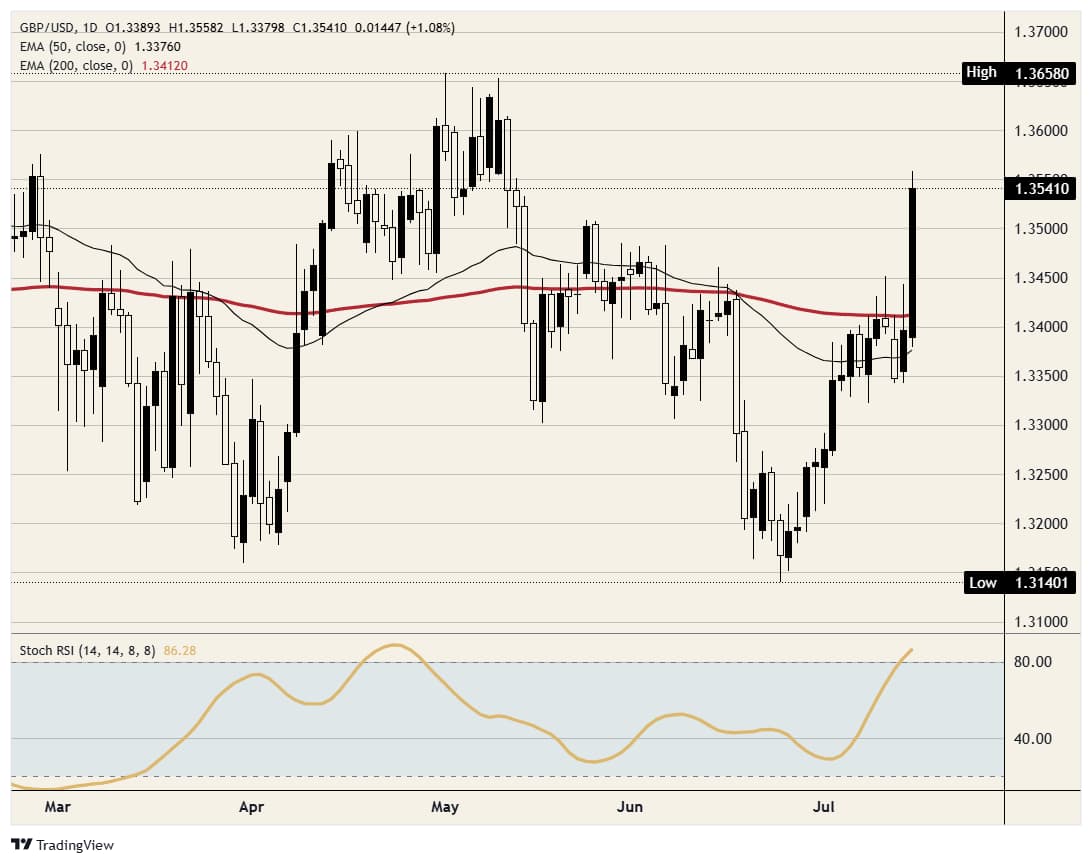
- GBP/USD trades near 1.3540, up by better than 1% and through the 200-day EMA and the 1.3400 handle in a single session.
- A June producer-price miss guts the Federal Reserve hike bid while a September Bank of England hike stays fully priced.
- The advance stalls just under 1.3550 with a Westminster leadership handover due within days.
Cable spent the London morning drifting, printed the session low at 1.3381 shortly after 10:00 GMT, and then spent the New York afternoon repricing the entire Dollar complex. The Pound trades near 1.3540 at writing, up better than 1% in one of its strongest sessions of the year, after tagging 1.3558 and clearing both the 200-day Exponential Moving Average (EMA) and the 1.3400 handle in a single afternoon. The move answers a month of indecision around those levels with the subtlety of a brick.

The significance here is structural rather than cosmetic. The 50-day and 200-day EMAs sit clustered at 1.3376 and 1.3385, and most of July's price action had been compressed between that band and the 1.3400 shelf, a coil that has now released in one direction. A single session does not repair a downtrend that ran from late April into early July, but it does shift the burden of proof onto Dollar bulls for the first time in months.
A producer-price print does the heavy lifting
The June Producer Price Index (PPI) landed at 12:30 GMT with a headline monthly decline of 0.3% against expectations for a flat reading, while the annual rate slowed to 5.5% from 6%, undercutting the 6.2% consensus by a wide margin. The core measure missed as well, printing 4.7% YoY against 5.2% expected. Factory-gate inflation north of 5% would have been an emergency in any normal cycle; in this one it counted as relief, and the Dollar was sold accordingly across the board.
Markets came into the week pricing a Federal Reserve (Fed) hike by September at close to 70%, courtesy of a committee that spent June writing additional increases into its dot plot. Wednesday's data blunted that conversation, and the Fed Chair's Capitol Hill testimony at 14:00 GMT was scored neutral rather than hawkish, which by this cycle's standards reads as a stand-down. An Empire State manufacturing beat at the same timestamp as the PPI was ignored entirely, which says plenty about what the market wanted to trade. A hawkish-scored Fed speech at 17:00 GMT and the Beige Book trimmed the move late; they did not reverse it.
Nobody is buying Sterling for the politics
The Pound's own contribution is a Bank of England (BoE) that markets refuse to see standing still. A September hike is fully priced and a second increase this year is nearly so, with 10-year gilt yields hovering near 5% as war-driven energy costs feed through the inflation outlook. The rate story, not the political one, is what has Sterling outperforming every major on the session, and it is the same story that has carried Cable off the early-July base near 1.3150.
Westminster remains a live wire even as the currency ignores it. The Labour leadership contest closes on Friday, July 17, Andy Burnham is expected to be appointed Prime Minister on Monday, and gilt investors are already fretting over chatter that a fiscally expansive candidate leads the race for the Treasury. A better than 1% rally into that handover is a rate-differential trade, not a confidence vote; the new government's fiscal arithmetic will decide whether it survives the month.
A crowded fortnight of catalysts
Thursday brings May Gross Domestic Product (GDP) at 06:00 GMT, expected at 0.1% MoM after April's 0.1% decline, alongside industrial and manufacturing production figures. The American side answers at 12:30 GMT with June Retail Sales, where consensus looks for 0.2% MoM after May's 0.9% and the control group is seen at 0.5%. Friday's preliminary Michigan consumer sentiment survey rounds out the week's red-band slate.
The heavier British docket lands next week: labour-market figures on Tuesday, where the prior report showed a 31.2K claimant-count rise, 100K jobs added over three months and unemployment at 4.9%; June Consumer Price Index (CPI) data on Wednesday, last seen at 2.8% YoY with core at 2.6%; and Friday's run of retail sales plus flash Purchasing Managers Index (PMI) surveys on both sides of the Atlantic. The new Prime Minister's first full week in office runs straight through all of it, so the political and macro calendars converge at exactly the moment the chart demands a decision at 1.3550.
Levels and bias
Resistance: The 1.3550 area is the line in the sand for bullish momentum, reinforced by the session high at 1.3558. Through there, 1.3600 comes quickly, with the spring range top at 1.3658 the larger prize.
Support: The 1.3500 handle is first reference on a dip, ahead of the broken 1.3400 shelf, which now flips to support. The 200-day EMA near 1.3385 backstops the structure from below.
Bias: Bullish. A daily close above 1.3550 extends the breakout toward 1.3650; a slip back beneath 1.3400 voids it and hands the initiative straight back to Dollar bulls.
GBP/USD daily chart
Pound Sterling FAQs
The Pound Sterling (GBP) is the oldest currency in the world (886 AD) and the official currency of the United Kingdom. It is the fourth most traded unit for foreign exchange (FX) in the world, accounting for 12% of all transactions, averaging $630 billion a day, according to 2022 data. Its key trading pairs are GBP/USD, also known as ‘Cable’, which accounts for 11% of FX, GBP/JPY, or the ‘Dragon’ as it is known by traders (3%), and EUR/GBP (2%). The Pound Sterling is issued by the Bank of England (BoE).
The single most important factor influencing the value of the Pound Sterling is monetary policy decided by the Bank of England. The BoE bases its decisions on whether it has achieved its primary goal of “price stability” – a steady inflation rate of around 2%. Its primary tool for achieving this is the adjustment of interest rates. When inflation is too high, the BoE will try to rein it in by raising interest rates, making it more expensive for people and businesses to access credit. This is generally positive for GBP, as higher interest rates make the UK a more attractive place for global investors to park their money. When inflation falls too low it is a sign economic growth is slowing. In this scenario, the BoE will consider lowering interest rates to cheapen credit so businesses will borrow more to invest in growth-generating projects.
Data releases gauge the health of the economy and can impact the value of the Pound Sterling. Indicators such as GDP, Manufacturing and Services PMIs, and employment can all influence the direction of the GBP. A strong economy is good for Sterling. Not only does it attract more foreign investment but it may encourage the BoE to put up interest rates, which will directly strengthen GBP. Otherwise, if economic data is weak, the Pound Sterling is likely to fall.
Another significant data release for the Pound Sterling is the Trade Balance. This indicator measures the difference between what a country earns from its exports and what it spends on imports over a given period. If a country produces highly sought-after exports, its currency will benefit purely from the extra demand created from foreign buyers seeking to purchase these goods. Therefore, a positive net Trade Balance strengthens a currency and vice versa for a negative balance.














