

Gold price drops below $5,100 as Oil spike lifts US Dollar
- XAU/USD falls over 1.5% to $5,090 as DXY climbs toward 99.10.
- WTI surges more than 30% amid shipping disruptions in the Strait of Hormuz.
- G7 may discuss strategic oil reserves release to cap energy price spikes.
Gold (XAU/USD) trims some of its earlier losses on Monday, yet it remains below its opening price by over 1.50% as shipping disruptions in the Strait of Hormuz sent West Texas Intermediate (WTI) Oil prices up more than 30%, to near to $113 a barrel. At the time of writing, XAU/USD trades at $5,090.
Strait of Hormuz disruption drives crude near $120, boosting the Greenback and pressuring bullion

The jump in WTI Oil is driving the US Dollar higher to the detriment of the safe-haven appeal of Bullion. Although it’s seen as an inflation hedge, Oil is dollar-denominated, hence higher petrol prices are underpinning the Greenback, which has reached a nearly three-month high, hitting levels last seen late November 2025.
The US Dollar Index (DXY), which tracks the performance of the buck’s value against a basket of six peers, is up 0.26 at 99.11, a headwind for Gold.
Hostilities continued with Israel attacking central Iran and Beirut. The Strait of Hormuz remains shut, where a fifth of global Oil is shipped worldwide.
On Sunday, Tehran named Mojtaba Khamenei as the new Supreme Leader Ayatollah, dashing hopes for a quick end to the Middle East conflict.
Recently, the Financial Times revealed that G7 finance ministers plan to discuss petroleum release from their reserves, which could cap higher Oil prices.
Fed expected to cut just once, stocked by expectations of high inflation
Traders seem convinced that the conflict between the US, Israel and Iran might extend further, as depicted by the swaps market, pricing in 36 basis points of rate cuts by the Federal Reserve towards the end of 2026, according to Prime Market Terminal.
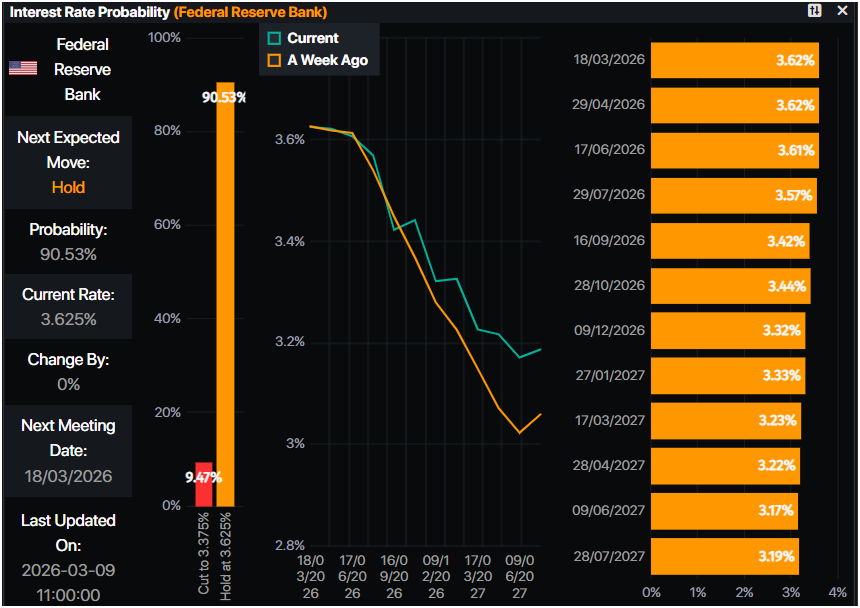
Data-wise, the New York Fed Survey of Consumer Expectations (SCE) showed that one-year inflation expectations in February fell to 3% from 3.1% in January, while three- and five-year forecasts remain steady at 3%.
Up next: US inflation data, Core PCE
In the US, the upcoming schedule includes employment figures, housing statistics such as Existing Home Sales, Building Permits, and Housing Starts, along with consumer inflation data and the Federal Reserve's preferred inflation measure, the Core Personal Consumption Expenditures (PCE) Price Index.
XAU/USD technical outlook: Bullish, but momentum is fading
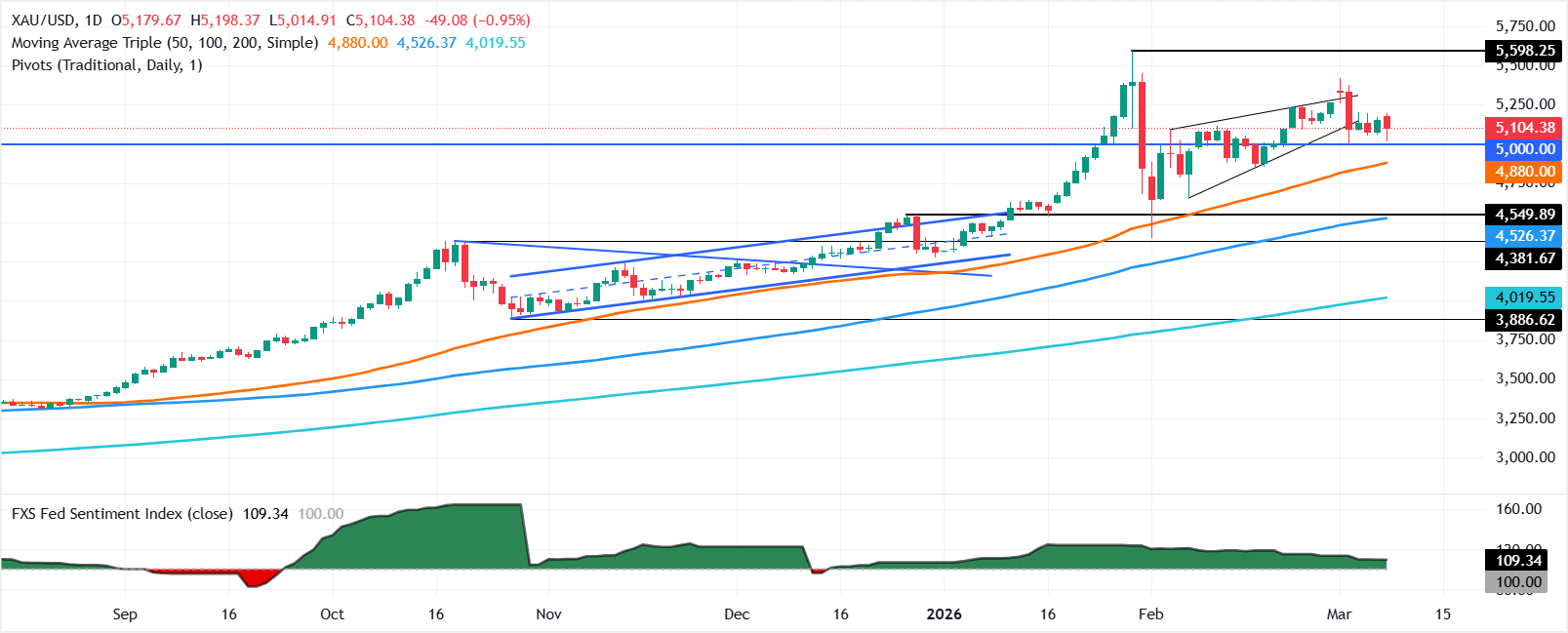
The technical picture shows Gold is upward biased, but failure to clear the $5,200 key resistance area keeps the yellow metal consolidated within the $5,000-$5,194 area. The Relative Strength Index (RSI) shows that buyers are losing momentum, with the index aiming towards its neutral level, failing to clear its latest peak.
If XAU/USD falls below $5,050, the first support would be the $5,000 mark. A breach of the latter will expose the 50-day SMA near $4,868 ahead of the February 17 cycle low at $4,841.
On further strength, if Gold clears $5,100, this opens the door to test $5,150. Once hurdle, the next area of interest would be the March 5 high at $5,194, ahead of the March 4 daily high at $5,206. Up next lies stir resistance like the February 24 high at $5,249 and then $5,300.
Gold FAQs
Gold has played a key role in human’s history as it has been widely used as a store of value and medium of exchange. Currently, apart from its shine and usage for jewelry, the precious metal is widely seen as a safe-haven asset, meaning that it is considered a good investment during turbulent times. Gold is also widely seen as a hedge against inflation and against depreciating currencies as it doesn’t rely on any specific issuer or government.
Central banks are the biggest Gold holders. In their aim to support their currencies in turbulent times, central banks tend to diversify their reserves and buy Gold to improve the perceived strength of the economy and the currency. High Gold reserves can be a source of trust for a country’s solvency. Central banks added 1,136 tonnes of Gold worth around $70 billion to their reserves in 2022, according to data from the World Gold Council. This is the highest yearly purchase since records began. Central banks from emerging economies such as China, India and Turkey are quickly increasing their Gold reserves.
Gold has an inverse correlation with the US Dollar and US Treasuries, which are both major reserve and safe-haven assets. When the Dollar depreciates, Gold tends to rise, enabling investors and central banks to diversify their assets in turbulent times. Gold is also inversely correlated with risk assets. A rally in the stock market tends to weaken Gold price, while sell-offs in riskier markets tend to favor the precious metal.
The price can move due to a wide range of factors. Geopolitical instability or fears of a deep recession can quickly make Gold price escalate due to its safe-haven status. As a yield-less asset, Gold tends to rise with lower interest rates, while higher cost of money usually weighs down on the yellow metal. Still, most moves depend on how the US Dollar (USD) behaves as the asset is priced in dollars (XAU/USD). A strong Dollar tends to keep the price of Gold controlled, whereas a weaker Dollar is likely to push Gold prices up.














