

Gold Price Forecast: 20-day EMA acts as key barrier ahead of Trump’s deadline to Iran
- Gold price rises to near $4,675 ahead of Trump’s final deadline on Iran.
- Iran denies accepting a temporary ceasefire in return for the reopening of Hormuz.
- Tehran wants permanent peace and fees for ships passing through the Hormuz.
Gold price (XAU/USD) trades higher to near $4,675.00, but is broadly sideways, during the European trading session on Tuesday. The yellow metal struggles for direction as investors remain cautious about how the Middle East war will flare after the completion of United States (US) President Donald Trump’s final deadline.
On Monday, US President Trump stated that Tuesday’s deadline is the final one and Iran “can be taken out in one night, and that might be tomorrow night”, if it doesn’t reopen the Strait of Hormuz.

Over the weekend, President Donald Trump announced, through a post on Truth.Social, Iran’s civilian infrastructure would be obliterated if it does not reopen the Hormuz before Tuesday, 08:00 PM ET.
Ahead of Trump’s final deadline, Iran has stated that it won’t accept a temporary ceasefire. Tehran has demanded permanent peace, the guarantee of no repetitive aggression, and compensation for damages. It has also demanded recognition of Iran’s authority on the Strait of Hormuz.
Meanwhile, the US Dollar (USD) has recovered its early losses, following Tehran’s denial of the US temporary ceasefire. As of writing, the US Dollar Index (DXY), which gauges the Greenback’s value against six major currencies, turns flat around 100.00.
Going forward, investors will focus on the Federal Open Market Committee (FOMC) minutes and the Consumer Price Index (CPI) data for March, which will be released on Wednesday and Friday, respectively.
Gold technical analysis
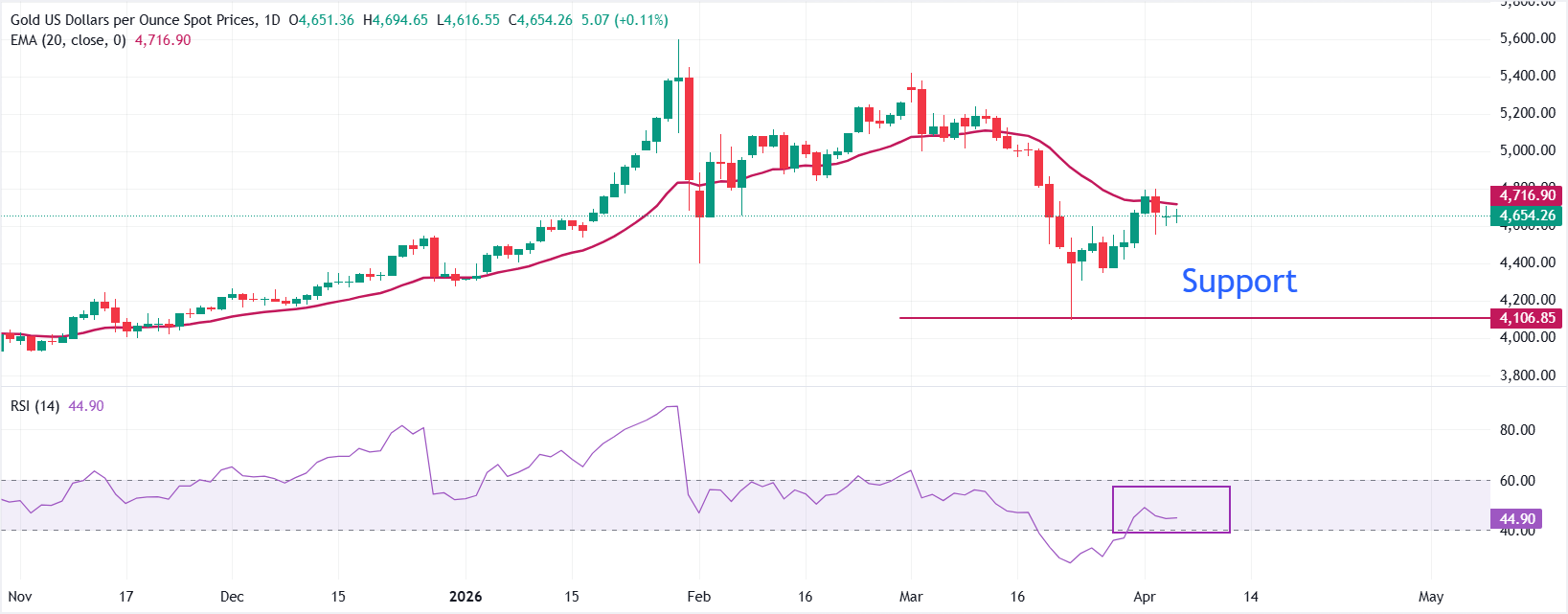
XAU/USD trades marginally higher at around $4,675.00 at the press time. The near-term bias stays neutral with a mild bearish tilt as price holds below the declining 20-day Exponential Moving Average, which caps recovery attempts around the $4,720 area. The recent sequence of lower closes from above $5,300 into the current region underscores persistent downside pressure, even as selling momentum cools.
The 14-day Relative Strength Index (RSI) around 45 remains below the 50 midline, indicating subdued bullish conviction and keeping focus on whether buyers can regain traction above the short-term average.
Initial resistance emerges at the 20-day EMA near $4,720, followed by the recent rebound high around $4,800, where a sustained break would open the way toward the $4,870 region as a stronger upside target. On the downside, immediate support is located at the April 2 low of $4,554, with a breakdown exposing the next bearish objective at $4,490 and then the $4,410 area. A daily close back above $4,720 would ease downside pressure, while a move below $4,650 would confirm continuation of the broader corrective phase.
(The technical analysis of this story was written with the help of an AI tool.)
Gold FAQs
Gold has played a key role in human’s history as it has been widely used as a store of value and medium of exchange. Currently, apart from its shine and usage for jewelry, the precious metal is widely seen as a safe-haven asset, meaning that it is considered a good investment during turbulent times. Gold is also widely seen as a hedge against inflation and against depreciating currencies as it doesn’t rely on any specific issuer or government.
Central banks are the biggest Gold holders. In their aim to support their currencies in turbulent times, central banks tend to diversify their reserves and buy Gold to improve the perceived strength of the economy and the currency. High Gold reserves can be a source of trust for a country’s solvency. Central banks added 1,136 tonnes of Gold worth around $70 billion to their reserves in 2022, according to data from the World Gold Council. This is the highest yearly purchase since records began. Central banks from emerging economies such as China, India and Turkey are quickly increasing their Gold reserves.
Gold has an inverse correlation with the US Dollar and US Treasuries, which are both major reserve and safe-haven assets. When the Dollar depreciates, Gold tends to rise, enabling investors and central banks to diversify their assets in turbulent times. Gold is also inversely correlated with risk assets. A rally in the stock market tends to weaken Gold price, while sell-offs in riskier markets tend to favor the precious metal.
The price can move due to a wide range of factors. Geopolitical instability or fears of a deep recession can quickly make Gold price escalate due to its safe-haven status. As a yield-less asset, Gold tends to rise with lower interest rates, while higher cost of money usually weighs down on the yellow metal. Still, most moves depend on how the US Dollar (USD) behaves as the asset is priced in dollars (XAU/USD). A strong Dollar tends to keep the price of Gold controlled, whereas a weaker Dollar is likely to push Gold prices up.














