

Japanese Yen drifts back to the intervention line, daring Tokyo to act
- The Japanese Yen weakened again on Monday, edging USD/JPY back toward the intervention zone.
- BoJ rate-hike speculation for later this month is the Yen's main domestic support.
- Thursday's wage data and Friday's US payrolls are the decisive catalysts.
The Japanese Yen (JPY) keeps doing the one thing Tokyo least wants: drifting weaker into the zone where intervention becomes a live question. USD/JPY firmed back above 159.50 and pressed toward the 160.00 handle on Monday, the same threshold that triggered official Yen-buying at the end of April. The story has not changed in months. A wide gap between US and Japanese interest rates, a Federal Reserve (Fed) in no hurry to cut, and a Crude Oil bid tied to the Middle East conflict that stings Japan harder than most given its near-total reliance on imported energy. The Yen is weak because the arithmetic says it should be, and official jawboning has not changed the arithmetic.

Intervention only buys time
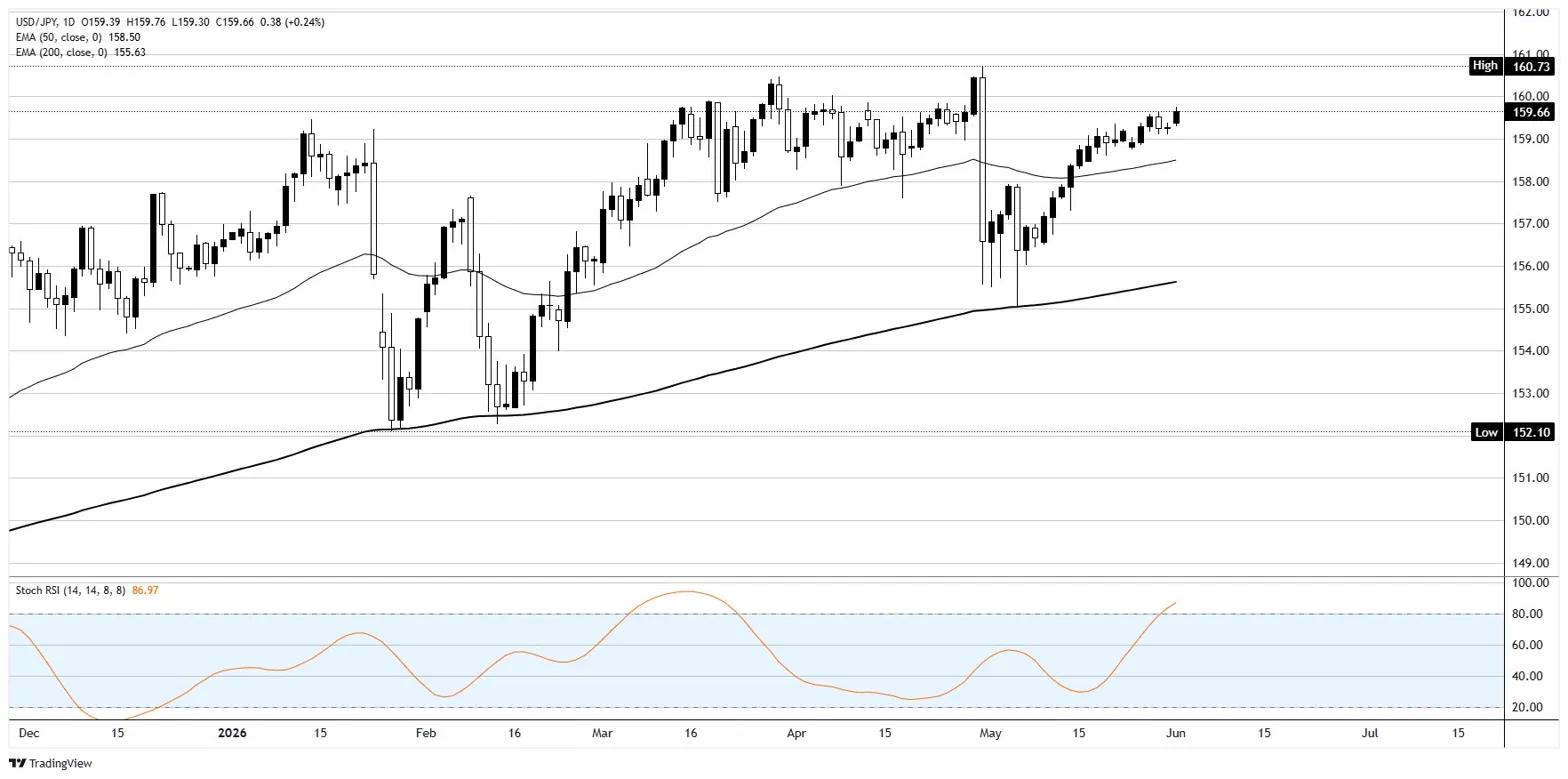
When the Bank of Japan (BoJ) and the finance ministry sold dollars near 160.00 in late April, USD/JPY dropped sharply, briefly trading down near 152.00 before grinding all the way back to the 159.00 area within weeks. The lesson the market took away was not subtle: intervention slows the move, it does not reverse it. The only durable fix for a chronically weak Yen is a narrower rate gap, which means either the Fed starts cutting or the BoJ keeps hiking. Everything else is noise designed to buy time.
The BoJ's slow-motion pivot
The BoJ left its policy rate at 0.75% in late April, but it was a hawkish hold: three members dissented in favour of an immediate hike, the widest split under the current governor. Speculation around a move at this month's meeting has been building, and Thursday's Labor Cash Earnings data feeds directly into the wage-price story the BoJ leans on to justify tightening. A firm wage print would harden June hike bets and give the Yen something real to rally on, for once on its own terms rather than on US Dollar weakness.
Levels and bias
The daily trend is still up, with price holding well above the 50-period Exponential Moving Average (EMA) near 158.50 and the 200 EMA close to 155.50. The catch is that the daily Stochastic Relative Strength Index (Stoch RSI) is deep in overbought territory, so the upside is getting stretched right as 160.00 looms. Resistance is the 160.00 handle and the intervention risk that sits on top of it, then toward 160.50. Support sits at 159.00, then the 50 EMA. Bias stays higher while above 159.00, but chasing strength into 160.00 is a poor risk-reward with Tokyo watching.
The US labor gauntlet
USD/JPY remains as much a US Dollar story as a Yen one, and the week is stacked with American labor data. The Job Openings and Labor Turnover Survey (JOLTS) is due Tuesday, the Automatic Data Processing (ADP) employment report Wednesday, and Nonfarm Payrolls (NFP) on Friday at 12:30 GMT, with consensus near 85K against 115K prior and the unemployment rate seen around 4.3%. A soft payrolls number would pull US yields and the Dollar lower, doing the heavy lifting the BoJ would rather avoid. A strong one pushes USD/JPY straight at the intervention line and squarely into Tokyo's hands.
USD/JPY daily chart
Japanese Yen FAQs
The Japanese Yen (JPY) is one of the world’s most traded currencies. Its value is broadly determined by the performance of the Japanese economy, but more specifically by the Bank of Japan’s policy, the differential between Japanese and US bond yields, or risk sentiment among traders, among other factors.
One of the Bank of Japan’s mandates is currency control, so its moves are key for the Yen. The BoJ has directly intervened in currency markets sometimes, generally to lower the value of the Yen, although it refrains from doing it often due to political concerns of its main trading partners. The BoJ ultra-loose monetary policy between 2013 and 2024 caused the Yen to depreciate against its main currency peers due to an increasing policy divergence between the Bank of Japan and other main central banks. More recently, the gradually unwinding of this ultra-loose policy has given some support to the Yen.
Over the last decade, the BoJ’s stance of sticking to ultra-loose monetary policy has led to a widening policy divergence with other central banks, particularly with the US Federal Reserve. This supported a widening of the differential between the 10-year US and Japanese bonds, which favored the US Dollar against the Japanese Yen. The BoJ decision in 2024 to gradually abandon the ultra-loose policy, coupled with interest-rate cuts in other major central banks, is narrowing this differential.
The Japanese Yen is often seen as a safe-haven investment. This means that in times of market stress, investors are more likely to put their money in the Japanese currency due to its supposed reliability and stability. Turbulent times are likely to strengthen the Yen’s value against other currencies seen as more risky to invest in.














