

Why a hawkish Bank of Japan could trigger the next Bitcoin sell-off
- The Japanese Yen hits a 40-year low of 162.00 against the US Dollar, raising concerns about intervention or additional rate hikes by the Bank of Japan.
- BoJ may sell US Treasuries to buy back Yen, potentially pushing US bond yields higher and making Bitcoin less attractive to investors.
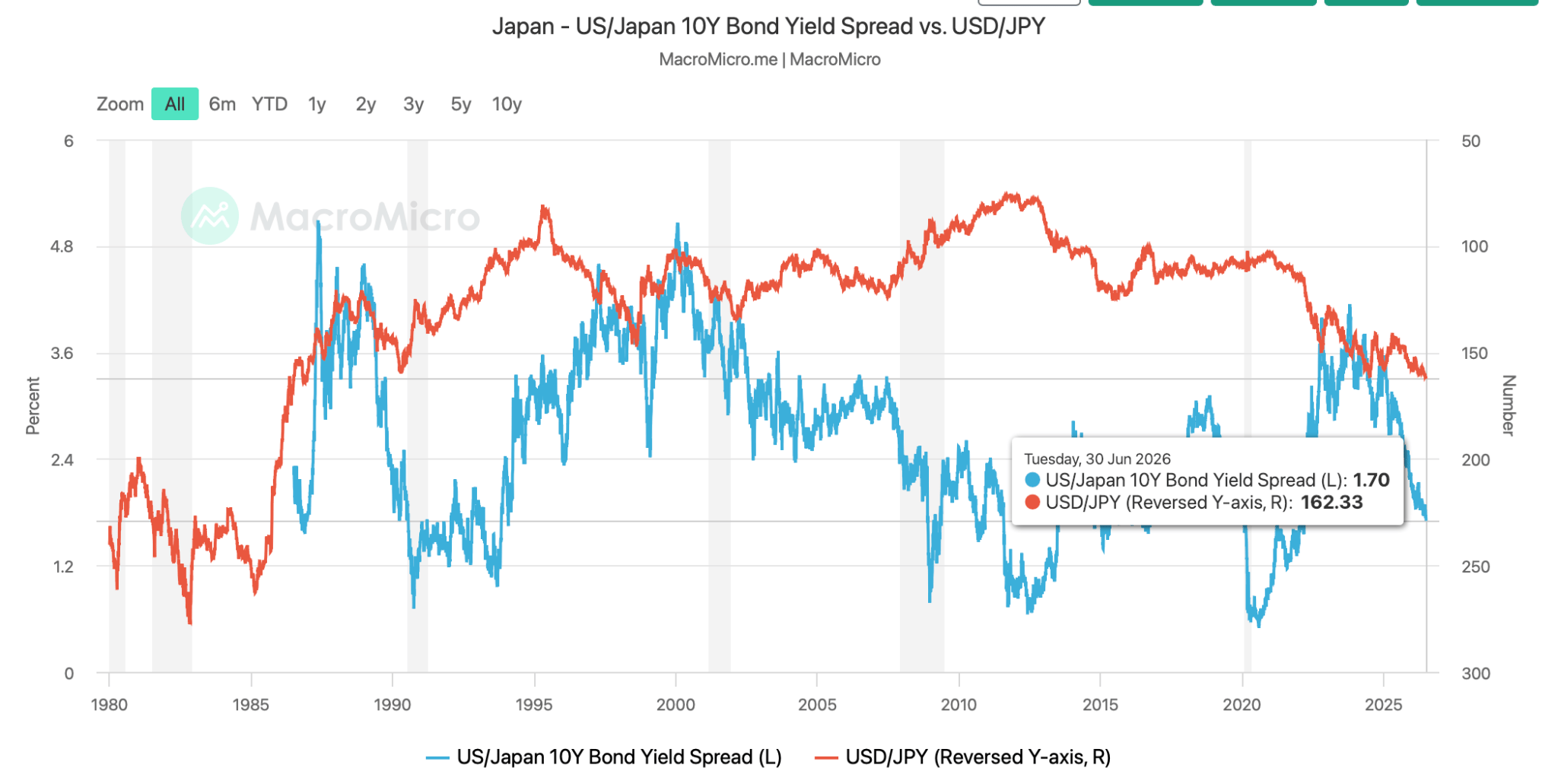
- The US-Japan 10-year bond yield spread has dropped to 1.70%, down from over 4% in late 2023, reflecting reduced incentive for yen carry trades.
- Tighter BoJ policy could trigger Yen carry-trade liquidations, as Bitcoin fell 25%-30% after the bank’s last four rate hikes.
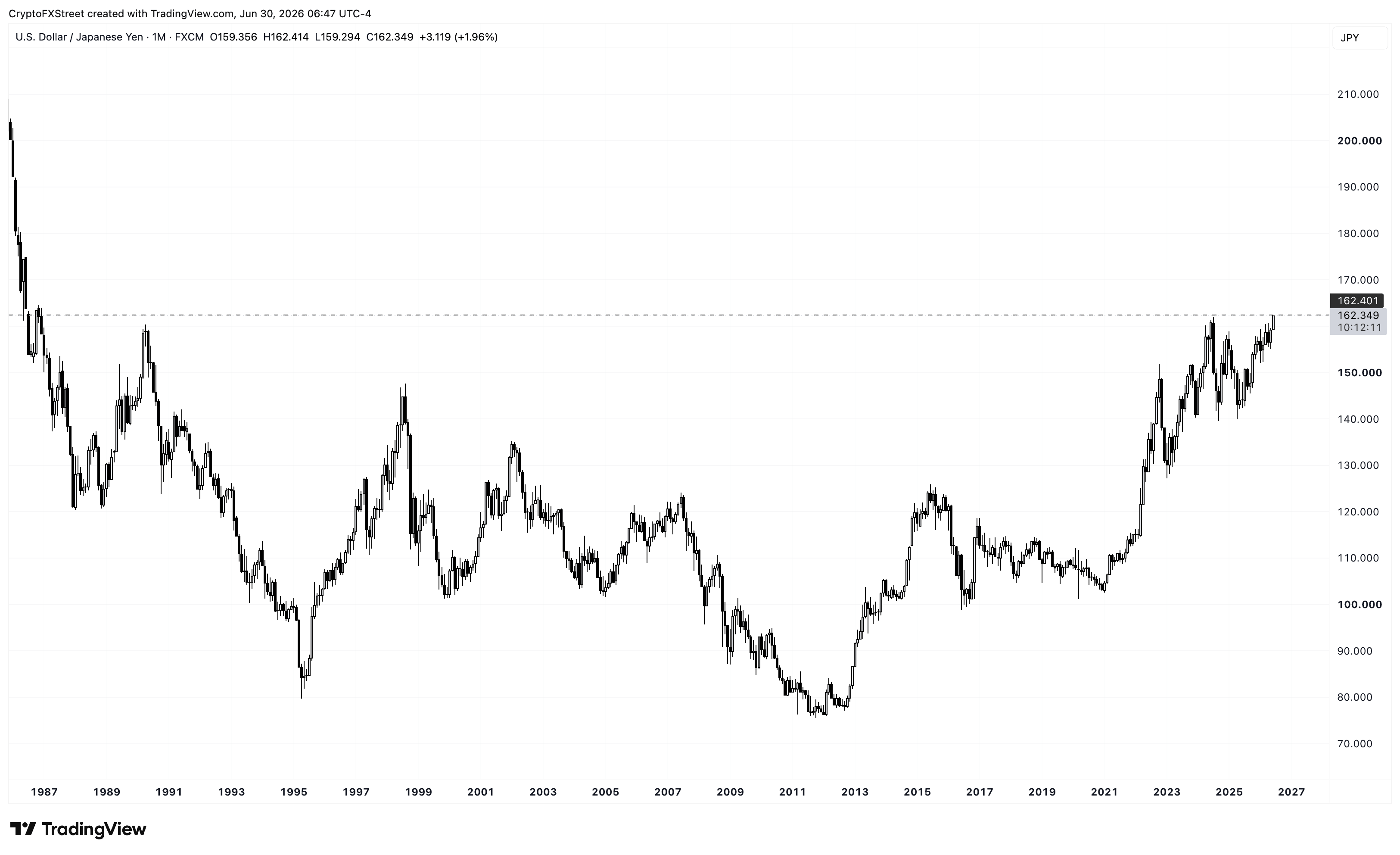
The Japanese Yen (JPY) recorded its lowest level in four decades, at 162.00 against the US Dollar (USD) on Tuesday, raising concerns that the Bank of Japan (BoJ) could intervene to protect the Yen. Tighter BoJ policies could include selling US Treasuries, which could push US bond yields higher amid a contracting US-Japan 10-year bond yield spread, accelerating the unwind pressure on Yen carry trades.
Historically, Bitcoin has dropped 25% to 30% after the last four rate hikes, risking deeper losses as the price consolidates near $60,000 after an over 50 % decline from its record high of $126,199.
Bank of Japan could intervene amid JPY downfall
A weaker Yen against the US Dollar raises the cost of imports in Japan such as energy, food, and raw materials, directly fueling domestic inflation, which is the BoJ's key concern.
To avoid higher inflation, the BoJ is gradually abandoning its ultra-loose monetary policy, making the Yen less attractive for carry trades. Since March 2024, the BoJ has raised the interest rate from negative levels to 1%, with the recent 25-basis-point increase on June 16. Still, Japanese interest rates are significantly lower than the 3.50%-3.75% range set by the US Federal Reserve.
The steady decline of the Yen to a 40-year low of 162.00 against the USD on Tuesday could prompt the BoJ to intervene and protect the local currency, as it has previously done earlier this year. Typical interventions other than rate hikes involve buying back local currency and selling US Treasury bonds, thereby contributing to the increase in US bond yields.
The hawkish leaning in Japan’s monetary policy fuels the unwind pressure on carry trades. The spread between US and Japanese 10-year bond yields has narrowed to 1.70% from over 4% in late 2023, suggesting that the Yen could become less attractive if the Bank of Japan moves further toward and continues to increase rates.
Japanese Finance Minister Satsuki Katayama on Tuesday reiterated that the authorities stood ready to respond appropriately at any time. In addition, Carol Kong, currency strategist at Commonwealth Bank of Australia, said, "It's a question of when, not if, the Ministry of Finance (MOF) intervenes again to support the yen," as previously reported by FXStreet.
Czhang Lin, Head of LBank Labs & LBank Partner, said: “For carry trade shift signals, we watch Yen futures positioning on the CME, CFTC non-commercial net short data, and cross-asset volatility clustering between Nikkei, USD/JPY, and BTC — when all three move in tandem, that's the tell.”
In addition, Lin revealed that intervention risk adds another layer: historically, MOF verbal warnings precede action, so monitoring Japanese finance ministry rhetoric is underrated as an early signal.
Bitcoin’s downside risk deepens amid BoJ intervention risk
Tighter BoJ policy roughly aligns with Yen carry-trade liquidations in the crypto market, which historically has triggered 25% to 30% drawdowns in Bitcoin. The first minor rate hike of 20 basis points on March 19, 2024, raising the BoJ interest rate from -0.1% to 0.1%, coincided with an intraday loss of 8%, which was quickly recovered. However, the 15 basis point increase to around 0.25% on July 31, 2024, came along with a 25% fall in Bitcoin's value within a week.
Meanwhile, the next two rate hikes, of 25 basis points each, led to a more controlled unwinding of Yen carry trades. The rate hike to 0.50% on January 24 led to a 30% decline between late January 2025 and early April 2025, while the jump to 0.75% on December 18, 2025 foreshadowed the pullback to $60,000 in early 2026.
At the time of writing, Bitcoin is trading around $59,000 and has recorded a drawdown of roughly 10% after the recent 25 basis point hike on June 16, raising the interest rate to 1%. Based on the previous rate hikes and the upcoming BoJ intervention risk, a conservative drawdown of roughly 25% could target the August 2024 low of around $49,000.














