
News & AnalysisCareer

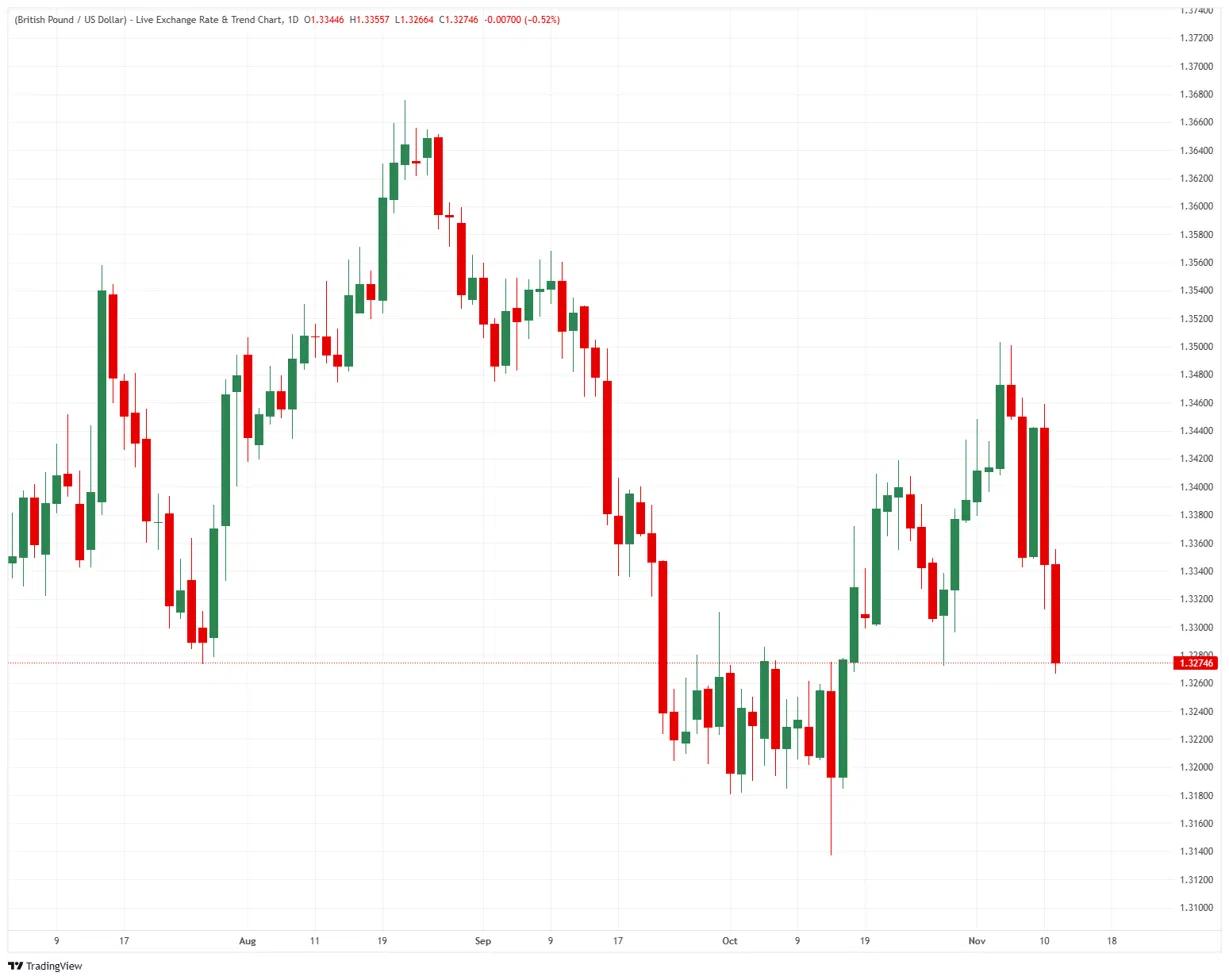
Third-quarter Gross Domestic Product (GDP) on Thursday is forecast to show the UK economy growing faster, and GBP/USD goes into it at its lowest since mid-October. It has fallen for two sessions in a row, from just under 1.3450 at the start of Tuesday to just under 1.3300, and it's trading near the bottom of Wednesday's range.
US consumer prices rose 0.4% in October, more than forecast, and Fed Governor Waller told a Bank of England (BoE) conference in London on Tuesday that a December hike is likely. Traders put a quarter-point Fed hike on December 9 near 90%. That would take the top of the Fed's rate to 4.25%, above the UK's Bank Rate at 4.00%, eight days before the BoE next meets.
The BoE raised the Bank Rate on November 5 in an 8-1 vote, its first hike in more than three years, and GBP/USD has fallen in four of the five sessions since. BoE external member Greene told the Financial Times on Wednesday that UK wage growth is too high and that tightening proactively is appropriate. That's a case for a second hike, made with GBP/USD well below where it was trading before the first.
The Office for National Statistics publishes third-quarter GDP at 07:00 GMT on Thursday, forecast up 0.7% on the quarter after 0.5% and up 1.9% on the year after 1.4%. September's monthly figure is forecast flat after 0.1%, and industrial production is forecast down 0.3% after a 0.8% rise. All of it feeds the BoE's December 17 decision, the UK side of the rate gap.
US jobless claims follow at 13:30 GMT on Thursday, forecast at 195K after 189K, and six Fed officials speak the same day, starting with Cleveland Fed President Hammack at 14:00 GMT. October producer prices are due at 13:30 GMT on Friday, forecast up 0.4% after 1.3%, the last inflation figure of the week before the Fed's December 8-9 meeting.
The climb from the October 14 low near 1.3150 topped out at 1.3500 on November 4 and 5, and GBP/USD has since given back about three fifths of it. That puts it back at the top of the 1.3200-1.3300 band it traded in through the first half of October, before the rally began.
The Pound Sterling (GBP) is the oldest currency in the world (886 AD) and the official currency of the United Kingdom. It is the fourth most traded unit for foreign exchange (FX) in the world, accounting for 12% of all transactions, averaging $630 billion a day, according to 2022 data. Its key trading pairs are GBP/USD, also known as ‘Cable’, which accounts for 11% of FX, GBP/JPY, or the ‘Dragon’ as it is known by traders (3%), and EUR/GBP (2%). The Pound Sterling is issued by the Bank of England (BoE).
The single most important factor influencing the value of the Pound Sterling is monetary policy decided by the Bank of England. The BoE bases its decisions on whether it has achieved its primary goal of “price stability” – a steady inflation rate of around 2%. Its primary tool for achieving this is the adjustment of interest rates. When inflation is too high, the BoE will try to rein it in by raising interest rates, making it more expensive for people and businesses to access credit. This is generally positive for GBP, as higher interest rates make the UK a more attractive place for global investors to park their money. When inflation falls too low it is a sign economic growth is slowing. In this scenario, the BoE will consider lowering interest rates to cheapen credit so businesses will borrow more to invest in growth-generating projects.
Data releases gauge the health of the economy and can impact the value of the Pound Sterling. Indicators such as GDP, Manufacturing and Services PMIs, and employment can all influence the direction of the GBP. A strong economy is good for Sterling. Not only does it attract more foreign investment but it may encourage the BoE to put up interest rates, which will directly strengthen GBP. Otherwise, if economic data is weak, the Pound Sterling is likely to fall.
Another significant data release for the Pound Sterling is the Trade Balance. This indicator measures the difference between what a country earns from its exports and what it spends on imports over a given period. If a country produces highly sought-after exports, its currency will benefit purely from the extra demand created from foreign buyers seeking to purchase these goods. Therefore, a positive net Trade Balance strengthens a currency and vice versa for a negative balance.










The information provided on this website is of a general nature only and does not constitute personal financial advice. Before acting on any information on this website, you should consider the suitability of the information in relation to your objectives, financial situation and needs. Investing in CFDs and FX Margin Contracts carries significant risks and is not suitable for all investors. You may lose more than your initial deposit. You do not own, or have, any interest in the underlying asset. We recommend that you seek independent advice and ensure you fully understand the risks involved before trading. It is important that you read and consider the disclosure document before you acquire any product listed on the website. The information and advertisements offered on this website are not intended for use by any person in any country or jurisdiction where such use would be contrary to local laws and regulations. The Products and Services offered on this website are not intended for residents of the United States, Malaysia and Thailand.
TMGM is authorized and regulated in various jurisdictions.
Trademax Australia Limited, trading as TMGM, is regulated by the Australian Securities and Investments Commission (ASIC), AFSL no. 436416 and is located at Level 28, One International Tower, 100 Barangaroo Avenue, 2000 Sydney, NSW Australia.
Email: support@tmgm.com.au
Trademax Global Limited, trading as TMGM, is authorized and regulated by the Vanuatu Financial Services Commission (VFSC), registration number 40356 and registered at 1276, Kumul Highway, Port Vila, Vanuatu, Republic of Vanuatu.
Email: support@tmgm.com
Trademax Global Markets (SE) Limited, trading as TMGM, is authorized and regulated by the Financial Services Authority (FSA) of Seychelles, with license number SD224. The company is registered at Office No 13, Providence Estate ABIS Centre, Mahe, Seychelles.
Email: support@tmgm.com
Trademax Global Markets (International) Pty Ltd, trading as TMGM, is authorized and regulated by the Financial Services Commission, Mauritius (FSC) with license no. GB22201012, and registered at 33, Edith Cavell Street C/o IQ EQ Fund Services (Mauritius) Ltd Port Louis, 11324 Mauritius.
Email: support@tmgm.com
Copyright © TMGM. All rights reserved


