Primary Products for Silver Trading
Institutional and retail traders access the silver market through distinct vehicles, each with specific liquidity profiles and expiry rules.
Spot Silver CFDs (XAG/USD): This is one of the most common forms of retail trading, trading the current market price for immediate settlement without having to pay for storage of physical Silver Bullion. It offers tight spreads and continuous trading hours, making it ideal for day traders and scalpers.
Silver ETFs: Silver Exchange Traded Funds track the underlying price of silver bullion. In India, these trade on NSE and BSE, with tickers such as SILVERBEES, HDFCSILVER, SBISILVER, SILVER, and SILVER1. They are suitable for swing traders who want exposure without the operational complexity of futures, though they typically do not offer the same leverage profile as CFDs or exchange traded derivatives.
Silver Stocks: One of the most popular Silver Stocks traded are the silver mining stocks. Mining stocks often act as a "leveraged play" on the spot price; once silver rises above a miner's break-even cost, their profit margins—and share prices—can expand disproportionately.
Pro tip: If you want to trade Silver without analyzing individual company’s balance sheets, you can use Silver Mining Stocks ETFs. The ETFMG Prime Junior Silver Miners ETF (SILJ) is a popular ticker for this, it tracks a basket of volatile small-cap explorers/miners (Juniors) that offer high-beta exposure to aggressive silver rallies.
Silver Futures: These are standardized contracts to buy or sell silver at a predetermined price on a future date. In India, silver futures trade on MCX and are quoted in rupees per kg, with common contract sizes such as 30 kg, 5 kg, and 1 kg, plus defined expiry and delivery rules. In global markets, futures also trade on centralized exchanges such as COMEX and NYMEX, with transparent volume and open interest, but they come with expiration dates and potential rollover costs (contango or backwardation).
Silver Trading Strategies
Silver trading strategies focus on capitalizing on price movements using approaches like Range Trading, Breakout Trading, Trend Following. After picking an approach, you will need to analyze the current market before deciding on the timing and price of entry.
Range Trading (The Accumulation Play)
Silver frequently spends weeks trapped between clear Support and Resistance levels. Range traders exploit this by buying at the bottom (Support) and selling at the top (Resistance). This strategy works best during Asian and early European sessions when volume is lower. The key is to place tight stops just outside the range to minimize loss if the floor collapses.
Breakout Trading (Volatility Capture)
When Silver finally leaves a range, the move is often rapid and substantial. Breakout traders wait for the price to breach a key psychological level in the correctly quoted unit, for example round number levels in rupees per kg on MCX (Rs. 300,000), with volume confirmation. Unlike range trading, you are entering with momentum.
Pro Tip: Silver is infamous for "Fakeouts" (false breakouts). Always wait for a candle close above the breakout level on the H4 or Daily chart before committing capital, rather than chasing the initial wick.
Trend Following (Riding the Industrial Cycle)
This approach aligns with longer-term macro drivers. Since industrial demand (solar, electronics) drives prolonged trends, traders use Moving Averages (like the 50-day and 200-day SMA) to identify the dominant direction. In this strategy, you are not looking for tops or bottoms; you are entering on pullbacks to the average during an established uptrend.
Silver Trading vs Silver Investing
Silver Investing:
Physical Bullion
Before executing a trade, you must distinguish between investment and speculation. Physical Silver involves buying bars or coins; it is a long term store of value with premiums, 3% GST on purchase, and storage and resale frictions, offering no leverage.
Silver ETFs
Exchange-Traded Funds (ETFs) like iShares Silver Trust (SLV) for high liquidity, and investing in silver mining stocks or ETFs. The main strength of investing using Silver ETFs is that ETFs provide exposure without storage costs or security concerns.
Silver Trading:
Silver trading involves using many instruments including silver stocks, silver ETFs and of course, Silver CFDs (Contracts for Difference). Silver CFDs are more suited for beginners, because it allows you to trade price movements without ownership.
An added benefit of trading Silver CFDs is that besides buy low sell high, CFDs also enable short selling (profiting when prices drop) and the use of leverage, where a small deposit controls a larger position size. For active traders seeking to capture short-term volatility, CFDs or Spot Silver offer superior liquidity and lower entry costs compared to physical dealers.
Pro Tip: When trading Spot Silver (XAG/USD), always check the Swap Rates (overnight financing); unlike physical holdings, holding leveraged positions long-term can erode profits due to negative carry.
Key Steps for Trading Silver
Choose your market and product
Spot Silver CFDs XAG USD are built for short term trading with tight spreads and fast execution. Futures are standardized contracts on exchanges such as MCX and NYMEX. ETFs and mining stocks are better for longer holding periods when you want price exposure without leverage.
Choose a broker that matches the product
For CFDs, choose a regulated CFD broker with reliable spreads, transparent swap rates, and strong risk controls.
For futures, choose a futures or commodities broker that offers access to MCX or NYMEX and supports the contract size you intend to trade.
For ETFs and stocks, use a stockbroker that provides access to the exchange where the ticker is listed.
Open the right account
CFDs usually come with margin trading accounts that allow leverage.
Futures require a commodities or derivatives enabled account with exchange permissions for MCX.
ETFs and stocks require a securities trading account, and in India this typically means a Demat account plus a linked trading account.
Decide your trading style and timeframe
Day trading focuses on intraday momentum and liquidity, often using spot CFDs or the most liquid futures contracts.
Swing trading holds positions for days to weeks, often using ETFs, longer timeframe CFD setups, or futures with a clear rollover plan.
Place the trade with a risk first checklist
Entry: Define the exact level and the invalidation point.
Size: Calculate position size from maximum loss per trade, not from a fixed lot size.
Stop loss: Place it immediately based on structure, not emotion.
Take profit: Set a target based on the next major level or expected range.
Order type: Use limit orders for precision in ranges and stop orders for breakout confirmation.
Market Hours and Why They Matter
Silver trades in different time windows depending on the instrument. On MCX, bullion and other non-agri commodities trade Monday to Friday from 9:00 a.m. to 11:30 p.m., and the close can extend to 11:55 p.m. during the US daylight saving period.
Liquidity also changes sharply by session, with spreads and slippage usually worsening during quiet hours and improving when the main US and Europe flows overlap.
Market Drivers: What Moves Silver Price?
Understanding silver requires analyzing its unique dual identity as both a precious metal and an industrial commodity.
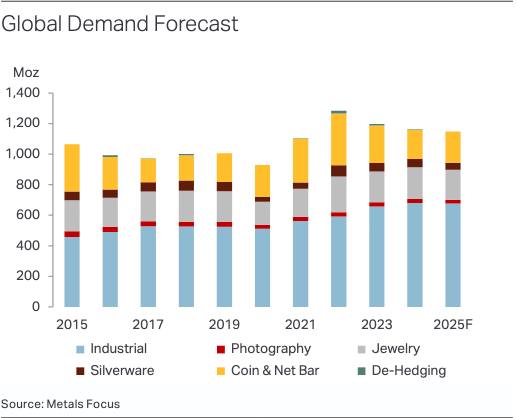
Figure: A bar chart with distribution of use cases of Global Silver Demand from The Silver Institute’s: World Silver Survey 2025.
Industrial Demand: Unlike gold, over 50% of silver demand stems from industrial applications, specifically photovoltaics (solar panels) and electronics. Consequently, silver prices are highly sensitive to global manufacturing data (PMI) and economic growth cycles in major hubs like China and the US.
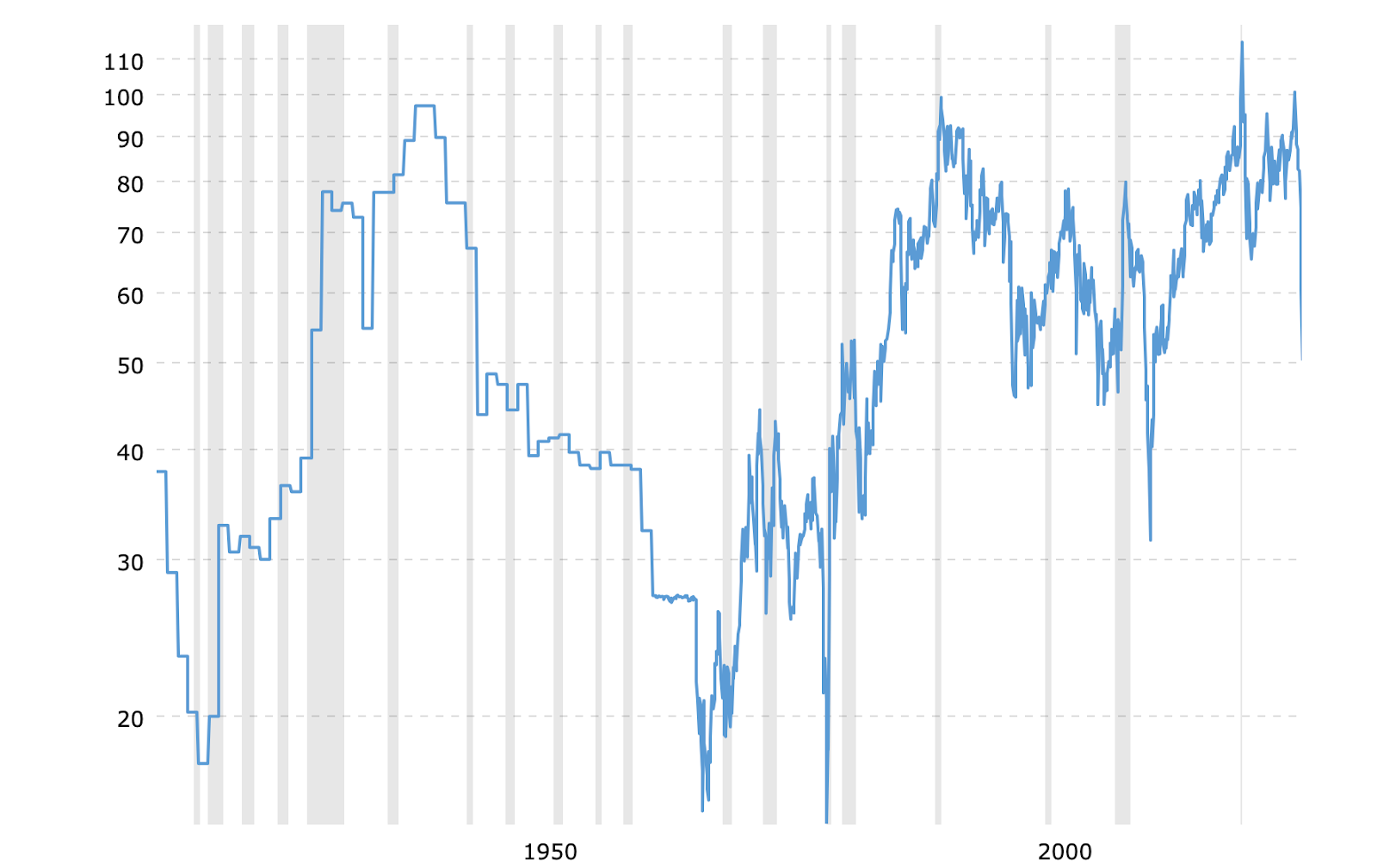
Figure: This chart tracks the current and historical ratio of gold prices to silver prices. Historical data goes back to 1915. Sources: The MacroTrends.net
The Most Important Precious Metal Tool – Gold-Silver Ratio: This metric measures how many ounces of silver it takes to buy one ounce of gold. A high ratio often signals that silver is undervalued relative to gold, potentially triggering a reversion-to-mean trade where institutional algorithms buy silver and sell gold.
Important: Silver is notoriously less liquid than Gold (XAU/USD), meaning it is more prone to Slippage during high-impact news events like NFP or CPI releases.
Analyzing the Market: Fundamentals & Technicals
Before executing any strategy, you must gauge the market environment. This involves a dual-layer analysis:
Fundamental Analysis: Monitor LBMA (London Bullion Market Association) stock levels and global industrial output reports. A drop in visible stockpiles often precedes a supply crunch squeeze.
You can learn how fundamental analysis on silver trading is done in our 2026 forecast article on Silver Prices which also explains silver trading approaches.
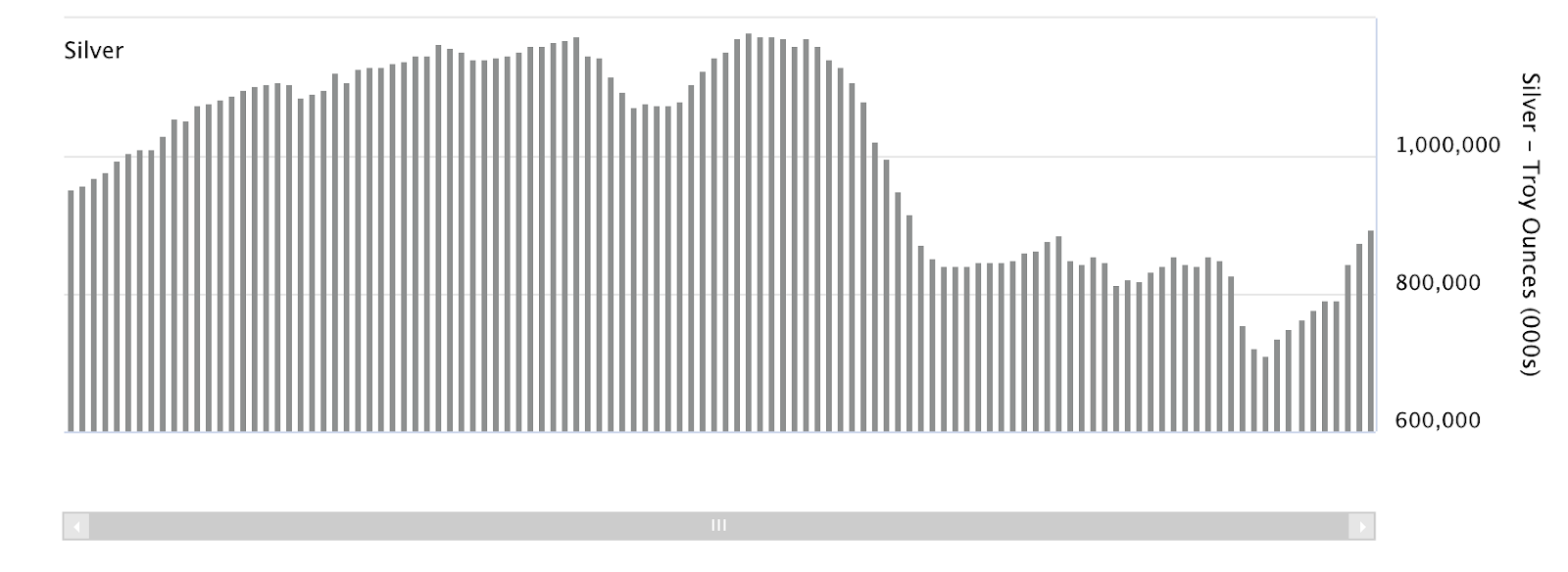
Figure: The data represents the volume of Loco London gold and silver held in the London vaults offering custodian services. Source: LBMA London Vault Data
Technical Analysis: Use the Gold-Silver Ratio to determine relative value. If the ratio hits historical highs (e.g., 80:1), Silver is statistically undervalued, signaling a potential mean-reversion, giving you a potential buy opportunity regardless of the specific chart pattern.
Risk Management & Volatility
Silver's volatility is famously higher than gold's ("Gold on steroids"), necessitating stricter risk controls.
Leverage Management: While leverage amplifies gains, it also accelerates losses. Traders should utilize Guaranteed Stop Loss Orders (GSLO) where available to protect against market gaps, especially over weekends when geopolitical news can cause prices to jump past standard stops.
Position Sizing: Due to silver's wide daily ranges, standard lot sizes used in Forex may expose you to excessive risk. It is critical to calculate position size based on dollar risk per trade rather than a fixed lot count, ensuring that a typical 2-3% daily move does not trigger a margin call.