

A crushed US Dollar sends Gold into a rally above $4,400
- Gold rallies above $4,420 as US Dollar weakness lifts bullion.
- Rising long-end yields cap upside near the $4,500 threshold.
- Fed minutes and Iran headlines may drive next market catalysts.
Gold (XAU/USD) price rises over 1% on Monday amid overall US Dollar (USD) weakness and lower US Treasury yields, following last week’s soft inflation data that reduced speculation of a hawkish Federal Reserve (Fed), . The XAU/USD trades at $4,422 after bouncing off daily lows of $4,367.
XAU/USD advances as softer inflation trims Fed bets despite rising yields

The US Dollar Index (DXY), which tracks the performance of the buck’s value against six currencies, is down 0.37% at 99.53, a tailwind for the precious metal. The US 10-year T-note yield, although rising over 2.5 basis points to 4.718%, caps Gold’s advance towards the $4,500 mark.
US Treasury yields at the long end of the curve, the 30-year, are reaching 2007 highs. Bloomberg reported that it reflects “investor angst over the surging national debt, a flood of long-dated bond sales and inflation that’s been stuck” above the Federal Reserve’s 2% for the past five years.
Last week’s consumer- and producer-side inflation triggered an investor reaction to trim Fed-hawkish bets. Fears that prices will not resume declines in the near term are fueled by the lack of progress in US-Iran talks in the Middle East.
Crude prices remain on the front seat, with West Texas Intermediate (WTI) surging over 2.30% to $84.35 per barrel.
Mixed geopolitical signals suggest that Iran is shifting its policy from defensive to an offensive one. The Iranian Foreign Ministry stated that the “Islamabad agreement has not collapsed and the possibility of returning to it remains,” via Al Arabiya.
In the meantime, Investors see a nearly 69% chance that the Fed will hold rates unchanged, while the odds for the December meeting continue to price in a 66% chance of a 25-basis-point rate hike, according to Prime Terminal.
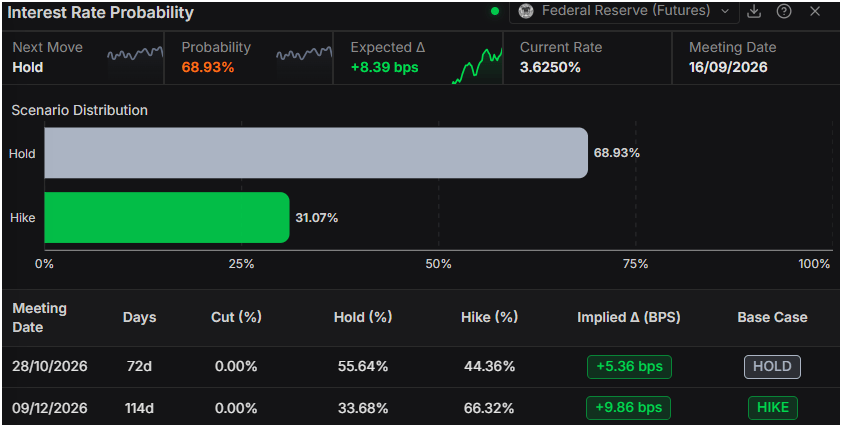
Markets are now looking forward to the Fed's July meeting minutes, set to be released on Wednesday, to gain more insight into policymakers' monetary stance.
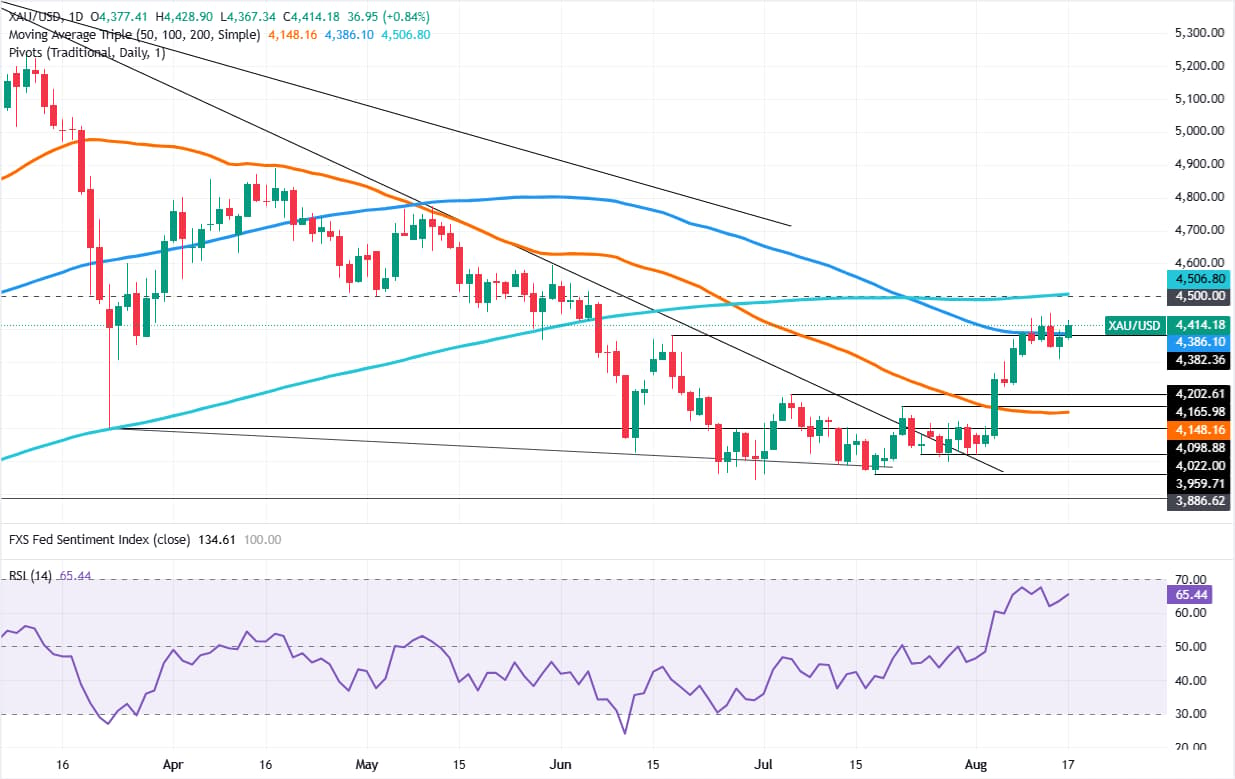
XAU/USD technical analysis: Gold surpasses the 100-day SMA, eyes on $4,500
Gold price has reclaimed the $4,400 figure and is on its way to clearing the 100-day Simple Moving Average (SMA) at $4,386, as part of a confluence of technical levels, which capped bullion’s price in the short term.
Worth noting that momentum is bullish, as depicted in the Relative Strength Index (RSI). This confirms that the uptrend is in place, though traders must clear the $4,500 milestone, followed by the 200-day SMA at $4,506. On further strength, the next resistance is the $4,600 mark.
For a bearish reversal, Gold needs to drop below the 100-day SMA, followed by the July 6 high at $4,202, followed by the 50-day SMA at $4,146 and $4,100.
Gold FAQs
Gold has played a key role in human’s history as it has been widely used as a store of value and medium of exchange. Currently, apart from its shine and usage for jewelry, the precious metal is widely seen as a safe-haven asset, meaning that it is considered a good investment during turbulent times. Gold is also widely seen as a hedge against inflation and against depreciating currencies as it doesn’t rely on any specific issuer or government.
Central banks are the biggest Gold holders. In their aim to support their currencies in turbulent times, central banks tend to diversify their reserves and buy Gold to improve the perceived strength of the economy and the currency. High Gold reserves can be a source of trust for a country’s solvency. Central banks added 1,136 tonnes of Gold worth around $70 billion to their reserves in 2022, according to data from the World Gold Council. This is the highest yearly purchase since records began. Central banks from emerging economies such as China, India and Turkey are quickly increasing their Gold reserves.
Gold has an inverse correlation with the US Dollar and US Treasuries, which are both major reserve and safe-haven assets. When the Dollar depreciates, Gold tends to rise, enabling investors and central banks to diversify their assets in turbulent times. Gold is also inversely correlated with risk assets. A rally in the stock market tends to weaken Gold price, while sell-offs in riskier markets tend to favor the precious metal.
The price can move due to a wide range of factors. Geopolitical instability or fears of a deep recession can quickly make Gold price escalate due to its safe-haven status. As a yield-less asset, Gold tends to rise with lower interest rates, while higher cost of money usually weighs down on the yellow metal. Still, most moves depend on how the US Dollar (USD) behaves as the asset is priced in dollars (XAU/USD). A strong Dollar tends to keep the price of Gold controlled, whereas a weaker Dollar is likely to push Gold prices up.













