

Trading
Explore a wide range of markets with competitive pricing, deep liquidity, and advanced trading tools.
Learn More 
Platform
Trade seamlessly with TMGM's powerful platform, built for speed, precision, and a superior trading experience.
Learn More Trading Platform
Academy
Learn the fundamentals of trading with beginner-friendly resources, including guides, webinars, and market insights.
Learn More News & Analysis
Get real-time market updates and expert analysis to stay ahead of trading opportunities
Learn More News & Analysis
About
Learn what sets TMGM apart — our global presence, regulatory strength, and commitment to innovation in trading.
Learn More Why Choose TMGM
Sponsorship
Australian Dollar falls following RBA’s 25 bps rate hike to 4.85%
- Selling pressure weighs on the Australian Dollar against its peers following the RBA’s policy announcement.
- A widely anticipated 25 bps increase by the RBA takes the OCR to 4.85%.
- Inflation could stay above 3% in 2027, the RBA has indicated.
Selling pressure is weighing on the Australian Dollar (AUD) against other currencies following the Reserve Bank of Australia’s (RBA) interest rate announcement. The Australian currency has slipped 0.25% against the US Dollar (USD), trading near 0.6975.
How Is the Australian Dollar Performing Today?
The Australian Dollar recorded its weakest performance against the Canadian Dollar. Today’s percentage movements in the Australian Dollar (AUD) against the major currencies listed are set out in the table below.
| USD | EUR | GBP | JPY | CAD | AUD | NZD | CHF | |
|---|---|---|---|---|---|---|---|---|
| USD | 0.00% | 0.00% | -0.03% | -0.09% | 0.20% | -0.03% | -0.01% | |
| EUR | -0.01% | 0.00% | -0.05% | -0.10% | 0.22% | -0.05% | -0.02% | |
| GBP | -0.00% | -0.00% | -0.06% | -0.09% | 0.19% | -0.07% | -0.01% | |
| JPY | 0.03% | 0.05% | 0.06% | -0.04% | 0.24% | 0.02% | 0.05% | |
| CAD | 0.09% | 0.10% | 0.09% | 0.04% | 0.29% | 0.05% | 0.09% | |
| AUD | -0.20% | -0.22% | -0.19% | -0.24% | -0.29% | -0.23% | -0.20% | |
| NZD | 0.03% | 0.05% | 0.07% | -0.02% | -0.05% | 0.23% | 0.04% | |
| CHF | 0.00% | 0.02% | 0.01% | -0.05% | -0.09% | 0.20% | -0.04% |
Percentage movements between major currencies are displayed in the heat map. Select the base currency in the left-hand column and the quote currency in the top row. For instance, choosing the Australian Dollar on the left and following its row across to the US Dollar gives the percentage change for AUD (base)/USD (quote) in the corresponding cell.

With a 25 basis points (bps) increase, the RBA has taken its Official Cash Rate (OCR) to 4.85%. The move marks the central bank’s fifth 25 bps interest rate increase this year.
Persistent acceleration in domestic inflationary pressures had already led to expectations of tighter monetary conditions from the Australian central bank. Data released last week by the Australian Bureau of Statistics showed Consumer Price Index (CPI) growth of 1.3% in the third quarter of this year, matching estimates and picking up from the previous reading of 0.6%.
Despite five rate increases this year, the prospect of further monetary tightening by the RBA has strengthened after the central bank indicated that inflation risks remain tilted to the upside. Its monetary policy statement said, “With revised inflation outlook and ongoing upside risks, board decides further tightening of financial conditions is necessary to support inflation return to target.” The central bank also said, “Inflation now expected to stay above 3% for next year with rising risk of entrenched higher inflation expectations.”
For the US Dollar, attention is turning to the United States (US) Midterm elections and a key economic data release.
September’s US JOLTS Job Openings report, due later in the day at 15:00 GMT, will be in focus for investors. Expectations are for US employers to have advertised 7.13 million new jobs, marginally above August’s 7.097 million.
AUD/USD Technical Analysis: Can the Pair Reclaim Its 20-Day EMA?
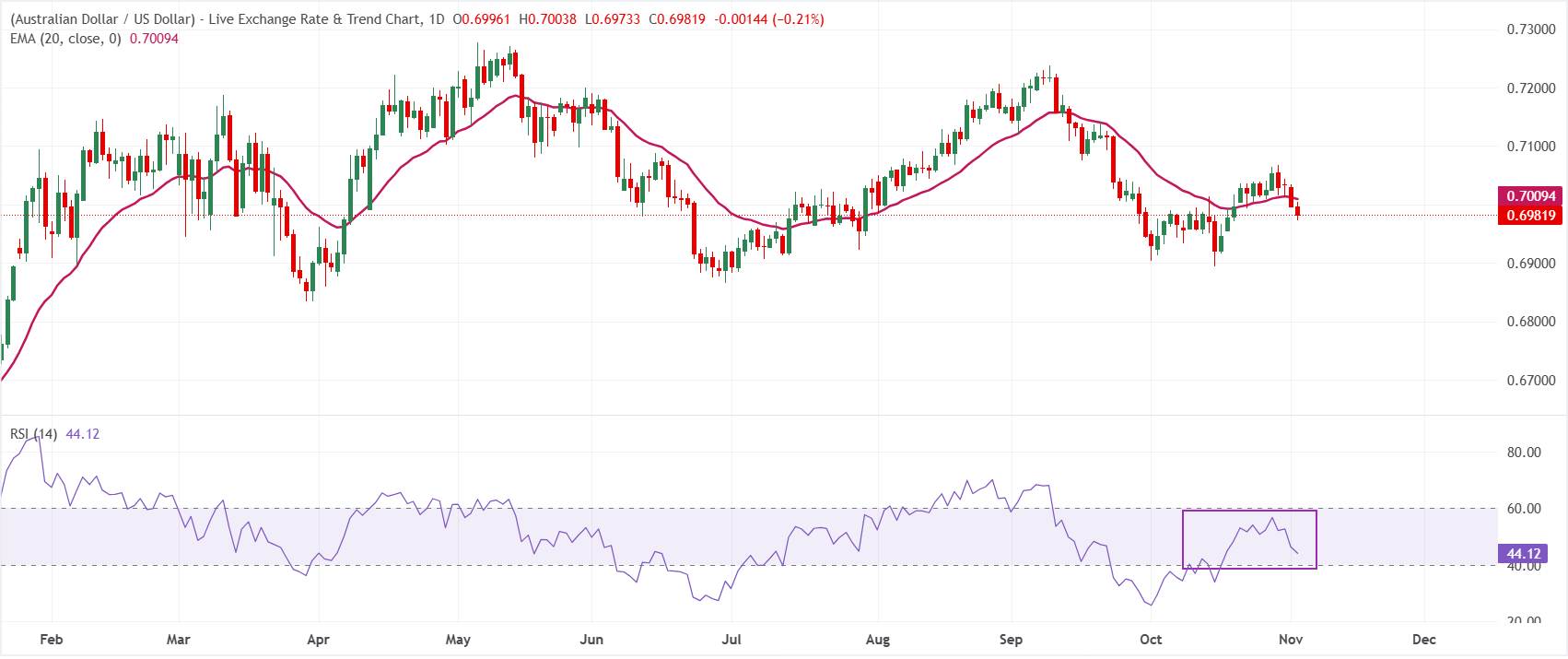
A near-term bearish bias persists on the daily AUD/USD chart, with the pair trading at 0.6982, below its 20-day Exponential Moving Average (EMA) of 0.7009. Failure to regain this short-term trend indicator continues to restrict gains. Meanwhile, a Relative Strength Index (RSI) reading of 44, below neutral, points to weak bullish momentum rather than a clearly oversold market.
To relieve the prevailing downward pressure, AUD/USD would need a daily close above immediate resistance at the 20-day EMA of 0.7009. The supplied dataset does not identify clear nearby structural support levels, leaving the response to this overhead moving average as the main focus. An inability to clear it would likely extend the broader sideways-to-bearish tone.
(The technical analysis of this story was written with the help of an AI tool. Know more.)
Economic Data Indicator
How Does the RBA Interest Rate Decision Affect AUD?
At the conclusion of each of its eight scheduled meetings a year, the Reserve Bank of Australia (RBA) announces its interest rate decision. A rate increase accompanied by a hawkish assessment of the economy’s inflation outlook is generally positive for the Australian Dollar (AUD). Conversely, an unchanged rate or a cut, alongside a dovish assessment of the Australian economy, is regarded as negative for AUD.
Learn more.Latest release: Tue 03 Nov 2026 03:30
Release frequency: Irregular
Reported figure: 4.85%
Market consensus: 4.85%
Prior reading: 4.6%
Data source: Reserve Bank of Australia
POPULAR ARTICLES
1WTI Price Forecast: Can modest gains above $96.00 hold as US-Iran peace hopes limit upside?2India Gold price today: FXStreet data shows a decline in Gold prices3How are Fed hike bets driving gold back below $3,950 ahead of US midterm elections?4Ripple and Stellar outlook: Can XRP and XLM halt declines as bearish signal strengthens?5Australian Dollar falls following RBA’s 25 bps rate hike to 4.85%6Pi Network Price Forecast: Can PI keep defending key support as crypto sentiment deteriorates?7Why is the Australian Dollar easing against the Japanese Yen as the RBA raises rates to 4.85% in its fifth hike this year?8Why is the Australian Dollar falling against the New Zealand Dollar despite an RBA rate hike?9Gold Price Forecast: XAU/USD stays near $3,950, retaining Monday’s gains amid hopes of a US-Iran deal


Get Started!
Sign up and access the Global Markets in less than 3 minutes

Connect With Us












The information provided on this website is of a general nature only and does not constitute personal financial advice. Before acting on any information on this website, you should consider the suitability of the information in relation to your objectives, financial situation and needs. Investing in CFDs and FX Margin Contracts carries significant risks and is not suitable for all investors. You may lose more than your initial deposit. You do not own, or have, any interest in the underlying asset. We recommend that you seek independent advice and ensure you fully understand the risks involved before trading. It is important that you read and consider the disclosure document before you acquire any product listed on the website. The information and advertisements offered on this website are not intended for use by any person in any country or jurisdiction where such use would be contrary to local laws and regulations. The Products and Services offered on this website are not intended for residents of the United States, Malaysia and Thailand.
TMGM is authorized and regulated in various jurisdictions.
Trademax Australia Limited, trading as TMGM, is regulated by the Australian Securities and Investments Commission (ASIC), AFSL no. 436416 and is located at Level 28, One International Tower, 100 Barangaroo Avenue, 2000 Sydney, NSW Australia.
Email: support@tmgm.com.au
Trademax Global Limited, trading as TMGM, is authorized and regulated by the Vanuatu Financial Services Commission (VFSC), registration number 40356 and registered at 1276, Kumul Highway, Port Vila, Vanuatu, Republic of Vanuatu.
Email: support@tmgm.com
Trademax Global Markets (SE) Limited, trading as TMGM, is authorized and regulated by the Financial Services Authority (FSA) of Seychelles, with license number SD224. The company is registered at Office No 13, Providence Estate ABIS Centre, Mahe, Seychelles.
Email: support@tmgm.com
Trademax Global Markets (International) Pty Ltd, trading as TMGM, is authorized and regulated by the Financial Services Commission, Mauritius (FSC) with license no. GB22201012, and registered at 33, Edith Cavell Street C/o IQ EQ Fund Services (Mauritius) Ltd Port Louis, 11324 Mauritius.
Email: support@tmgm.com
Copyright © TMGM. All rights reserved