

Trading
Explore a wide range of markets with competitive pricing, deep liquidity, and advanced trading tools.
Learn More 
Platform
Trade seamlessly with TMGM's powerful platform, built for speed, precision, and a superior trading experience.
Learn More Trading Platform
Academy
Learn the fundamentals of trading with beginner-friendly resources, including guides, webinars, and market insights.
Learn More News & Analysis
Get real-time market updates and expert analysis to stay ahead of trading opportunities
Learn More News & Analysis
About
Learn what sets TMGM apart — our global presence, regulatory strength, and commitment to innovation in trading.
Learn More Why Choose TMGM
Sponsorship
Why is the Japanese Yen still weakening with the Bank of Japan set for a December rate hike?
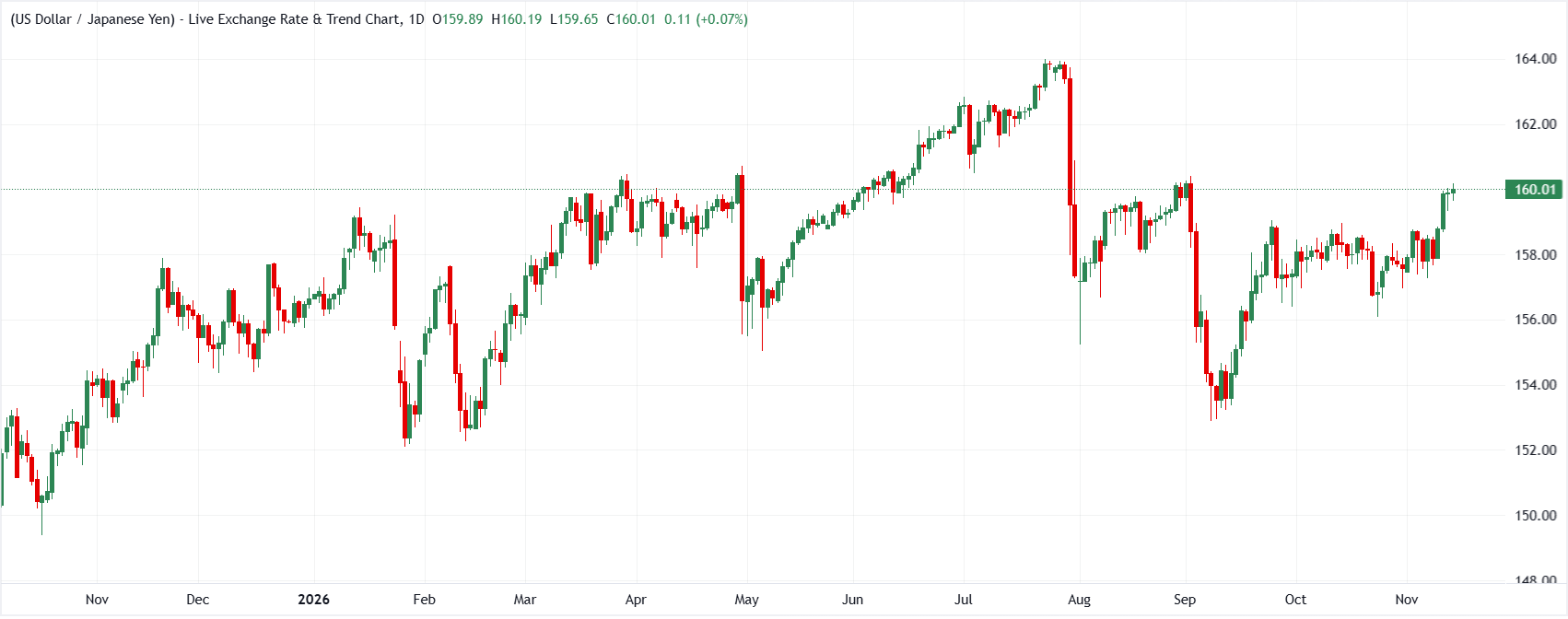
Pressure on the Japanese Yen (JPY) continues near multi-month lows, with USD/JPY moving beyond 160.00 for a second consecutive session and drawing warnings from Japanese Finance Minister Katayama over one-sided and rapid foreign exchange moves. Expectations of a 25 bps Bank of Japan (BoJ) rate hike in December are supported by resilient domestic activity, including projected Q3 real GDP growth of 0.8% QoQ saar, and inflation above target. However, upward revisions to Federal Reserve (Fed) tightening expectations are offsetting that domestic policy support. The question for institutional strategists at DBS Group Research, Societe Generale, and Commerzbank is whether technical breakouts above 160.00 will prolong near-term Yen weakness towards 162.20, or whether changes in Japan’s interest rate landscape will underpin a longer-term JPY recovery.

Will firm growth and above-target inflation support a December BoJ rate hike? DBS expects so
AI-led demand for exports and wage-driven domestic consumption should support third-quarter real GDP growth of 0.8% QoQ saar in Japan, according to economists at DBS Group Research. Their October trade projections point to a wider deficit of JPY1.2 trillion, even with exports growing 17% YoY. Nevertheless, inflation remaining above target, fuelled by higher energy costs and Yen weakness, should strengthen the argument for a 25 bps Bank of Japan rate increase in December.
"Real GDP is expected to expand by 0.8% qoq saar in 3Q, broadly in line with trend... October trade data are likely to show export growth remaining solid at 17% yoy, but the trade deficit widening to JPY1.2tn... Overall, these data should reinforce the case for a 25bp BOJ rate hike at the December policy meeting, with growth around trend, inflation above target, and continued pressure on external balance/exchange rate."
Could USD/JPY’s break above 160 extend Yen losses towards 162.20? Societe Generale flags the risk
Having cleared the top of its narrow consolidation range and regained its 200-day moving average, USD/JPY traded above 160.00 for a second successive day, observe Kenneth Broux and colleagues at Societe Generale. Verbal warnings from Finance Minister Katayama subsequently moderated the gains. The 200-day SMA around 158.70 provides initial support; if the advance persists, the Japanese Yen remains exposed to key resistance levels at 160.40/160.70 and 162.20.
"USD/JPY witnessed a sharp rebound in September and evolved within a narrow consolidation. It has now broken out above the upper limit of this rang denoting possibility of extension in bounce. The next potential hurdles could be located at April high of 160.40/160.70 and projections near 162.20... The pair has reclaimed the 200-DMA. If a short-term pullback develops, the moving average at 158.70 could be an important support... USD/JPY: 159.66 - 160.19 overnight range. Spot trades through 160 for second day before traders pare back on warning by FinMin Katayama one-sided action and rapid forex moves. Support 158.70, resistance 160.70."
Can the Yen recover as Fed-BoJ policies converge? Commerzbank sees near-term limits before structural gains
An additional Federal Reserve rate hike now expected in March would offset the currency impact of anticipated Bank of Japan increases in December and next spring, argues Volkmar Baur at Commerzbank. In the bank’s assessment, tightening by both central banks represents policy convergence, not divergence, leaving little scope for near-term Japanese Yen gains. It forecasts only a modest move towards 155.00 by mid-2027. Over the longer term, however, structurally more attractive domestic bond yields should underpin a sustained JPY recovery.
"This reassessment of our US central bank expectations naturally impacts our forecast for the Japanese yen as well. Our economists no longer expect the US central bank to halt its interest rate hikes in December. Instead, they have factored in a further rate rise by the Fed in March... While we also expect the Bank of Japan to implement two further rate rises - in December and in spring next year - this no longer favours the Japanese yen. Rather, it signals a convergence between the central banks, which will likely have little impact on the currency... Consequently, we see little potential for the Japanese yen in the near future. In recent days, the yen has already weakened slightly due to rising market expectations regarding the Fed, and is currently trading just below USD-JPY 160. By the middle of next year, we now expect only a slight appreciation towards 155... In the longer term, however, we continue to expect the JPY to strengthen. The structural shift in Japan’s interest rate landscape means that domestic bonds are once again significantly more attractive, particularly for Japanese investors."
What does this mean for the Yen?
Near 160.00, the Japanese Yen remains caught between improving domestic macroeconomic fundamentals and sustained pressure from overseas interest rates. For DBS Group Research, GDP growth around trend at 0.8% QoQ saar and persistent inflation provide firm grounds for a 25 bps BoJ rate increase in December. By contrast, Societe Generale cautions that USD/JPY’s technical break above its 200-day SMA at 158.70 exposes the Yen to tests of 160.40/160.70 and 162.20, unless official intervention stops the advance. The broader constraint, according to Commerzbank, is parallel Federal Reserve tightening into March, which will limit near-term JPY appreciation to around 155.00. A more lasting Yen recovery is therefore delayed until higher Japanese bond yields draw sustained domestic capital inflows over the longer term.
(This article was created with the help of an Artificial Intelligence tool and reviewed by an editor. Learn more.)
POPULAR ARTICLES
1United States annual producer inflation misses 6.6% forecast despite rising to 6.5% in October2Mixed Eurozone data leave Euro with smaller gains against British Pound3Why is the Japanese Yen still weakening with the Bank of Japan set for a December rate hike?4NZD/USD Price Forecast: Will growing bearish momentum drive a test of 19-month lows at 0.5527?5Oil: Brent rebound lifts prices above 200-day average – BBH6USD/JPY Price Forecast: Can bulls break 160.00 as intervention risks mount?7Ripple Price Forecast: Can XRP hold $1.00 support as 24-hour liquidations reach $20 million?8Amid bets on steeper Fed tightening, WTI Oil pares gains and slips below $879GBP/USD Price Forecast: Is a Retest of the Four-Month Low Near 1.3140 Likely?


Get Started!
Sign up and access the Global Markets in less than 3 minutes

Connect With Us












The information provided on this website is of a general nature only and does not constitute personal financial advice. Before acting on any information on this website, you should consider the suitability of the information in relation to your objectives, financial situation and needs. Investing in CFDs and FX Margin Contracts carries significant risks and is not suitable for all investors. You may lose more than your initial deposit. You do not own, or have, any interest in the underlying asset. We recommend that you seek independent advice and ensure you fully understand the risks involved before trading. It is important that you read and consider the disclosure document before you acquire any product listed on the website. The information and advertisements offered on this website are not intended for use by any person in any country or jurisdiction where such use would be contrary to local laws and regulations. The Products and Services offered on this website are not intended for residents of the United States, Malaysia and Thailand.
TMGM is authorized and regulated in various jurisdictions.
Trademax Australia Limited, trading as TMGM, is regulated by the Australian Securities and Investments Commission (ASIC), AFSL no. 436416 and is located at Level 28, One International Tower, 100 Barangaroo Avenue, 2000 Sydney, NSW Australia.
Email: support@tmgm.com.au
Trademax Global Limited, trading as TMGM, is authorized and regulated by the Vanuatu Financial Services Commission (VFSC), registration number 40356 and registered at 1276, Kumul Highway, Port Vila, Vanuatu, Republic of Vanuatu.
Email: support@tmgm.com
Trademax Global Markets (SE) Limited, trading as TMGM, is authorized and regulated by the Financial Services Authority (FSA) of Seychelles, with license number SD224. The company is registered at Office No 13, Providence Estate ABIS Centre, Mahe, Seychelles.
Email: support@tmgm.com
Trademax Global Markets (International) Pty Ltd, trading as TMGM, is authorized and regulated by the Financial Services Commission, Mauritius (FSC) with license no. GB22201012, and registered at 33, Edith Cavell Street C/o IQ EQ Fund Services (Mauritius) Ltd Port Louis, 11324 Mauritius.
Email: support@tmgm.com
Copyright © TMGM. All rights reserved