

Trading
Explore a wide range of markets with competitive pricing, deep liquidity, and advanced trading tools.
Learn More 
Platform
Trade seamlessly with TMGM's powerful platform, built for speed, precision, and a superior trading experience.
Learn More Trading Platform
Academy
Learn the fundamentals of trading with beginner-friendly resources, including guides, webinars, and market insights.
Learn More News & Analysis
Get real-time market updates and expert analysis to stay ahead of trading opportunities
Learn More News & Analysis
About
Learn what sets TMGM apart — our global presence, regulatory strength, and commitment to innovation in trading.
Learn More Why Choose TMGM
Sponsorship
Sharp fall in oil prices lifts Indian Rupee further
- Indian Rupee builds on gains against the US Dollar, supported by a steep fall in oil prices.
- A diplomatic settlement with Iran remains the US preference over renewed military action, Washington indicates.
- US midterm elections move into the spotlight for investors.
The Indian Rupee (INR) strengthens further against the US Dollar (USD) on Monday, building on the previous session’s advance as oil prices correct sharply. At the opening of trade, USD/INR is trading near 94.72, down 0.23%.
A decline of almost 4% takes the MCX Crude Oil contract expiring on 19 November to around Rs. 9,545 as the week begins. This marks a sharp pullback from Friday’s multi-month high of Rs. 9,972.

For economies such as India, where energy requirements are met largely through oil imports, a correction in crude prices supports their currencies.
Why have oil prices corrected so sharply?
Renewed optimism over a diplomatic settlement between the United States (US) and Iran has sent oil prices sharply lower at the open.
Speaking over the weekend, US Secretary of State Marco Rubio said President Donald Trump favours a diplomatic solution and that Washington has not decided to resume strikes on Tehran. Nevertheless, he cautioned that the US still has the capability to fulfil whatever military objective Trump chooses to pursue.
Concerns over prolonged risks to energy supplies have eased following Washington’s indication that it is prepared to seek peace. This contrasts with its earlier stated course of joint military action with Israel after the midterm elections.
Supply concerns have also receded after Iran indicated that it could reopen the Strait of Hormuz, a crucial route for almost 20% of global energy supplies.
According to Al Jazeera, Iran’s Foreign Minister Abbas Araghchi said discussions with Qatari mediators are continuing on a proposal to reopen the Strait of Hormuz within two days, provided the US cooperates.
How could US midterm elections influence the US Dollar?
Tuesday’s US midterm elections are set to be this week’s main catalyst for the US Dollar as well as global markets.
For ING analysts, political uncertainty surrounding the forthcoming US midterm elections has become the Dollar’s principal near-term driver. With positions exposed to changes in the political landscape, they point out that “the main risk for the dollar today is some precautionary unwinding of net-long positions ahead of Tuesday’s US midterm elections,”.
According to ING, “a Democratic sweep is trading around 68% in prediction markets,”. The bank cautions that such a result “could be seen as slightly negative for the US dollar from a few angles, from higher risk of government shutdown and gridlock on debt ceiling negotiations to potential damage to already shaky AI-related sentiment.” In this setting, ING advises against excessive near-term optimism towards the greenback, concluding: “We’d be cautious in chasing the USD upside in the next few days.”
USD/INR Technical Analysis: Can the pair shake off its bearish bias?
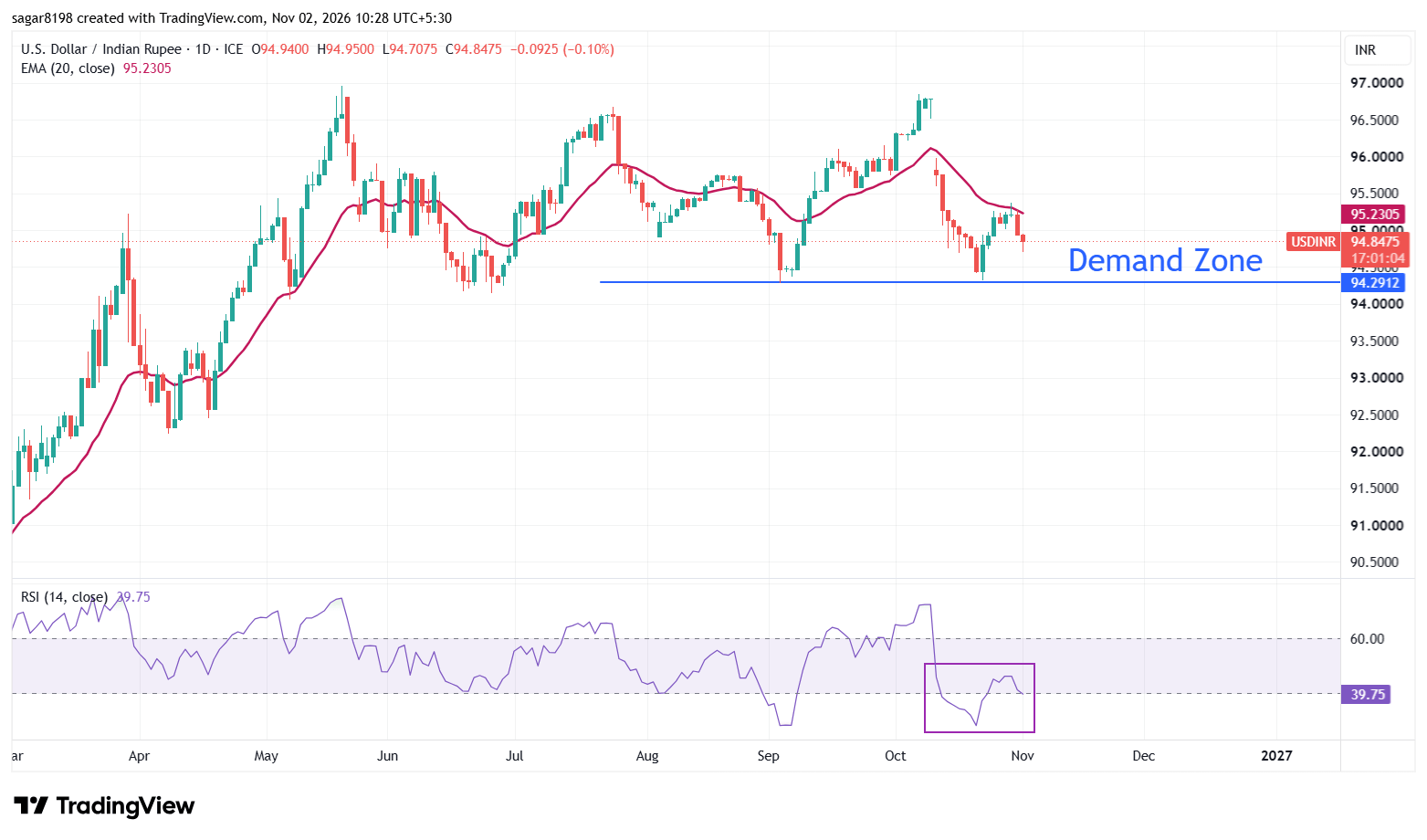
A fall towards 94.70 on Monday leaves USD/INR with a bearish near-term outlook. Spot continues to trade beneath the 20-day Exponential Moving Average (EMA), which stands at 95.23.
Immediate selling pressure from this short-term EMA continues to weigh on the pair. Meanwhile, the Relative Strength Index (14), at around 40, points to weak momentum but not extreme oversold conditions, suggesting scope for further declines.
For the bearish bias to ease and a broader recovery to become possible, USD/INR would have to break decisively above its first resistance at the 20-day EMA near 95.23. Below current levels, the September low of 94.28 represents a key demand zone.
(The technical analysis of this story was written with the help of an AI tool. Know more.)
Indian Rupee: Common questions
External developments have a particularly strong influence on the Indian Rupee (INR). Key drivers include Crude Oil prices, given India’s heavy reliance on imported Oil; the US Dollar’s value, since most trade is settled in USD; and foreign investment levels. The Reserve Bank of India (RBI) also plays a major role through direct intervention in FX markets to stabilise the exchange rate and through the interest rates it sets.
To facilitate trade, the Reserve Bank of India (RBI) regularly intervenes in the forex market to keep the exchange rate stable. Interest rate adjustments are another policy tool, used to keep inflation at the RBI’s 4% target. The Rupee typically gains when interest rates rise, partly because of the ‘carry trade’. In this strategy, investors borrow in lower-interest-rate countries and invest the proceeds in countries offering relatively higher rates, earning the difference.
Inflation, interest rates, economic growth (GDP), the trade balance and foreign investment inflows all help determine the Rupee’s value. Faster growth can attract additional overseas investment and lift demand for the currency. A narrowing trade deficit will, over time, also strengthen the Rupee. Higher interest rates provide support too, particularly when real rates, or interest rates minus inflation, rise. When risk appetite improves, larger inflows of Foreign Direct and Indirect Investment (FDI and FII) can provide another boost to the Rupee.
The Rupee generally comes under pressure from higher inflation, especially when it exceeds that of India’s peers, because it signals a loss of currency value through oversupply. Inflation also makes exports more expensive, prompting more Rupees to be sold to pay for foreign imports and weighing on the currency. However, rising inflation usually prompts the Reserve Bank of India (RBI) to increase interest rates. By drawing greater demand from international investors, those higher rates can support the Rupee. Lower inflation has the reverse effect.
POPULAR ARTICLES
1Germany’s Retail Sales: September decline of 2.0% vs. 0.4% expected2Gold: Despite near-term pressure, recovery towards 2027 expected - OCBC3Oil: Geopolitical Risk Premium Persists Ahead of Midterms – ING4WTI Price Forecast: Correction continues below $1005Could policy risks bring back Euro volatility against the US Dollar? - Commerzbank6Dogecoin Price Forecast: Could DOGE face a steeper decline amid diverging whale activity?7Why is the Indonesian Rupiah falling after mixed economic data?8USD/JPY Price Forecast: Why is the Japanese Yen lagging despite several supportive factors?9Cardano Price Forecast: Can ADA defend key support as bearish pressure intensifies?

Get Started!
Sign up and access the Global Markets in less than 3 minutes

Connect With Us












The information provided on this website is of a general nature only and does not constitute personal financial advice. Before acting on any information on this website, you should consider the suitability of the information in relation to your objectives, financial situation and needs. Investing in CFDs and FX Margin Contracts carries significant risks and is not suitable for all investors. You may lose more than your initial deposit. You do not own, or have, any interest in the underlying asset. We recommend that you seek independent advice and ensure you fully understand the risks involved before trading. It is important that you read and consider the disclosure document before you acquire any product listed on the website. The information and advertisements offered on this website are not intended for use by any person in any country or jurisdiction where such use would be contrary to local laws and regulations. The Products and Services offered on this website are not intended for residents of the United States, Malaysia and Thailand.
TMGM is authorized and regulated in various jurisdictions.
Trademax Australia Limited, trading as TMGM, is regulated by the Australian Securities and Investments Commission (ASIC), AFSL no. 436416 and is located at Level 28, One International Tower, 100 Barangaroo Avenue, 2000 Sydney, NSW Australia.
Email: support@tmgm.com.au
Trademax Global Limited, trading as TMGM, is authorized and regulated by the Vanuatu Financial Services Commission (VFSC), registration number 40356 and registered at 1276, Kumul Highway, Port Vila, Vanuatu, Republic of Vanuatu.
Email: support@tmgm.com
Trademax Global Markets (SE) Limited, trading as TMGM, is authorized and regulated by the Financial Services Authority (FSA) of Seychelles, with license number SD224. The company is registered at Office No 13, Providence Estate ABIS Centre, Mahe, Seychelles.
Email: support@tmgm.com
Trademax Global Markets (International) Pty Ltd, trading as TMGM, is authorized and regulated by the Financial Services Commission, Mauritius (FSC) with license no. GB22201012, and registered at 33, Edith Cavell Street C/o IQ EQ Fund Services (Mauritius) Ltd Port Louis, 11324 Mauritius.
Email: support@tmgm.com
Copyright © TMGM. All rights reserved