

Trading
Explore a wide range of markets with competitive pricing, deep liquidity, and advanced trading tools.
Learn More 
Platform
Trade seamlessly with TMGM's powerful platform, built for speed, precision, and a superior trading experience.
Learn More Trading Platform
Academy
Learn the fundamentals of trading with beginner-friendly resources, including guides, webinars, and market insights.
Learn More News & Analysis
Get real-time market updates and expert analysis to stay ahead of trading opportunities
Learn More News & Analysis
About
Learn what sets TMGM apart — our global presence, regulatory strength, and commitment to innovation in trading.
Learn More Why Choose TMGM
Sponsorship
Can RBNZ inflation expectations check the New Zealand Dollar's slump?
- Pressure on NZD/USD persists, with a third consecutive decline taking it close to the 6 November low.
- Markets fully price in a December Fed rate increase, while the RBNZ holds its rate at 2.75%.
- Tuesday brings the RBNZ's quarterly survey of inflation expectations.
Renewed selling has left the Kiwi near its weakest level in more than 18 months, erasing Monday's one-session post-election rebound over three consecutive declines. At around 0.5550, NZD/USD is trading only marginally above Thursday's low. The pair is now below the starting point of Monday's recovery and remains just above the 6 November trough.

A rate increase on 9 December is fully reflected in futures prices after San Francisco Fed President Daly said on Thursday that further tightening would be necessary, without specifying its timing or size. By contrast, the Reserve Bank of New Zealand (RBNZ) left its Official Cash Rate (OCR) unchanged at 2.75% on 28 October. With US rates at 3.75%-4.00%, another Fed increase would extend an interest-rate gap already amounting to at least a full percentage point.
National, ACT and New Zealand First have secured 67 of 131 seats in preliminary counting from New Zealand's 7 November election, one seat above a majority. Nearly 400K votes remain uncounted until 27 November. With unemployment at 5.7%, Labour's proposal to restore employment to the RBNZ's mandate points towards lower rates for the Kiwi. Meanwhile, the Business NZ manufacturing index eased from 56.5 to 54.9 in October, reducing pressure on the RBNZ to match the Fed's tightening.
Which upcoming releases could influence rates?
Following September's reading of 50.9, Business NZ's services index is scheduled for 21:30 GMT on Sunday. Next comes the RBNZ's Financial Stability Report at 20:00 GMT on Monday, ahead of its quarterly inflation expectations survey at 02:00 GMT on Tuesday, 17 November. The survey, which previously recorded 2.34%, will inform the RBNZ's next interest-rate decision.
Before those releases, US producer price data are scheduled for 13:30 GMT on Friday, followed by another speech from San Francisco Fed President Daly at 17:00 GMT. At 13:30 GMT on Tuesday, 17 November, October retail sales are expected to show no change following a 0.8% increase. Both the producer price and retail sales figures will feed into the Fed's 9 December decision.
What do the charts indicate for NZD/USD?
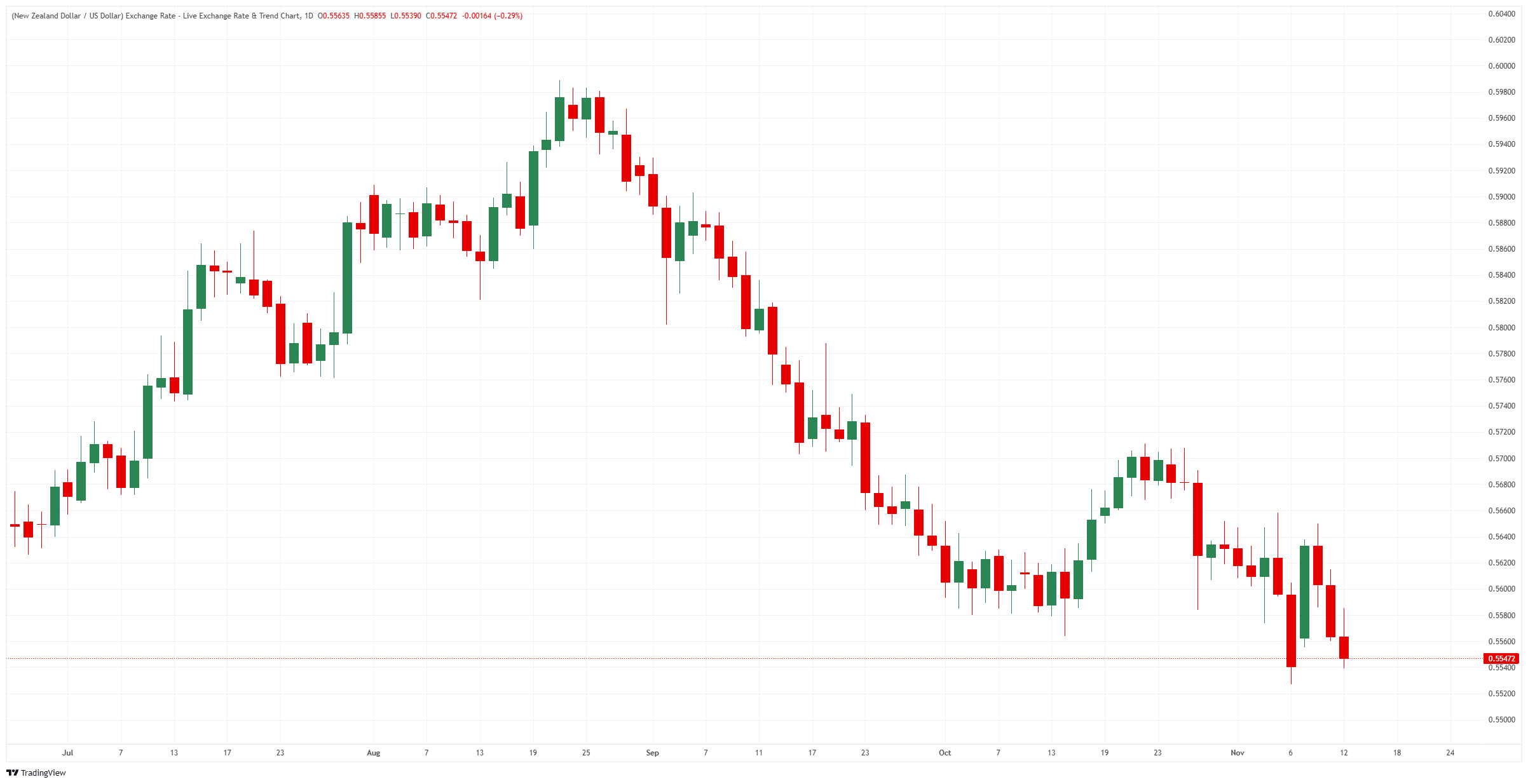
Successively lower rebound peaks have marked trading since August: slightly below 0.6000 on 21 August, around 0.5700 in late October and 0.5650 on 10 November. Between 0.5500 and 0.5550, the 6 November trough marks the lowest level on a daily chart beginning in late June. Losses have been recorded in four of the pair's past five sessions.
Daily price chart for NZD/USD
New Zealand Dollar: frequently asked questions
Widely traded by investors, the New Zealand Dollar (NZD) is also known as the Kiwi. Although New Zealand's economic health and central bank policy largely determine its value, several distinctive influences also affect the currency. One is China's economic performance, given its position as New Zealand's largest trading partner. Negative developments in China are likely to reduce demand for New Zealand's exports, weighing on both its economy and currency. Dairy prices are another important driver, as dairy is New Zealand's principal export industry. Higher prices raise export earnings, supporting the economy and, in turn, the NZD.
Keeping inflation within a 1% to 3% range over the medium term, with particular emphasis on the 2% midpoint, is the aim of the Reserve Bank of New Zealand (RBNZ). The central bank sets interest rates at a level suited to that objective. If inflation becomes too high, it raises rates to moderate economic activity. Higher rates also lift bond yields, making investment in New Zealand more attractive and supporting the NZD. Rate reductions, by contrast, generally weaken the currency. Another significant influence on NZD/USD is the interest-rate differential: the comparison between current or expected New Zealand rates and those set by the US Federal Reserve.
By helping investors assess the economy's condition, New Zealand's macroeconomic releases can influence the valuation of the New Zealand Dollar (NZD). Robust growth, low unemployment and strong confidence support the currency. Faster economic growth draws foreign investment and, when accompanied by elevated inflation, may prompt the Reserve Bank of New Zealand to raise interest rates. Weak economic readings, on the other hand, are likely to result in NZD depreciation.
During risk-on phases, the New Zealand Dollar (NZD) generally gains as investors see limited risks across markets and take an optimistic view of growth. Such conditions usually improve the outlook for commodities and so-called ‘commodity currencies’, including the Kiwi. Market turbulence or economic uncertainty typically has the opposite effect: investors sell higher-risk assets in favour of more stable safe havens, tending to weaken the NZD.
POPULAR ARTICLES
1Fed's Williams says inflation is still too high2Inflation concerns weigh on gold as it slides below $3,900 to over one-year low ahead of US PPI data3Can RBNZ inflation expectations check the New Zealand Dollar's slump?4USD reaches 19-month high on Fed hawks’ push as Australian Dollar probes 0.685Tokyo's warning keeps yen stalled at 160.00 ahead of Japan's growth data6What do Eurozone growth and US prices hold for the Euro at an 18-month low?7Can the Pound end its three-day slide as UK jobs and inflation data loom?8Ethereum Price Forecast: As Nvidia's Jensen Huang resigns, ETH slides below $2,0009A rate cut sends the wrong signal on inflation, warns Banxico’s Heath


Get Started!
Sign up and access the Global Markets in less than 3 minutes

Connect With Us












The information provided on this website is of a general nature only and does not constitute personal financial advice. Before acting on any information on this website, you should consider the suitability of the information in relation to your objectives, financial situation and needs. Investing in CFDs and FX Margin Contracts carries significant risks and is not suitable for all investors. You may lose more than your initial deposit. You do not own, or have, any interest in the underlying asset. We recommend that you seek independent advice and ensure you fully understand the risks involved before trading. It is important that you read and consider the disclosure document before you acquire any product listed on the website. The information and advertisements offered on this website are not intended for use by any person in any country or jurisdiction where such use would be contrary to local laws and regulations. The Products and Services offered on this website are not intended for residents of the United States, Malaysia and Thailand.
TMGM is authorized and regulated in various jurisdictions.
Trademax Australia Limited, trading as TMGM, is regulated by the Australian Securities and Investments Commission (ASIC), AFSL no. 436416 and is located at Level 28, One International Tower, 100 Barangaroo Avenue, 2000 Sydney, NSW Australia.
Email: support@tmgm.com.au
Trademax Global Limited, trading as TMGM, is authorized and regulated by the Vanuatu Financial Services Commission (VFSC), registration number 40356 and registered at 1276, Kumul Highway, Port Vila, Vanuatu, Republic of Vanuatu.
Email: support@tmgm.com
Trademax Global Markets (SE) Limited, trading as TMGM, is authorized and regulated by the Financial Services Authority (FSA) of Seychelles, with license number SD224. The company is registered at Office No 13, Providence Estate ABIS Centre, Mahe, Seychelles.
Email: support@tmgm.com
Trademax Global Markets (International) Pty Ltd, trading as TMGM, is authorized and regulated by the Financial Services Commission, Mauritius (FSC) with license no. GB22201012, and registered at 33, Edith Cavell Street C/o IQ EQ Fund Services (Mauritius) Ltd Port Louis, 11324 Mauritius.
Email: support@tmgm.com
Copyright © TMGM. All rights reserved