

Trading
Explore a wide range of markets with competitive pricing, deep liquidity, and advanced trading tools.
Learn More 
Platform
Trade seamlessly with TMGM's powerful platform, built for speed, precision, and a superior trading experience.
Learn More Trading Platform
Academy
Learn the fundamentals of trading with beginner-friendly resources, including guides, webinars, and market insights.
Learn More News & Analysis
Get real-time market updates and expert analysis to stay ahead of trading opportunities
Learn More News & Analysis
About
Learn what sets TMGM apart — our global presence, regulatory strength, and commitment to innovation in trading.
Learn More Why Choose TMGM
Sponsorship
Below 1.1050: Euro faces renewed pressure against US Dollar as focus turns to US PPI
- 1.1047 draws some Euro buying against the US Dollar. The outlook is still uncertain.
- At each of the next three policy meetings, TD Securities expects the Fed to raise interest rates.
- October US PPI figures are the next focus for investors.
1.1047 offers temporary support for the Euro (EUR) against the US Dollar (USD). The pair is trading around that level in Friday’s European session. Its outlook remains uncertain, with the US Dollar outperforming as markets anticipate more near-term interest rate increases from the Federal Reserve (Fed) than previously expected.

103.24 remains the level held by the US Dollar Index (DXY) at the time of writing, matching the 19-month high reached on Thursday. The index measures the Greenback against six major currencies.
Three Fed meetings, three hikes: TD Securities takes a more hawkish view
Strategists at TD Securities say the firm now anticipates "25bp hikes in December, January, and March," having previously forecast increases only in December and March. The revision marks a more hawkish assessment of the near-term policy trajectory.
The risk of persistently elevated price pressures underpins TD Securities’ expectations for additional Fed rate increases. It warned that the “Fed could hike more if inflation remains strong while the labor market accelerates." However, the firm also cautioned that policymakers "could also halt tightening if uncertainty begins to weigh on the labor market or in the event equities begin a rapid sell-off."
Due at 13:30 GMT, October’s US Producer Price Index (PPI) release is also in focus. Forecasts put monthly headline PPI growth at a more moderate 0.4%, compared with September’s 1.3%. Excluding volatile food and energy items, core PPI is likewise expected to post a smaller increase of 0.3%, against the previous 0.7% reading.
For the Euro, attention turns to the revised Q3 Gross Domestic Product (GDP) estimate at 10:00 GMT. Growth is forecast to remain at the preliminary reading of 0.4%.
1.1064: EUR/USD Technical Analysis Points to Near-Term Weakness
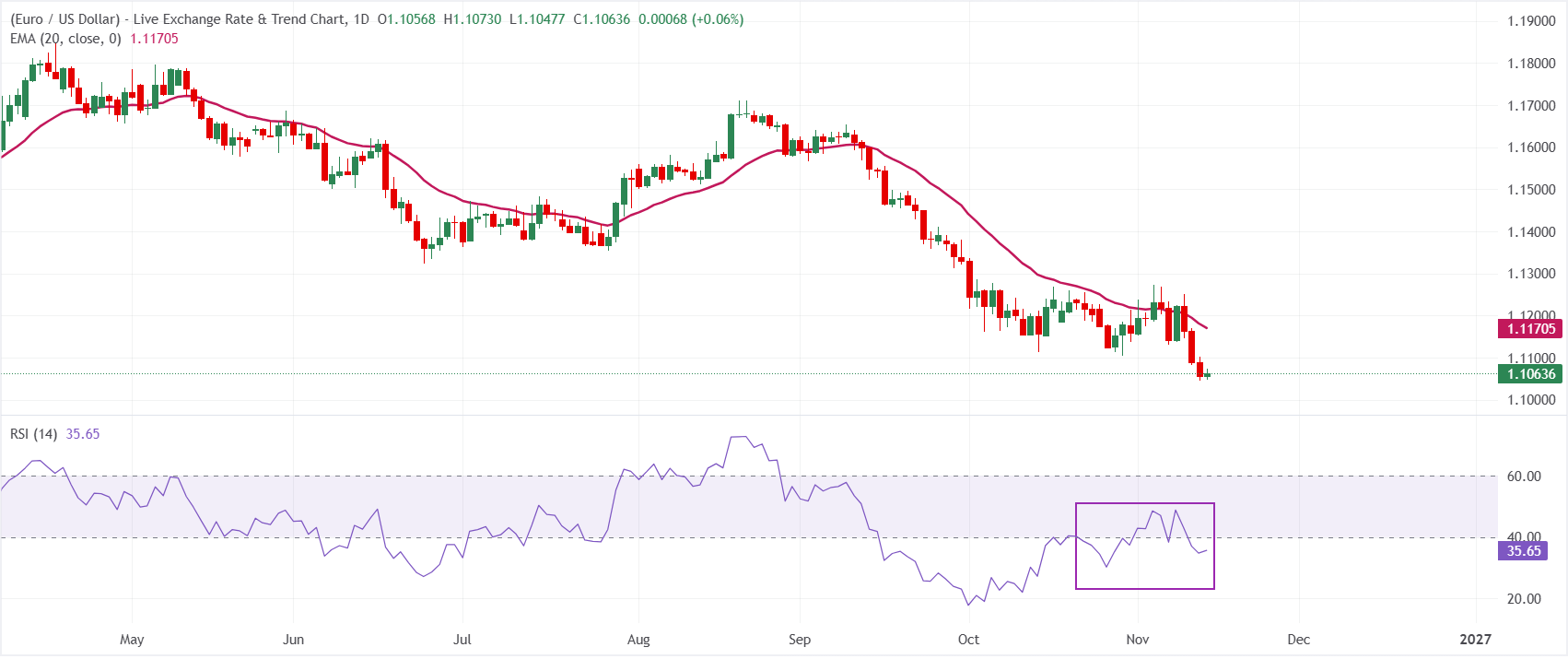
At 1.1064 on the daily chart, EUR/USD retains a bearish near-term bias. Spot sits well below the 20-day exponential moving average (EMA) of 1.1170 and is edging lower after failing to regain it. A Relative Strength Index (RSI) reading of 35.7, below the midline but outside oversold territory, signals sustained downward pressure with few indications of exhaustion.
A daily close above the 20-day EMA at 1.1170 would be required to soften the bearish tone and allow a wider corrective rebound. That average represents the first significant resistance. As the dataset identifies no nearby structural support levels, traders are likely to assess downside risk through price action around the latest lows. Repeated rejection below 1.1170 would strengthen the view that rallies remain exposed to selling pressure.
(The technical analysis of this story was written with the help of an AI tool. Learn more.)
Economic Data Indicator
Gross Domestic Product (QoQ, Seasonally Adjusted)
Published quarterly by Eurostat, Gross Domestic Product (GDP) measures the total value of goods and services produced across the Eurozone over a specified period. GDP and its principal aggregates rank among the most important gauges of an economy’s condition. The quarter-on-quarter (QoQ) figure compares activity in the reporting quarter with the preceding quarter. An increase is generally considered bullish for the Euro (EUR); a low reading is viewed as bearish.
View more.Next scheduled release: Fri 13 Nov 2026 10:00 (Prel)
Release frequency: Quarterly
Consensus forecast: 0.4%
Previous reading: 0.4%
Data source: Eurostat
POPULAR ARTICLES
1EUR/USD: Political risks tilt against Euro – Commerzbank2US inflation: Producer prices watched with Oil – UBS3USD/JPY: Breakout extends as resistance tested – Societe Generale4US Dollar: Yields Provide Support Amid AI Risks – MUFG50.6% Eurozone Q3 GDP growth exceeds flash estimate of 0.4%6Surging US bond yields: Australian Dollar falls further against US Dollar7Silver price today: FXStreet data show silver holding broadly steady8Crypto Today: Losses deepen for Bitcoin, Ethereum, XRP as sellers strengthen control9Swiss Franc Slides to Fresh Monthly Lows as Hawkish Fed and Higher US Yields Weigh


Get Started!
Sign up and access the Global Markets in less than 3 minutes

Connect With Us












The information provided on this website is of a general nature only and does not constitute personal financial advice. Before acting on any information on this website, you should consider the suitability of the information in relation to your objectives, financial situation and needs. Investing in CFDs and FX Margin Contracts carries significant risks and is not suitable for all investors. You may lose more than your initial deposit. You do not own, or have, any interest in the underlying asset. We recommend that you seek independent advice and ensure you fully understand the risks involved before trading. It is important that you read and consider the disclosure document before you acquire any product listed on the website. The information and advertisements offered on this website are not intended for use by any person in any country or jurisdiction where such use would be contrary to local laws and regulations. The Products and Services offered on this website are not intended for residents of the United States, Malaysia and Thailand.
TMGM is authorized and regulated in various jurisdictions.
Trademax Australia Limited, trading as TMGM, is regulated by the Australian Securities and Investments Commission (ASIC), AFSL no. 436416 and is located at Level 28, One International Tower, 100 Barangaroo Avenue, 2000 Sydney, NSW Australia.
Email: support@tmgm.com.au
Trademax Global Limited, trading as TMGM, is authorized and regulated by the Vanuatu Financial Services Commission (VFSC), registration number 40356 and registered at 1276, Kumul Highway, Port Vila, Vanuatu, Republic of Vanuatu.
Email: support@tmgm.com
Trademax Global Markets (SE) Limited, trading as TMGM, is authorized and regulated by the Financial Services Authority (FSA) of Seychelles, with license number SD224. The company is registered at Office No 13, Providence Estate ABIS Centre, Mahe, Seychelles.
Email: support@tmgm.com
Trademax Global Markets (International) Pty Ltd, trading as TMGM, is authorized and regulated by the Financial Services Commission, Mauritius (FSC) with license no. GB22201012, and registered at 33, Edith Cavell Street C/o IQ EQ Fund Services (Mauritius) Ltd Port Louis, 11324 Mauritius.
Email: support@tmgm.com
Copyright © TMGM. All rights reserved