

Trading
Explore a wide range of markets with competitive pricing, deep liquidity, and advanced trading tools.
Learn More 
Platform
Trade seamlessly with TMGM's powerful platform, built for speed, precision, and a superior trading experience.
Learn More Trading Platform
Academy
Learn the fundamentals of trading with beginner-friendly resources, including guides, webinars, and market insights.
Learn More News & Analysis
Get real-time market updates and expert analysis to stay ahead of trading opportunities
Learn More News & Analysis
About
Learn what sets TMGM apart — our global presence, regulatory strength, and commitment to innovation in trading.
Learn More Why Choose TMGM
Sponsorship
$3,850 area: gold tumbles to one-year low as Fed hawks take control
- $3,874: Gold slides after setting a new yearly low at $3,852.
- 19-month highs come into view for the US Dollar as Fed officials call for more tightening.
- Traders awaiting US PPI put the probability of a December Fed 25 bps rate increase at 87%.
Gold (XAU/USD) trades at $3,874. The metal is down nearly 2.8% on Thursday, having hit a yearly low of $3,852 as traders priced in a greater probability of a 50 bps rate increase by the Federal Reserve (Fed) in December.

Higher Oil prices accompany hawkish Fed signals
A hawkish shift among more Fed officials is supporting the Greenback and keeping bullion under pressure.
Although the Cleveland Fed's Beth Hammack favours gradual interest rate increases, she warned that the inflation outlook is deteriorating. Inflation has been “well above target,” according to the Chicago Fed's Austan Goolsbee. The San Francisco Fed's Mary Daly also acknowledged the need for additional tightening, saying inflation pressure “is up, not down.”
Initial Jobless Claims increased by 200K in the week ending 7 November, against a forecast of 195K and a previous reading of 191K, leaving US employment data slightly weaker than expected. The labour market nevertheless remains firm: Continuing Jobless Claims fell to 1.697 million from 1.717 million.
Existing Home Sales, meanwhile, recorded a -5.5% change from September, falling to 3.75 million from 3.97 million.
At 103.48, the US Dollar Index (DXY) is 0.34% higher and close to 19-month highs. The index measures the dollar against a basket of six currencies.
US President Donald Trump, meanwhile, said in a social media post that the US does not need an agreement with Iran. His comments left open the possibility of further strikes, contradicting his statement two days earlier that new strikes were unnecessary.
A 2.7% gain took West Texas Intermediate (WTI), the US crude Oil benchmark, to $88.79 per barrel. The advance fuelled speculation about higher petrol prices and increased the likelihood of Federal Reserve rate rises.
According to the CME FedWatch Tool, money markets assigned an 85% probability to a 25-basis-point December rate increase, with only a 15% probability of a 50-basis-point rise. A week earlier, markets had attached zero probability to a 50 bps increase.
Friday's US economic calendar includes the October Producer Price Index (PPI) release.
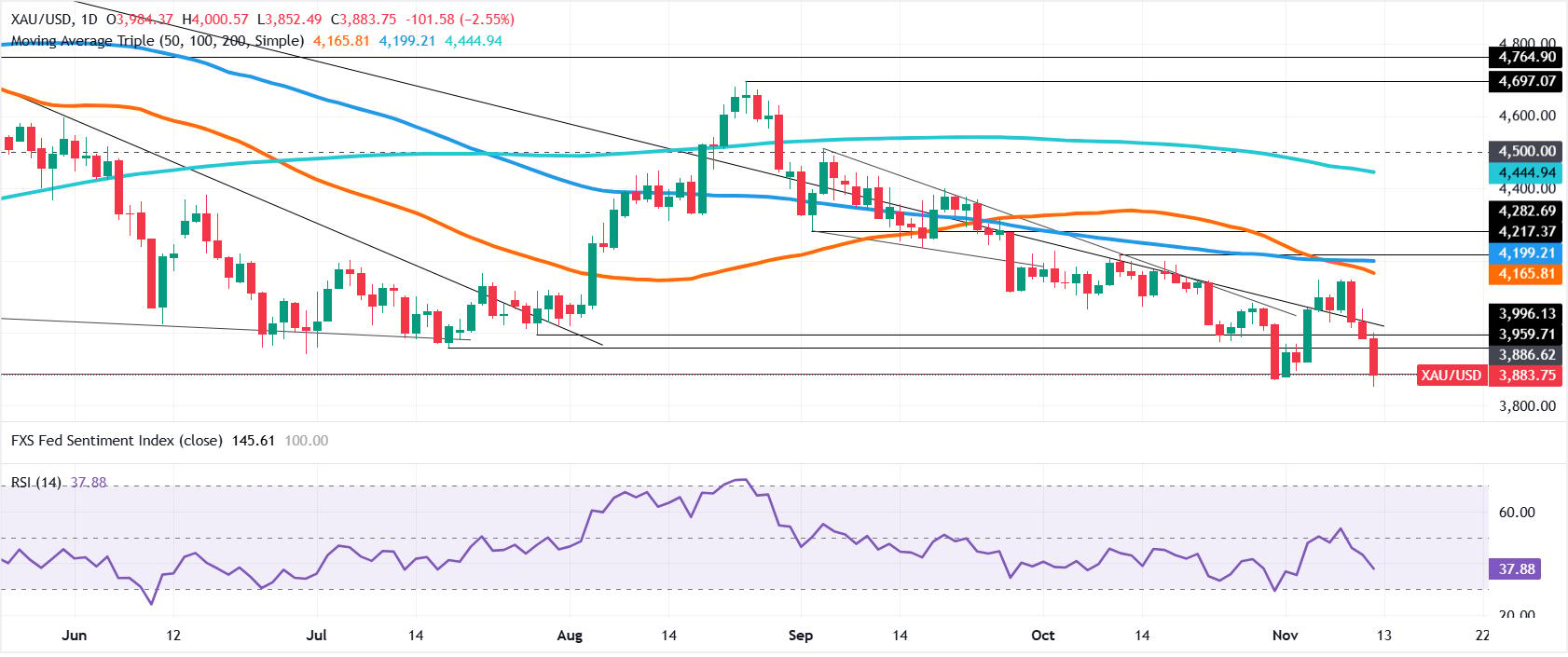
Over 2.5% lower: Gold drops below $3,900 in XAU/USD technical outlook
Below $3,900, Gold has regained some ground following its fall to a year-to-date (YTD) low of $3,852. Price action and momentum, as gauged by the Relative Strength Index (RSI), both point to additional downside.
For XAU/USD, immediate support stands at $3,852, with $3,800 next if that level gives way. Key psychological levels follow, while the next area of interest is $3,500, the 22 April 2025 swing high that has become support.
On the upside, $3,900 is the first major resistance, ahead of the day's high at $4,000. Further gains would bring $4,100 into focus, followed by the confluence of the 50-day Simple Moving Average (SMA) at $4,165 and the 100-day SMA at $4,199.
Gold: frequently asked questions
Widely used to preserve value and facilitate exchange, Gold has held an important place throughout human history. Beyond its lustre and use in jewellery, the precious metal is now widely regarded as a safe-haven asset, or an attractive investment during periods of turbulence. Because it is not dependent on a particular issuer or government, Gold is also commonly viewed as a hedge against inflation and currency depreciation.
The largest holders of Gold are central banks. To underpin their currencies during turbulent periods, they typically diversify reserves and purchase Gold, reinforcing perceptions of economic and currency strength. Substantial Gold reserves can bolster confidence in a country's solvency. World Gold Council data show that central banks increased their reserves by 1,136 tonnes of Gold in 2022, valued at around $70 billion. That marked the largest annual purchase on record. Emerging-economy central banks, including those in China, India and Turkey, are rapidly expanding their Gold holdings.
The US Dollar and US Treasuries, both leading reserve and safe-haven assets, have an inverse correlation with Gold. A weaker dollar generally accompanies higher Gold prices, allowing investors and central banks to diversify holdings during turbulent periods. Gold also tends to move in the opposite direction to risk assets. Equity market gains typically put pressure on the metal, whereas selling in riskier markets tends to support it.
Many factors can shift Gold prices. Its safe-haven appeal means geopolitical instability or concerns over a deep recession can trigger rapid gains. Since Gold pays no yield, lower interest rates generally support it, while more expensive borrowing usually weighs on the metal. Most price moves, however, hinge on the performance of the US Dollar (USD), as Gold is denominated in dollars (XAU/USD). Dollar strength tends to restrain Gold prices; a weaker dollar is more likely to lift them.
POPULAR ARTICLES
1Banxico rate cut sends wrong signal on inflation, Heath warns2Bitcoin and crypto market losses deepen after Jensen Huang's resignation3$3,850 area: gold tumbles to one-year low as Fed hawks take control4Fed’s Daly sees further rate hikes ahead, warning AI is fuelling inflation5Forex Today: US inflation returns to the spotlight6Over 3% slide in silver as Fed rate hike bets drive US Dollar rally7Hot inflation no fluke: Fed’s Goolsbee warns as economy overheats81.32 in sight as British Pound slides and Fed hawks overshadow solid UK growth910-month low: Australian Dollar falls as Fed tightening bets build

Get Started!
Sign up and access the Global Markets in less than 3 minutes

Connect With Us












The information provided on this website is of a general nature only and does not constitute personal financial advice. Before acting on any information on this website, you should consider the suitability of the information in relation to your objectives, financial situation and needs. Investing in CFDs and FX Margin Contracts carries significant risks and is not suitable for all investors. You may lose more than your initial deposit. You do not own, or have, any interest in the underlying asset. We recommend that you seek independent advice and ensure you fully understand the risks involved before trading. It is important that you read and consider the disclosure document before you acquire any product listed on the website. The information and advertisements offered on this website are not intended for use by any person in any country or jurisdiction where such use would be contrary to local laws and regulations. The Products and Services offered on this website are not intended for residents of the United States, Malaysia and Thailand.
TMGM is authorized and regulated in various jurisdictions.
Trademax Australia Limited, trading as TMGM, is regulated by the Australian Securities and Investments Commission (ASIC), AFSL no. 436416 and is located at Level 28, One International Tower, 100 Barangaroo Avenue, 2000 Sydney, NSW Australia.
Email: support@tmgm.com.au
Trademax Global Limited, trading as TMGM, is authorized and regulated by the Vanuatu Financial Services Commission (VFSC), registration number 40356 and registered at 1276, Kumul Highway, Port Vila, Vanuatu, Republic of Vanuatu.
Email: support@tmgm.com
Trademax Global Markets (SE) Limited, trading as TMGM, is authorized and regulated by the Financial Services Authority (FSA) of Seychelles, with license number SD224. The company is registered at Office No 13, Providence Estate ABIS Centre, Mahe, Seychelles.
Email: support@tmgm.com
Trademax Global Markets (International) Pty Ltd, trading as TMGM, is authorized and regulated by the Financial Services Commission, Mauritius (FSC) with license no. GB22201012, and registered at 33, Edith Cavell Street C/o IQ EQ Fund Services (Mauritius) Ltd Port Louis, 11324 Mauritius.
Email: support@tmgm.com
Copyright © TMGM. All rights reserved