

Trading
Explore a wide range of markets with competitive pricing, deep liquidity, and advanced trading tools.
Learn More 
Platform
Trade seamlessly with TMGM's powerful platform, built for speed, precision, and a superior trading experience.
Learn More Trading Platform
Academy
Learn the fundamentals of trading with beginner-friendly resources, including guides, webinars, and market insights.
Learn More News & Analysis
Get real-time market updates and expert analysis to stay ahead of trading opportunities
Learn More News & Analysis
About
Learn what sets TMGM apart — our global presence, regulatory strength, and commitment to innovation in trading.
Learn More Why Choose TMGM
Sponsorship
Gold holds above Monday's low while recouping retail sales-driven losses
- $3,830 marked a 13-month low for XAU/USD on Monday. A day later, the pair remains within Monday's range.
- Gold's pricing is being driven by rising US yields and the Dollar rather than the Iran war.
- Wednesday brings the Fed minutes, ahead of remarks from Fed Governor Waller on Friday.
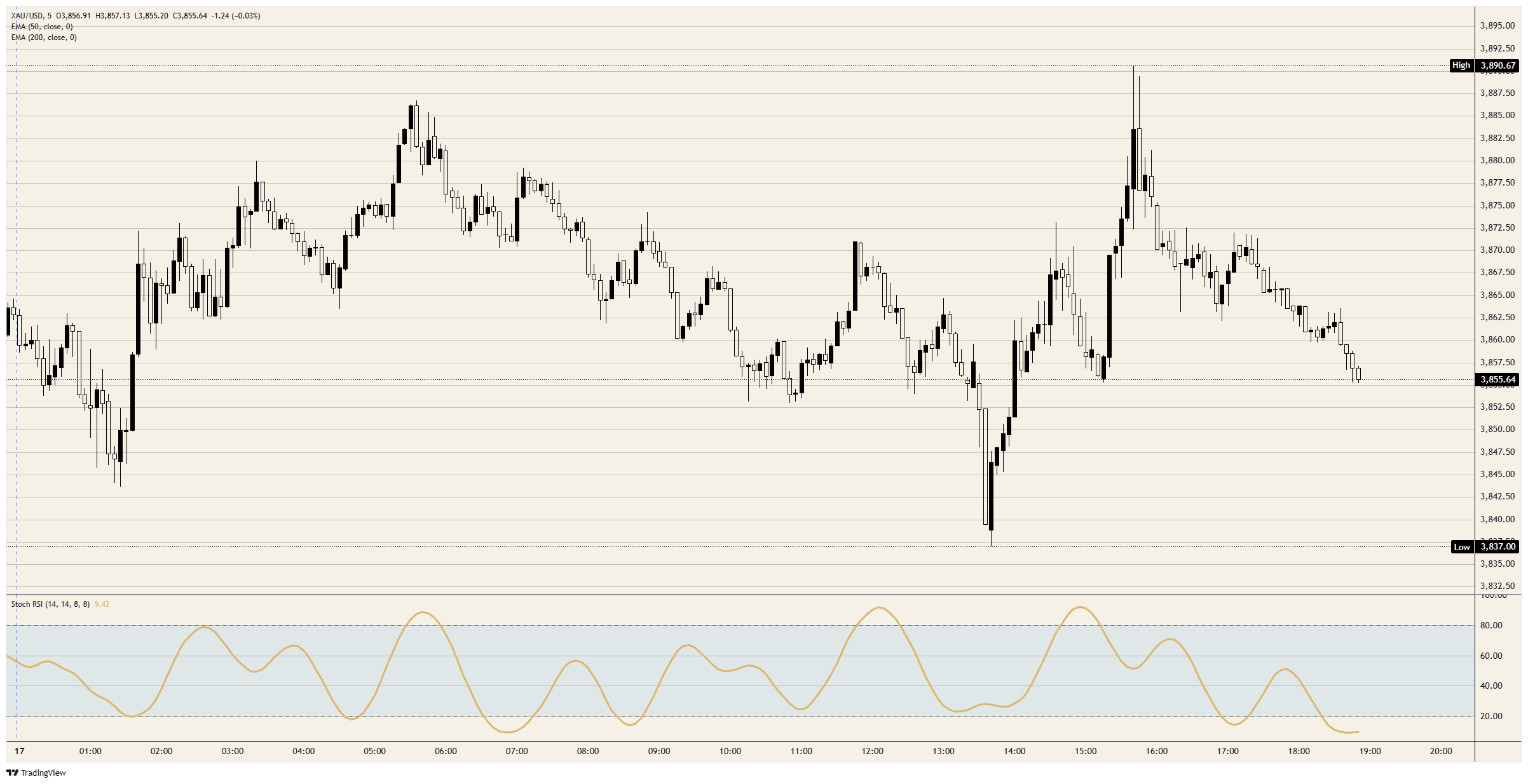
Gold is near $3,850. That leaves it broadly back at its level before the data release, with Tuesday's entire trading range contained within Monday's. The subdued session follows the metal's lowest price since October 2025. October retail sales initially pushed Gold to just below $3,840, before a recovery took it just above $3,890, the session high.

A rise of about three-tenths of a point in 10-year inflation-protected Treasury yields during November, alongside the Dollar, explains Gold's decline, according to the World Gold Council. The session low followed October retail sales excluding autos, which increased 0.6% versus a 0.4% forecast. Gold had recouped that loss before industrial production was released. It then extended its recovery as production fell 0.4%, against expectations for a 0.1% increase.
Reports from Iranian state media of explosions and a US attack on Qeshm island coincided with Gold's session high. However, the war's boost to Crude Oil, and the resulting inflation-driven increase in bets on Fed rate hikes, has outweighed the support Gold has received from safe-haven demand. With the conflict now in its ninth month, the metal stands nearly a third below its January record.
19:00 GMT Wednesday: Fed minutes due
At 19:00 GMT on Wednesday, the Fed will publish minutes of its October 27-28 meeting. New York Fed President Williams follows with remarks at 19:30 GMT. Friday brings a speech by Fed Governor Waller at 13:25 GMT; his November 10 remarks helped strengthen expectations for a December hike. Markets fully price a quarter-point increase on December 9 and expect a further hike in January. The speakers' main significance is therefore what they signal about the number of subsequent increases.
Thursday's initial jobless claims, scheduled for 13:30 GMT, are expected at 196K versus 200K previously. At 15:00 GMT on Friday, the University of Michigan survey is forecast to show sentiment at 52, up from 51, with one-year inflation expectations holding at 4.3%. Both releases will inform the Fed's December 8-9 decision, which sets the course for the yields driving Gold's decline.
$3,830 low anchors Gold's technical picture
From just below $4,700 in late August, Gold reached a high near $4,150 on November 9 before touching Monday's low near $3,830 five sessions later. The metal is again trading below the October 30 low of around $3,870, a level it breached on November 12. Near $4,100, the 50-day Exponential Moving Average (EMA) remains below the 200-day EMA at roughly $4,225.
5-minute chart: Spot Gold
Gold: key questions answered
Widely used as both a store of value and a medium of exchange, Gold has held an important place throughout human history. Today, its appeal extends beyond its lustre and use in jewellery. The precious metal is broadly regarded as a safe-haven asset, or an attractive investment during periods of turbulence. Because it does not depend on a particular issuer or government, Gold is also commonly viewed as a hedge against inflation and currency depreciation.
The largest holders of Gold are central banks. To support their currencies during unsettled periods, they typically diversify reserves and purchase Gold, reinforcing perceptions of economic and currency strength. Substantial Gold reserves can bolster confidence in a country's solvency. World Gold Council data show that central banks expanded their reserves by 1,136 tonnes in 2022, worth about $70 billion. That was the largest annual purchase on record. Emerging-economy central banks, including those in China, India and Turkey, are rapidly building their Gold holdings.
The US Dollar and US Treasuries, both leading reserve and safe-haven assets, have an inverse correlation with Gold. Dollar weakness typically supports the metal, helping investors and central banks diversify holdings in turbulent periods. Gold also tends to move in the opposite direction to risk assets. Stock market gains generally put pressure on its price, whereas selling in riskier markets usually supports the precious metal.
Many influences can shift Gold prices. Its safe-haven appeal means geopolitical instability or concern over a deep recession can trigger rapid gains. Gold pays no yield, so lower interest rates tend to support it, while higher borrowing costs usually create pressure. Nevertheless, the US Dollar (USD) drives most price movements because Gold is dollar-denominated (XAU/USD). Dollar strength generally restrains the metal's price, while a weaker Dollar is likely to lift it.
POPULAR ARTICLES
12028 Outlook: Copper Set for Gradual Gains – Commerzbank2Below $1,800: Ethereum Price Forecast as ETH Drops Ahead of Nvidia's Earnings3Taiwan Dollar: TWD faces pressure from equity outflows – OCBC4Crude Oil rebounds on Gulf attacks but remains below levels before Monday's drop5Gold holds above Monday's low while recouping retail sales-driven losses6Oil: Prices under pressure as supply recovers – ING7Forex Today: UK CPI and FOMC Minutes in focus8Chinese Yuan: Diverging reserve data prompt FX questions – Commerzbank919-month high: Dollar Index pulls back after retail sales surge


Get Started!
Sign up and access the Global Markets in less than 3 minutes

Connect With Us












The information provided on this website is of a general nature only and does not constitute personal financial advice. Before acting on any information on this website, you should consider the suitability of the information in relation to your objectives, financial situation and needs. Investing in CFDs and FX Margin Contracts carries significant risks and is not suitable for all investors. You may lose more than your initial deposit. You do not own, or have, any interest in the underlying asset. We recommend that you seek independent advice and ensure you fully understand the risks involved before trading. It is important that you read and consider the disclosure document before you acquire any product listed on the website. The information and advertisements offered on this website are not intended for use by any person in any country or jurisdiction where such use would be contrary to local laws and regulations. The Products and Services offered on this website are not intended for residents of the United States, Malaysia and Thailand.
TMGM is authorized and regulated in various jurisdictions.
Trademax Australia Limited, trading as TMGM, is regulated by the Australian Securities and Investments Commission (ASIC), AFSL no. 436416 and is located at Level 28, One International Tower, 100 Barangaroo Avenue, 2000 Sydney, NSW Australia.
Email: support@tmgm.com.au
Trademax Global Limited, trading as TMGM, is authorized and regulated by the Vanuatu Financial Services Commission (VFSC), registration number 40356 and registered at 1276, Kumul Highway, Port Vila, Vanuatu, Republic of Vanuatu.
Email: support@tmgm.com
Trademax Global Markets (SE) Limited, trading as TMGM, is authorized and regulated by the Financial Services Authority (FSA) of Seychelles, with license number SD224. The company is registered at Office No 13, Providence Estate ABIS Centre, Mahe, Seychelles.
Email: support@tmgm.com
Trademax Global Markets (International) Pty Ltd, trading as TMGM, is authorized and regulated by the Financial Services Commission, Mauritius (FSC) with license no. GB22201012, and registered at 33, Edith Cavell Street C/o IQ EQ Fund Services (Mauritius) Ltd Port Louis, 11324 Mauritius.
Email: support@tmgm.com
Copyright © TMGM. All rights reserved