

Gold declines as firmer US Dollar and hawkish Fed outlook weigh
- Gold retreats as the US Dollar regains ground following Thursday's sharp decline.
- Elevated energy prices linked to the Middle East war keep inflation concerns and hawkish Fed expectations in focus.
- Technical indicators suggest stabilization, with XAU/USD holding above $4,000 despite remaining below key moving averages.
Gold (XAU/USD) edges lower on Friday as the US Dollar (USD) stabilizes following the previous day’s sharp sell-off, while hawkish Federal Reserve (Fed) expectations remain a key headwind for the non-yielding metal.
At the time of writing, XAU/USD trades around $4,0553, down 1.22% on the day after struggling to sustain gains above $4,100.

The US Dollar Index (DXY) slumped to a six-week low on Thursday amid suspected foreign exchange intervention by Tokyo to support the Japanese Yen (JPY).
The DXY, which tracks the Greenback’s value against a basket of six major currencies, trades around 100.20, up 0.21% on the day. The rebound comes as the war in the Middle East and the resulting rise in energy prices add to inflation concerns, reinforcing expectations that the Fed may raise interest rates. Nevertheless, the index remains on track to end July in negative territory.
Meanwhile, Gold looks set to snap a four-month losing streak as buyers continue to defend the psychological $4,000 level. However, the prospect of higher US interest rates is keeping US Treasury yields elevated and limiting the metal’s upside.
The Fed left interest rates unchanged within the 3.50%-3.75% range on Wednesday, with three policymakers voting for an immediate rate hike. Although Fed Chair Kevin Warsh stopped short of offering clear forward guidance, he reiterated the central bank’s commitment to bringing inflation under control.
According to the CME FedWatch Tool, traders currently price in around a 66% probability of a 25-basis-point rate hike in September.
Traders now await the final University of Michigan Consumer Sentiment and Consumer Expectations data, alongside the one-year and five-year Consumer Inflation Expectations, due later on Friday during American trading hours.
In the near term, XAU/USD is expected to remain range-bound as traders assess developments in the Middle East and the Fed’s interest-rate outlook, while technical indicators point to signs of stabilization.
Technical analysis: XAU/USD recovery remains capped below the 21-day SMA
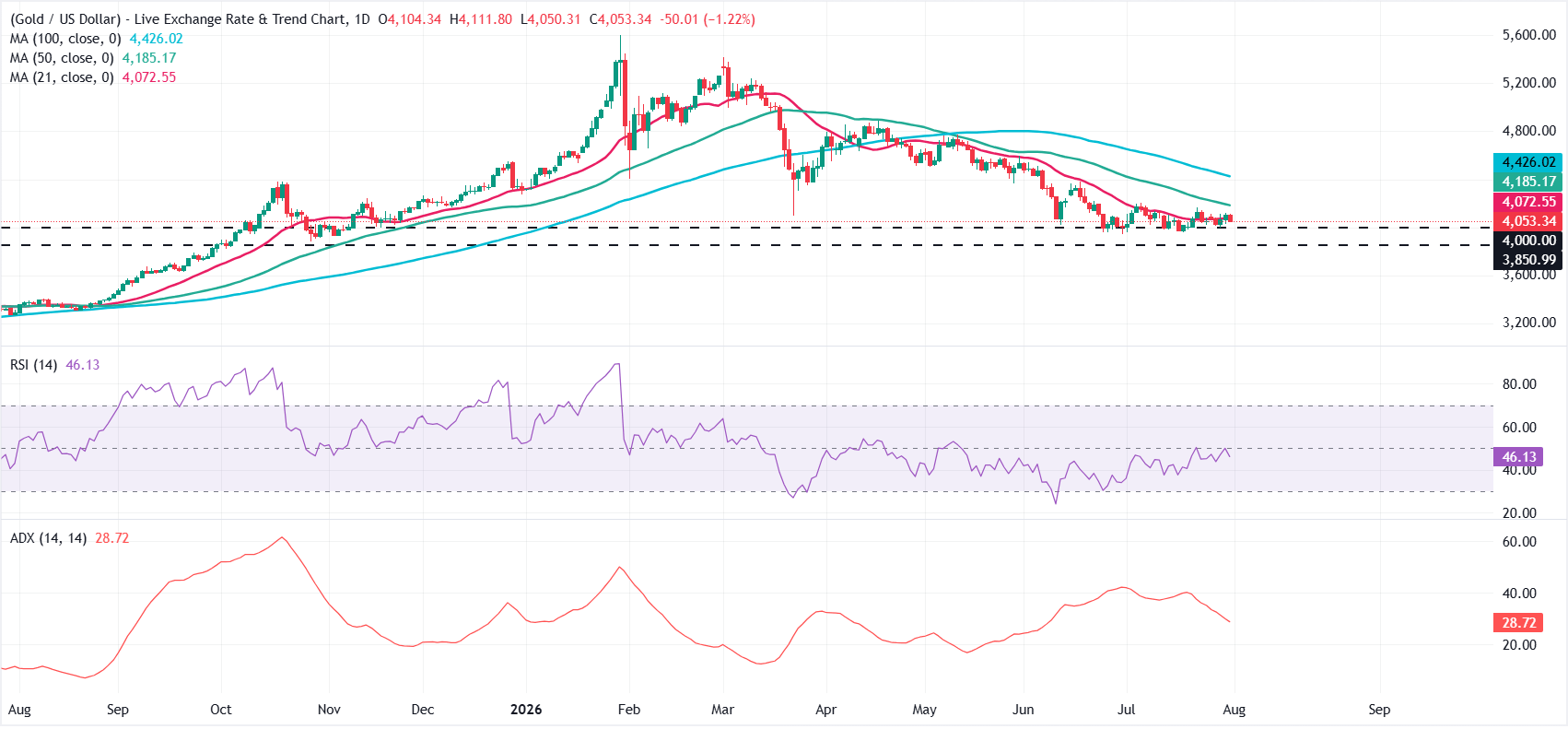
On the daily chart, XAU/USD shows signs of stabilization after repeatedly finding support around the psychological $4,000 mark, while holding beneath a cluster of key moving averages.
The Relative Strength Index (RSI) near 46 sits just below the neutral 50 level, pointing to subdued momentum rather than strong selling pressure. Meanwhile, the Average Directional Index (ADX) around 28 suggests that the earlier downtrend is losing strength
On the downside, the $4,000 level provides immediate support, with a sustained break below this area exposing the next cushion near $3,850. On the upside, initial resistance is seen at the 21-day Simple Moving Average (SMA) at $4,072.
A decisive move above this level could open the door towards the 50-day SMA at $4,185, while the 100-day SMA at $4,426 represents a stronger barrier.
(The technical analysis of this story was written with the help of an AI tool. Know more.)
Gold FAQs
Gold has played a key role in human’s history as it has been widely used as a store of value and medium of exchange. Currently, apart from its shine and usage for jewelry, the precious metal is widely seen as a safe-haven asset, meaning that it is considered a good investment during turbulent times. Gold is also widely seen as a hedge against inflation and against depreciating currencies as it doesn’t rely on any specific issuer or government.
Central banks are the biggest Gold holders. In their aim to support their currencies in turbulent times, central banks tend to diversify their reserves and buy Gold to improve the perceived strength of the economy and the currency. High Gold reserves can be a source of trust for a country’s solvency. Central banks added 1,136 tonnes of Gold worth around $70 billion to their reserves in 2022, according to data from the World Gold Council. This is the highest yearly purchase since records began. Central banks from emerging economies such as China, India and Turkey are quickly increasing their Gold reserves.
Gold has an inverse correlation with the US Dollar and US Treasuries, which are both major reserve and safe-haven assets. When the Dollar depreciates, Gold tends to rise, enabling investors and central banks to diversify their assets in turbulent times. Gold is also inversely correlated with risk assets. A rally in the stock market tends to weaken Gold price, while sell-offs in riskier markets tend to favor the precious metal.
The price can move due to a wide range of factors. Geopolitical instability or fears of a deep recession can quickly make Gold price escalate due to its safe-haven status. As a yield-less asset, Gold tends to rise with lower interest rates, while higher cost of money usually weighs down on the yellow metal. Still, most moves depend on how the US Dollar (USD) behaves as the asset is priced in dollars (XAU/USD). A strong Dollar tends to keep the price of Gold controlled, whereas a weaker Dollar is likely to push Gold prices up.














