

Ripple Price: XRP bears retail control despite increasing retail demand
- XRP extends sideways, with the upside capped below $1.10.
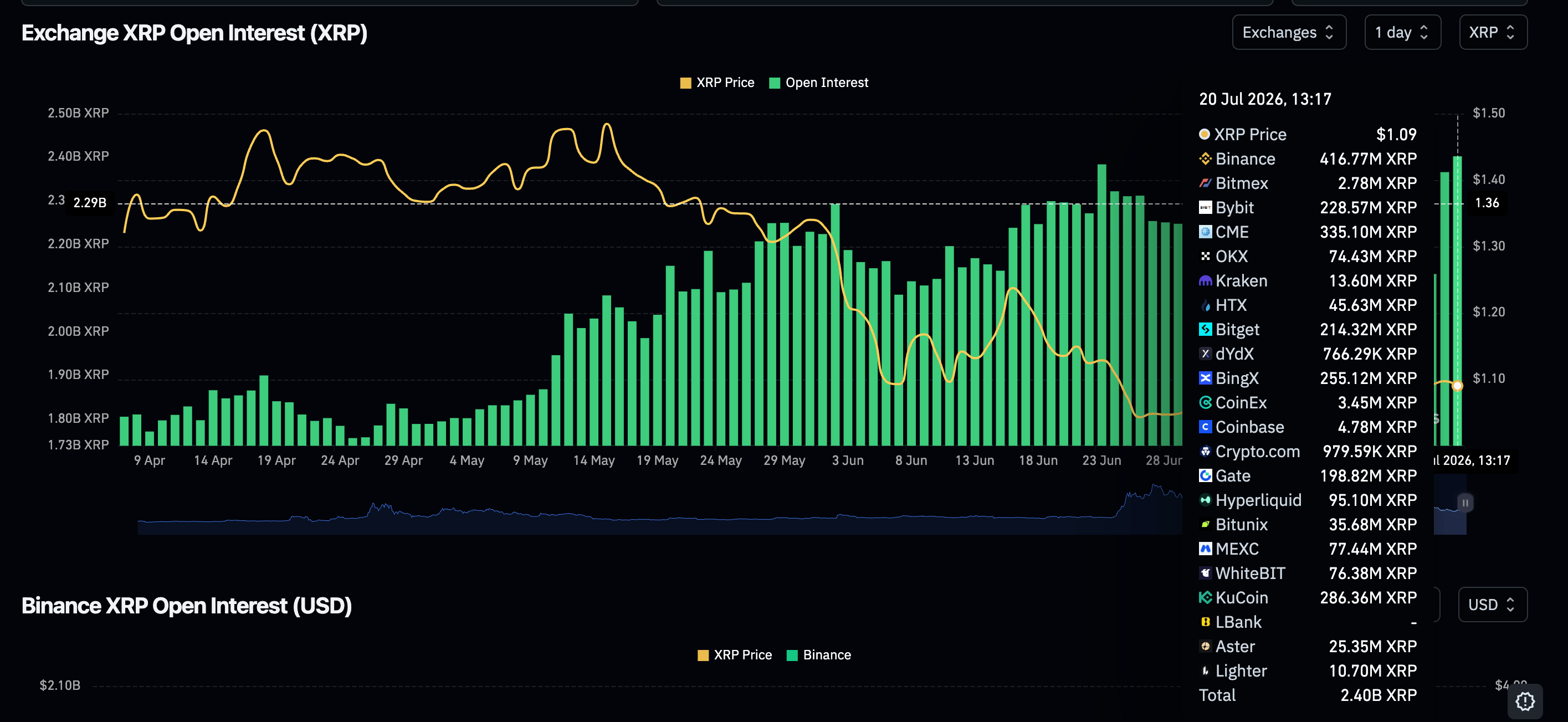
- Retail Open Interest spikes to 2.4 billion XRP as broader cryptocurrency market sentiment marginally improves.
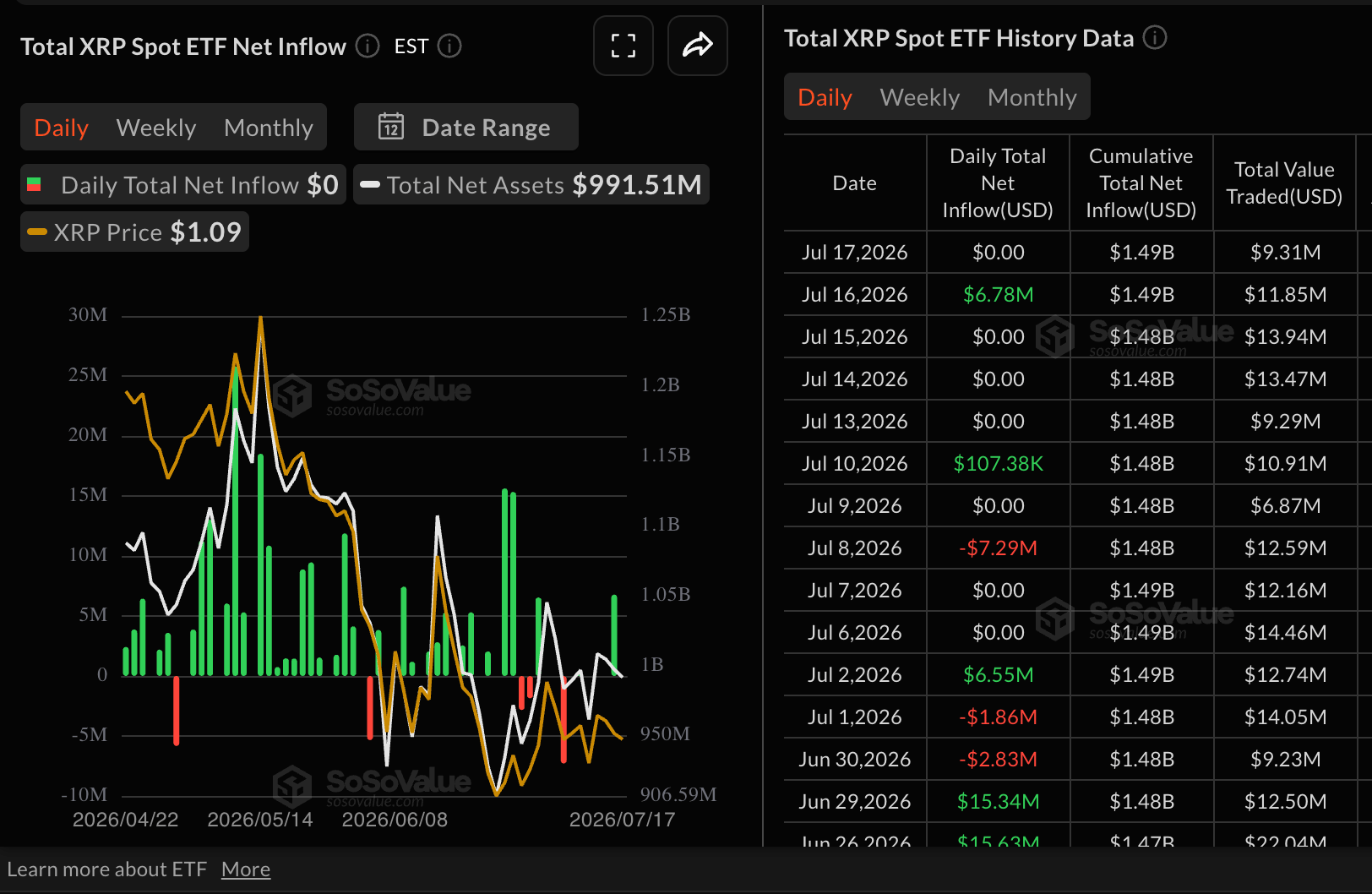
- Institutional capital inflows mildly returned, with spot XRP ETFs averaging $7 million last week.
Ripple (XRP) faces sustained selling pressure as bears maintain control on Monday. The remittance token has struggled to break above the $1.10 resistance since last Thursday, as risk sentiment weighs.
XRP sees mild capital inflows
Demand for XRP derivatives has gradually increased since last week, with the perpetual futures Open Interest (OI) averaging 2.4 billion XRP on Monday, up from 2.13 billion XRP the previous day. A broader scope shows OI averaged 2.09 billion XRP on July 7, underscoring steady growth in risk-on sentiment.

Meanwhile, demand for XRP spot Exchange-Traded Funds (ETFs) returned on Thursday, attracting nearly $7 million in inflows last week, according to SoSoValue data. This mild but positive turnaround comes after outflows of approximately $7 million on the week ending July 10.
Still, cumulative inflows edged higher to $1.49 billion, with net assets averaging $991 million. Sustained appetite for US-listed ETFs is needed to absorb the selling pressure in the spot market and support a steady rebound.
“From a macro perspective, the current environment is also creating two opposing forces. Softer U.S. inflation has eased concerns about an extended period of restrictive monetary policy, which is supportive of liquidity-sensitive assets,” Simon-Peter Massabni, Head of Business Development at XS.com.
Price analysis: XRP bears tighten grip
XRP trades at $1.09, retaining a bearish near-term bias as it sits below the 50-day, 100-day and 200-day Exponential Moving Averages (EMAs) clustered at roughly $1.15, $1.24 and $1.45. The Moving Average Convergence Divergence (MACD) histogram remains slightly positive, hinting at modest underlying buying interest, but the Relative Strength Index (RSI) around 46 underscores a lack of strong momentum, leaving price capped beneath this stacked EMA resistance band.
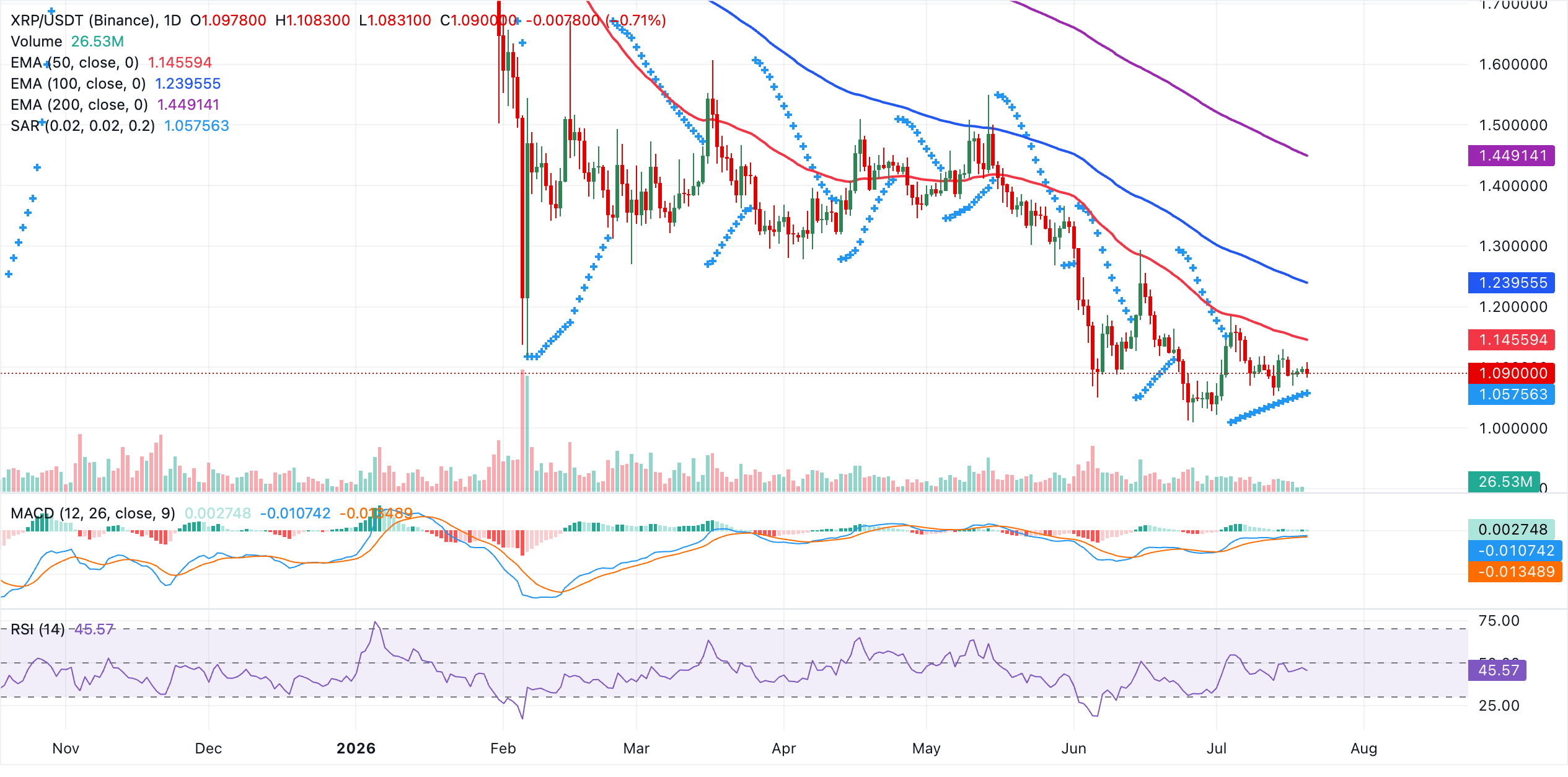
On the topside, immediate resistance emerges at the 50-day EMA near $1.15, with further hurdles at the 100-day EMA around $1.24 and the longer-term 200-day EMA near $1.45, which collectively define a broad overhead supply zone. On the downside, initial support is provided by the Parabolic SAR indicator around $1.06. A daily close below this level would expose the pair to further corrective pressure, while holding above it could allow XRP to consolidate before attempting another test of the EMA barrier.
(The technical analysis of this story was written with the help of an AI tool. Know more.)
Crypto ETF FAQs
An Exchange-Traded Fund (ETF) is an investment vehicle or an index that tracks the price of an underlying asset. ETFs can not only track a single asset, but a group of assets and sectors. For example, a Bitcoin ETF tracks Bitcoin’s price. ETF is a tool used by investors to gain exposure to a certain asset.
Yes. The first Bitcoin futures ETF in the US was approved by the US Securities & Exchange Commission in October 2021. A total of seven Bitcoin futures ETFs have been approved, with more than 20 still waiting for the regulator’s permission. The SEC says that the cryptocurrency industry is new and subject to manipulation, which is why it has been delaying crypto-related futures ETFs for the last few years.
Yes. The SEC approved in January 2024 the listing and trading of several Bitcoin spot Exchange-Traded Funds, opening the door to institutional capital and mainstream investors to trade the main crypto currency. The decision was hailed by the industry as a game changer.
The main advantage of crypto ETFs is the possibility of gaining exposure to a cryptocurrency without ownership, reducing the risk and cost of holding the asset. Other pros are a lower learning curve and higher security for investors since ETFs take charge of securing the underlying asset holdings. As for the main drawbacks, the main one is that as an investor you can’t have direct ownership of the asset, or, as they say in crypto, “not your keys, not your coins.” Other disadvantages are higher costs associated with holding crypto since ETFs charge fees for active management. Finally, even though investing in ETFs reduces the risk of holding an asset, price swings in the underlying cryptocurrency are likely to be reflected in the investment vehicle too.














