

USD/JPY Price Forecast: Likely to extend rally towards 164.00
- USD/JPY trades firmly near a fresh multi-decade high at around 163.24.
- Surging Oil prices due to Middle East supply risks have weakened the Japanese Yen.
- Japan’s Katayama warns of possible intervention, but declines to comment on specific FX levels.
The Japanese Yen (JPY) hovers near a multi-decade high at around 163.24 against the US Dollar (USD) during the early European trading session on Wednesday. The USD/JPY pair reflects significant strength as the Japanese currency underperforms due to surging Oil prices.

Oil prices have increased further as global energy supply risks have escalated due to the closure of the Bab el-Mandeb Strait by Yemen’s Iran-aligned Houthis.
Higher oil prices bode poorly for currencies from economies, such as Japan, which rely heavily on energy imports.
Sheer weakness in the Japanese Yen has increased hopes of Japan’s intervention in the FX market. Earlier in the day, Japan’s Finance Minister (FM) Satsuki Katayama said that the authorities will take necessary steps on the foreign exchange if necessary. However, she declined to comment on specific forex levels.
Going forward, investors will focus on Japan's National Consumer Price Index (CPI) data for June, which will be released on Friday.
USD/JPY technical analysis
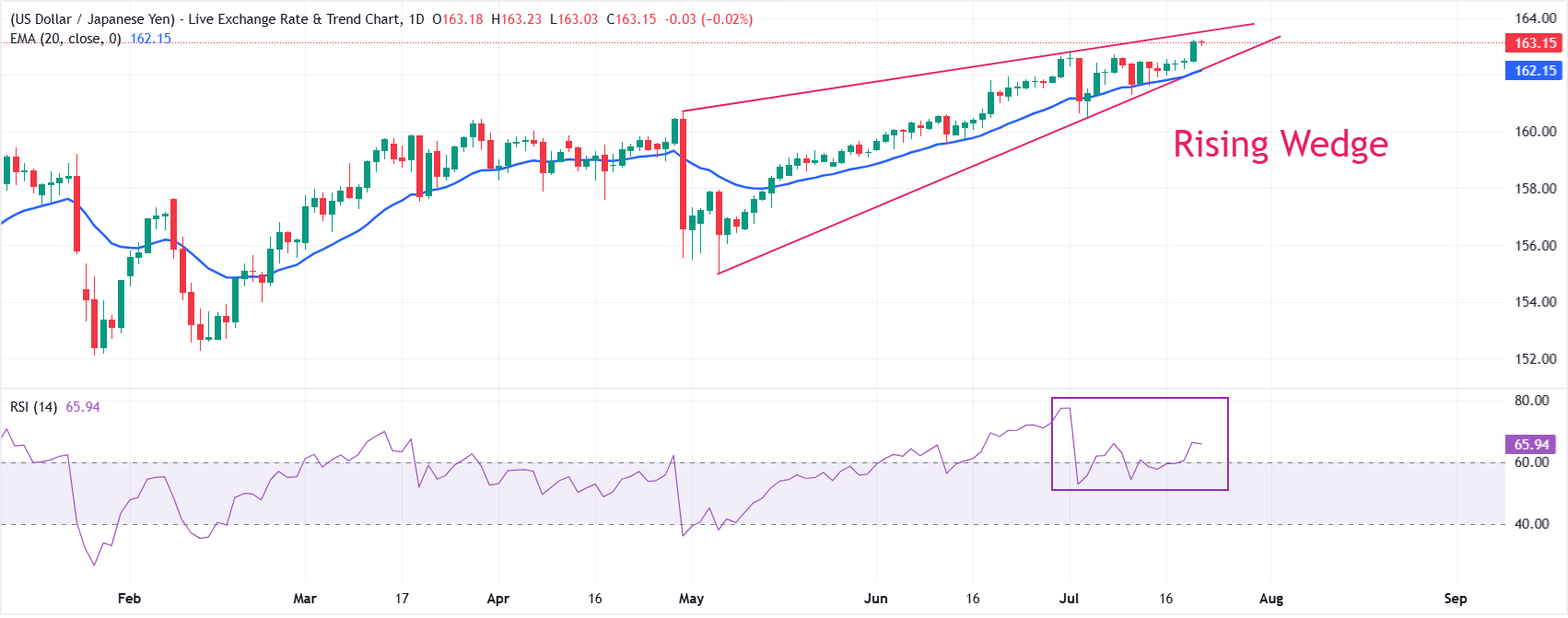
Bias: USD/JPY trades firmly at around 163.20 at press time. The overall bias is bullish as the 20-day Exponential Moving Average (EMA) slopes higher at around 162.15 and the reclaimed upward support trend line around 162.16, which both now underpin the bullish near-term bias.
Momentum: The Relative Strength Index (14) stands at 65.94, staying in positive territory just shy of classic overbought thresholds and suggesting that upside momentum remains constructive, though increasingly stretched.
Pattern: There is a Rising Wedge formation on the daily chart, which generally leads to a bearish reversal after a strong rally. However, the pair could extend the rally if it breaks the chart pattern on the upside above the upper border, which is around 163.50.
Resistance: USD/JPY could extend its advance towards 164.00 once it breaks above the immediate hurdle of 163.50.
Support: On the downside, initial support is clustered in the 162.15–162.16 area, where the 20-day EMA and the former breakout point of the rising trend line converge as a key demand zone before any deeper correction can develop.
(The technical analysis of this story was written with the help of an AI tool. Know more.)
Japanese Yen FAQs
The Japanese Yen (JPY) is one of the world’s most traded currencies. Its value is broadly determined by the performance of the Japanese economy, but more specifically by the Bank of Japan’s policy, the differential between Japanese and US bond yields, or risk sentiment among traders, among other factors.
One of the Bank of Japan’s mandates is currency control, so its moves are key for the Yen. The BoJ has directly intervened in currency markets sometimes, generally to lower the value of the Yen, although it refrains from doing it often due to political concerns of its main trading partners. The BoJ ultra-loose monetary policy between 2013 and 2024 caused the Yen to depreciate against its main currency peers due to an increasing policy divergence between the Bank of Japan and other main central banks. More recently, the gradually unwinding of this ultra-loose policy has given some support to the Yen.
Over the last decade, the BoJ’s stance of sticking to ultra-loose monetary policy has led to a widening policy divergence with other central banks, particularly with the US Federal Reserve. This supported a widening of the differential between the 10-year US and Japanese bonds, which favored the US Dollar against the Japanese Yen. The BoJ decision in 2024 to gradually abandon the ultra-loose policy, coupled with interest-rate cuts in other major central banks, is narrowing this differential.
The Japanese Yen is often seen as a safe-haven investment. This means that in times of market stress, investors are more likely to put their money in the Japanese currency due to its supposed reliability and stability. Turbulent times are likely to strengthen the Yen’s value against other currencies seen as more risky to invest in.














