

Gold Price Forecast: XAU/USD struggles to extend recovery above 20-day EMA
- Gold price fails to extend its three-day winning streak as the US Dollar rebounds.
- The Fed is highly anticipated to deliver at least one interest rate hike this year.
- Fed Chair Warsh said at the ECB forum that inflation remains too high.
Gold price (XAU/USD) is down 0.8% to near $4,140 during the European trading session on Monday. The precious metal faces selling pressure as the three-day rally hits a pause after failing to extend above $4,202.
Bullions come under pressure as the US Dollar (USD) bounces back after a negative week. At press time, the US Dollar Index (DXY), which gauges the Greenback’s value against six major currencies, trades 0.22% higher to near 101.10.

Technically, a higher US Dollar makes the Gold price an unfavorable risk-reward bet for investors.
Last week, the US Dollar fell sharply after traders slightly trimmed the Federal Reserve’s (Fed) hawkish interest rate expectations, following the release of the United States (US) Nonfarm Payrolls (NFP) data for June. The US NFP report showed that the economy created 57K fresh jobs, significantly lower than estimates of 110K.
According to the CME FedWatch tool, the odds of the Fed delivering at least one interest rate hike by the end of September are 53.2%, down from 59.4% seen a week ago.
However, traders are still increasingly confident that there will be an interest rate hike by the Fed this year.
Higher interest rates by the Fed diminish the appeal of non-yielding assets, such as Gold.
Also, the latest remarks from Fed Chairman Kevin Warsh at the European Central Bank (ECB) Forum in Sintra show that officials are more concerned about inflation than the labor market. Warsh said at the Forum that inflation remains “too high”, and stressed to bring price stability.
Gold technical analysis
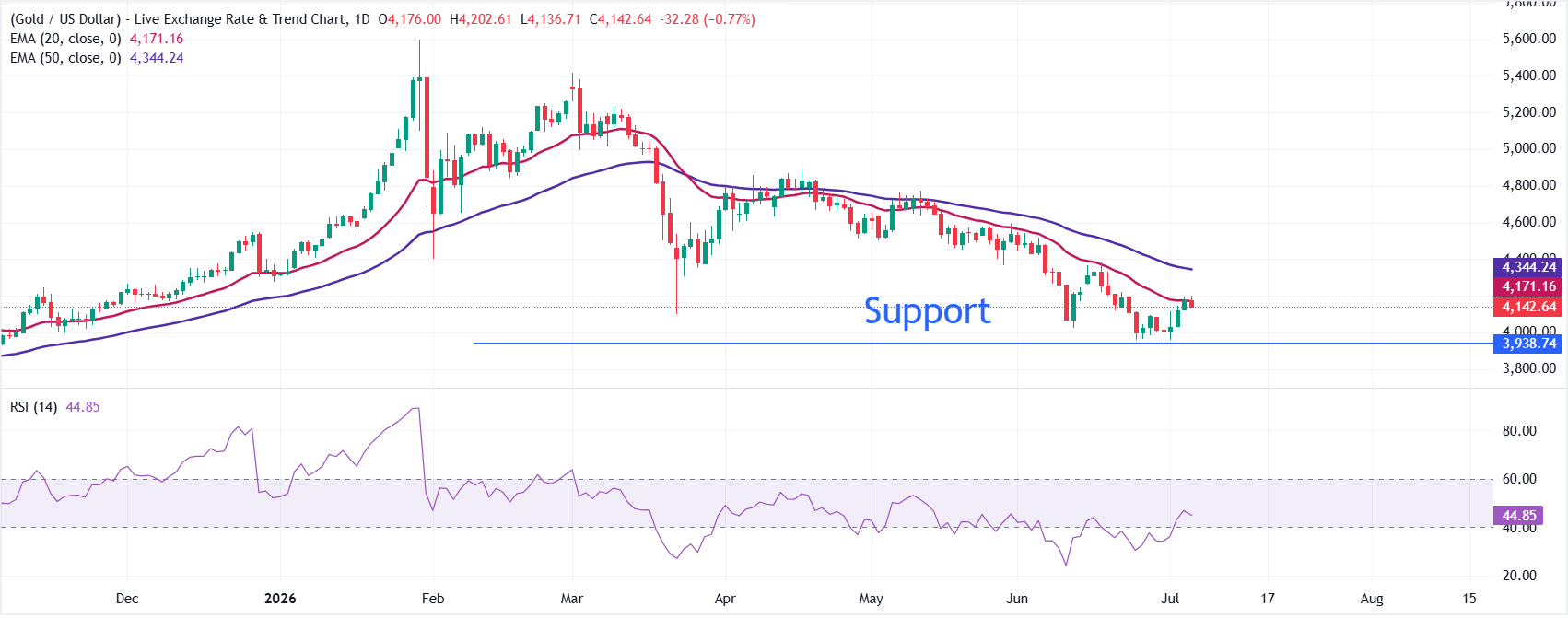
XAU/USD trades lower at around $4,143.46, maintaining a bearish near-term bias as it holds beneath both the 20-day Exponential Moving Average (EMA) at roughly $4,171 and the 50-day EMA near $4,344. The dual cluster of overhead EMAs suggests rallies are likely to be capped while price remains lodged below these trend gauges, with the Relative Strength Index (RSI) hovering just under the 50 line and hinting at subdued bullish momentum during any corrective bounces.
On the topside, initial resistance emerges at the 20-day EMA around $4,171, with a stronger barrier at the 50-day EMA near $4,344, where sellers could look to reassert control if the metal extends a recovery. On the downside, the Gold price could resume its downside journey if it fails to hold the June low of $3,941.76. A break below $3,941.76 would expose the Gold price to $3,900, followed by the September 25 low near $3,722.
(This article was created with the help of an Artificial Intelligence tool and reviewed by an editor. Know more.)
Gold FAQs
Gold has played a key role in human’s history as it has been widely used as a store of value and medium of exchange. Currently, apart from its shine and usage for jewelry, the precious metal is widely seen as a safe-haven asset, meaning that it is considered a good investment during turbulent times. Gold is also widely seen as a hedge against inflation and against depreciating currencies as it doesn’t rely on any specific issuer or government.
Central banks are the biggest Gold holders. In their aim to support their currencies in turbulent times, central banks tend to diversify their reserves and buy Gold to improve the perceived strength of the economy and the currency. High Gold reserves can be a source of trust for a country’s solvency. Central banks added 1,136 tonnes of Gold worth around $70 billion to their reserves in 2022, according to data from the World Gold Council. This is the highest yearly purchase since records began. Central banks from emerging economies such as China, India and Turkey are quickly increasing their Gold reserves.
Gold has an inverse correlation with the US Dollar and US Treasuries, which are both major reserve and safe-haven assets. When the Dollar depreciates, Gold tends to rise, enabling investors and central banks to diversify their assets in turbulent times. Gold is also inversely correlated with risk assets. A rally in the stock market tends to weaken Gold price, while sell-offs in riskier markets tend to favor the precious metal.
The price can move due to a wide range of factors. Geopolitical instability or fears of a deep recession can quickly make Gold price escalate due to its safe-haven status. As a yield-less asset, Gold tends to rise with lower interest rates, while higher cost of money usually weighs down on the yellow metal. Still, most moves depend on how the US Dollar (USD) behaves as the asset is priced in dollars (XAU/USD). A strong Dollar tends to keep the price of Gold controlled, whereas a weaker Dollar is likely to push Gold prices up.














