

Gold sinks to two-month lows as doubts on Middle East deal revive USD demand
- Trump rejects sanctions relief unless Tehran gives up uranium.
- Hawkish central banks deepen pressure on non-yielding Gold.
- Traders await GDP, jobs data and Core PCE inflation.
Gold (XAU/USD) plungesmore than 1% on Wednesday as the Greenback recovers some ground, pairing some of its earlier losses, while risk appetite shifted to neutral amid speculation that US-Iran negotiations could stall. At the time of writing, XAU/USD trades at $4,443, its lowest level since March 30.
XAU/USD slides as Iran deal doubts revive Dollar demand
The US Dollar is recovering some ground as US President Donald Trump toughens his posture on Iran. Trump said that there wouldn’t be sanctions relief on Iran unless they agree to give up uranium. He added that Iran wants to make a deal, but the US is not satisfied with it.

Earlier, the White House denied Iran’s state TV report that had revealed the contents of a draft sent to US negotiators.
The US Dollar Index (DXY), which measures the performance of the buck’s value against six currencies, shifted positively in the day, up 0.06% at 99.20, a headwind for the yellow metal.
Major central banks shifting hawkishly could be one reason for Gold’s downturn. The Reserve Bank of New Zealand (RBNZ) delivered a hawkish hold, with forward guidance suggesting they’re open to raising rates due to the impact of the energy shock sparked by the Middle East conflict.
Investors priced in Fed hawkish bets
The US economic docket featured Federal Reserve (Fed) officials, led by Minneapolis Fed President Neel Kashkari. He said that the balance of risks to the dual mandate suggests focusing on inflation. He added that it is too soon to predict the timing of Fed action.
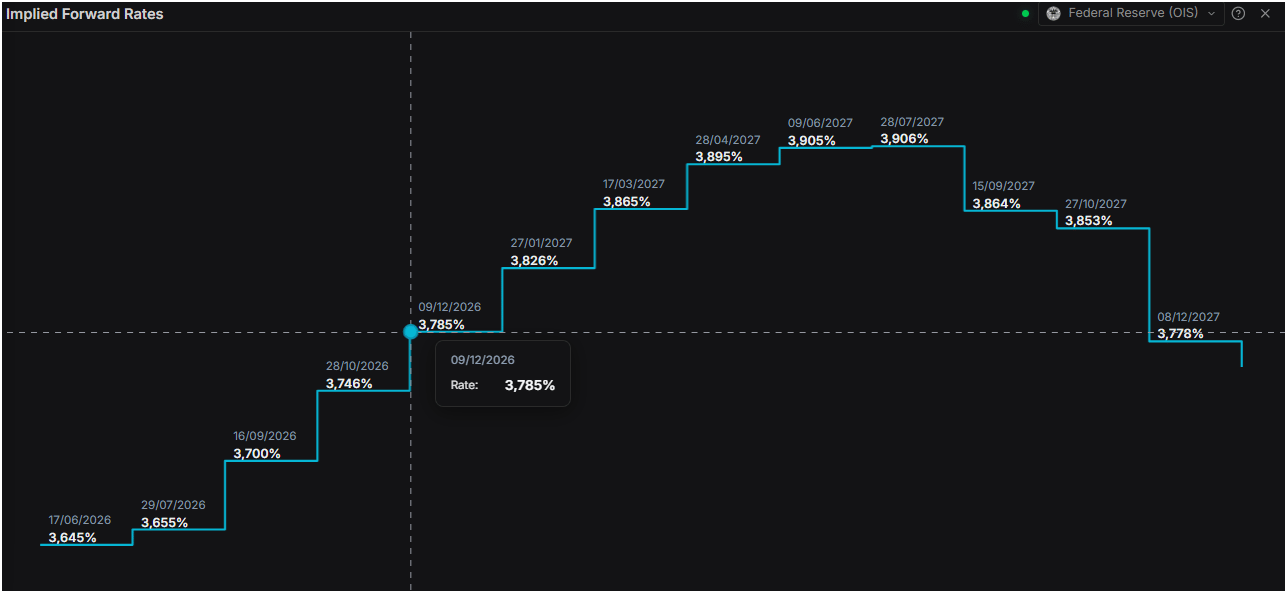
Money markets have priced in a nearly 50% chance that the Federal Reserve, now led by Kevin Warsh, would hike rates towards the end of the year, according to Prime Terminal data.
On the data front, the ADP Employment Change four-week average eased to 35.75K from a revised 40.75K, though it continued to point to underlying resilience in the labor market.
This week, the US economic calendar includes Durable Goods Orders, jobs data, GDP figures, and the Fed’s preferred inflation indicator, the Core PCE Price Index.
XAU/USD technical analysis: Gold extends losses below $4,500, eyes on $4,400
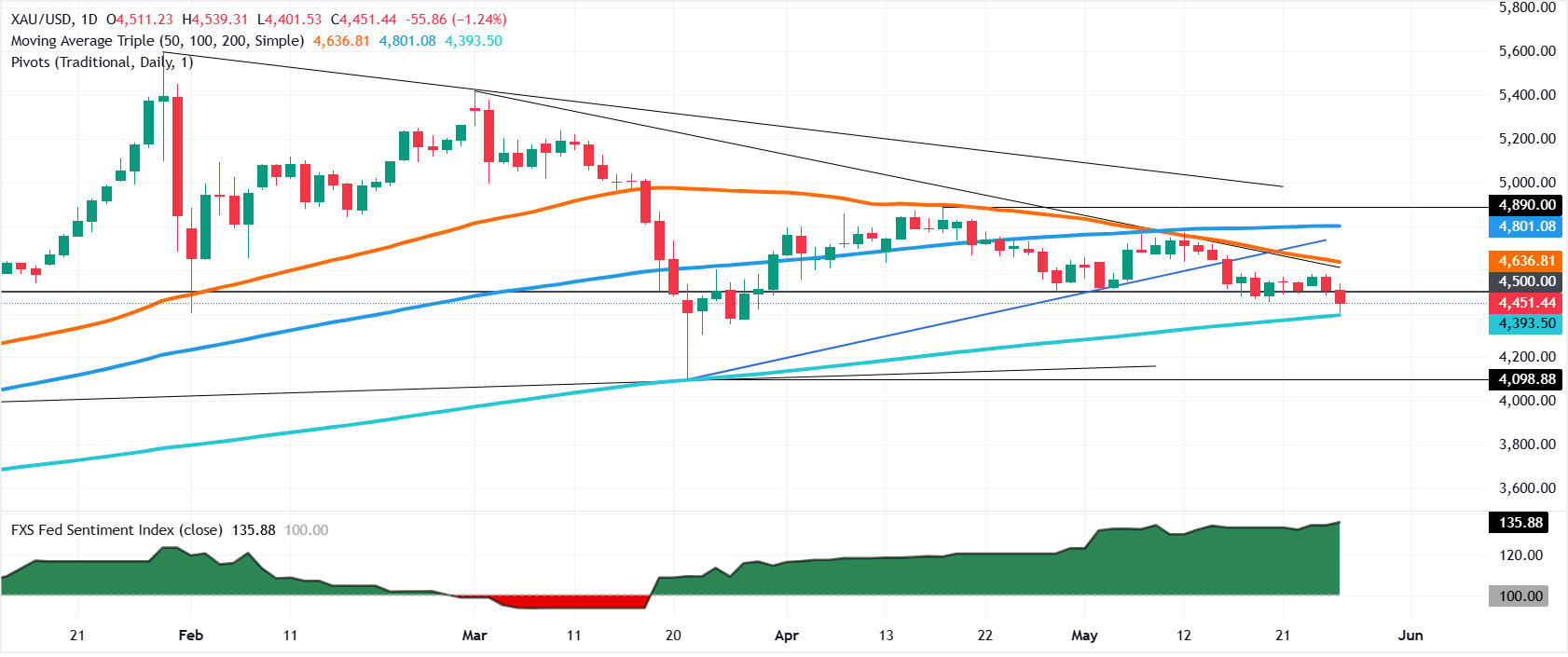
Price action depicts Gold is poised to extend its losses after reaching a two-month low of $4,401, before recovering some ground. The Relative Strength Index (RSI) is falling deep into bearish territory but is still above the oversold area. This suggests that sellers are in charge, opening the door for further losses.
The first support for XAU/USD is $4,400. A breach of the latter will expose the March 23 cycle low of $4,098, ahead of the $4,000 milestone.
Upwards, the first area of interest would be $4,500. Once hurdled, the next stop would be the $4,550 psychological level. Breaking through this could lead to the $4,600 level and eventually challenge the 50-day Simple Moving Average (SMA) at $4,636.
Gold FAQs
Gold has played a key role in human’s history as it has been widely used as a store of value and medium of exchange. Currently, apart from its shine and usage for jewelry, the precious metal is widely seen as a safe-haven asset, meaning that it is considered a good investment during turbulent times. Gold is also widely seen as a hedge against inflation and against depreciating currencies as it doesn’t rely on any specific issuer or government.
Central banks are the biggest Gold holders. In their aim to support their currencies in turbulent times, central banks tend to diversify their reserves and buy Gold to improve the perceived strength of the economy and the currency. High Gold reserves can be a source of trust for a country’s solvency. Central banks added 1,136 tonnes of Gold worth around $70 billion to their reserves in 2022, according to data from the World Gold Council. This is the highest yearly purchase since records began. Central banks from emerging economies such as China, India and Turkey are quickly increasing their Gold reserves.
Gold has an inverse correlation with the US Dollar and US Treasuries, which are both major reserve and safe-haven assets. When the Dollar depreciates, Gold tends to rise, enabling investors and central banks to diversify their assets in turbulent times. Gold is also inversely correlated with risk assets. A rally in the stock market tends to weaken Gold price, while sell-offs in riskier markets tend to favor the precious metal.
The price can move due to a wide range of factors. Geopolitical instability or fears of a deep recession can quickly make Gold price escalate due to its safe-haven status. As a yield-less asset, Gold tends to rise with lower interest rates, while higher cost of money usually weighs down on the yellow metal. Still, most moves depend on how the US Dollar (USD) behaves as the asset is priced in dollars (XAU/USD). A strong Dollar tends to keep the price of Gold controlled, whereas a weaker Dollar is likely to push Gold prices up.














