

Trading
Explore a wide range of markets with competitive pricing, deep liquidity, and advanced trading tools.
Learn More 
Platform
Trade seamlessly with TMGM's powerful platform, built for speed, precision, and a superior trading experience.
Learn More Trading Platform
Academy
Learn the fundamentals of trading with beginner-friendly resources, including guides, webinars, and market insights.
Learn More News & Analysis
Get real-time market updates and expert analysis to stay ahead of trading opportunities
Learn More News & Analysis
About
Learn what sets TMGM apart — our global presence, regulatory strength, and commitment to innovation in trading.
Learn More Why Choose TMGM
Sponsorship
Can the Euro Sustain Support Near 1.1066 Against the US Dollar as the Outlook Remains Uncertain?
- Modest buying supports the Euro against the US Dollar following a decline to a new 18-month low near 1.1066.
- The US Dollar retains support as robust US CPI figures drive a further hawkish reassessment of Fed policy.
- An extension of the ECB’s monetary tightening cycle beyond December appears unlikely.
Selling pressure on the Euro (EUR) eases as the US Dollar (USD) surrenders part of its early advance on Thursday, allowing EUR/USD a modest recovery. Having touched a new 18-month low near 1.1066 earlier in the day, the pair trades broadly unchanged around 1.1090 during European trading.

After reaching a new 18-month peak of 103.08 earlier in the day, the US Dollar Index (DXY) pulls back towards 102.90 in the European session. The index tracks the Greenback against a basket of six major currencies.
Rising inflation in the United States (US) has prompted traders to further strengthen their hawkish expectations for the Federal Reserve (Fed), keeping the US Dollar’s outlook firm.
How Far Has CPI Shifted Fed Funds Futures Towards a Hawkish Outlook?
Despite the closure of US Treasury cash markets, Deutsche Bank analysts observe that the “hawkish implications from the CPI print continued to be felt in futures pricing yesterday.” According to the analysts, “Fed funds futures continued to shift in a hawkish direction, with pricing for the December meeting edging up to 28.5bps.” Looking further along the curve, they add that “expectations for the September 2027 meeting surged another +7bps to 82bps, although that’s edged back down to 77bps overnight,” highlighting the substantial reassessment of the Fed’s policy path following the CPI release.
Friday’s release of the October Producer Price Index (PPI) will provide the next test of the strength of US inflation.
For the Euro, broader pressure persists as market experts question whether the European Central Bank (ECB) can sustain monetary tightening over the longer term. Following two interest rate increases this year, the ECB is expected to announce another at its December meeting. Growing economic uncertainty, however, means that increase is expected to be the last in the cycle.
Could Eurozone Growth Concerns Limit Further ECB Tightening?
The current ECB tightening cycle could be approaching its conclusion, Rabobank strategists warn, observing that “the ECB, however, could prove to be reluctant to hike rates beyond December.” As they explain, “the last ECB press conference suggested that the Governing Council was becoming increasingly concerned about the growth outlook,” supporting expectations of a more cautious approach to additional rate increases after the December move.
EUR/USD Technical Analysis: Can the Pair Ease Its Bearish Bias?
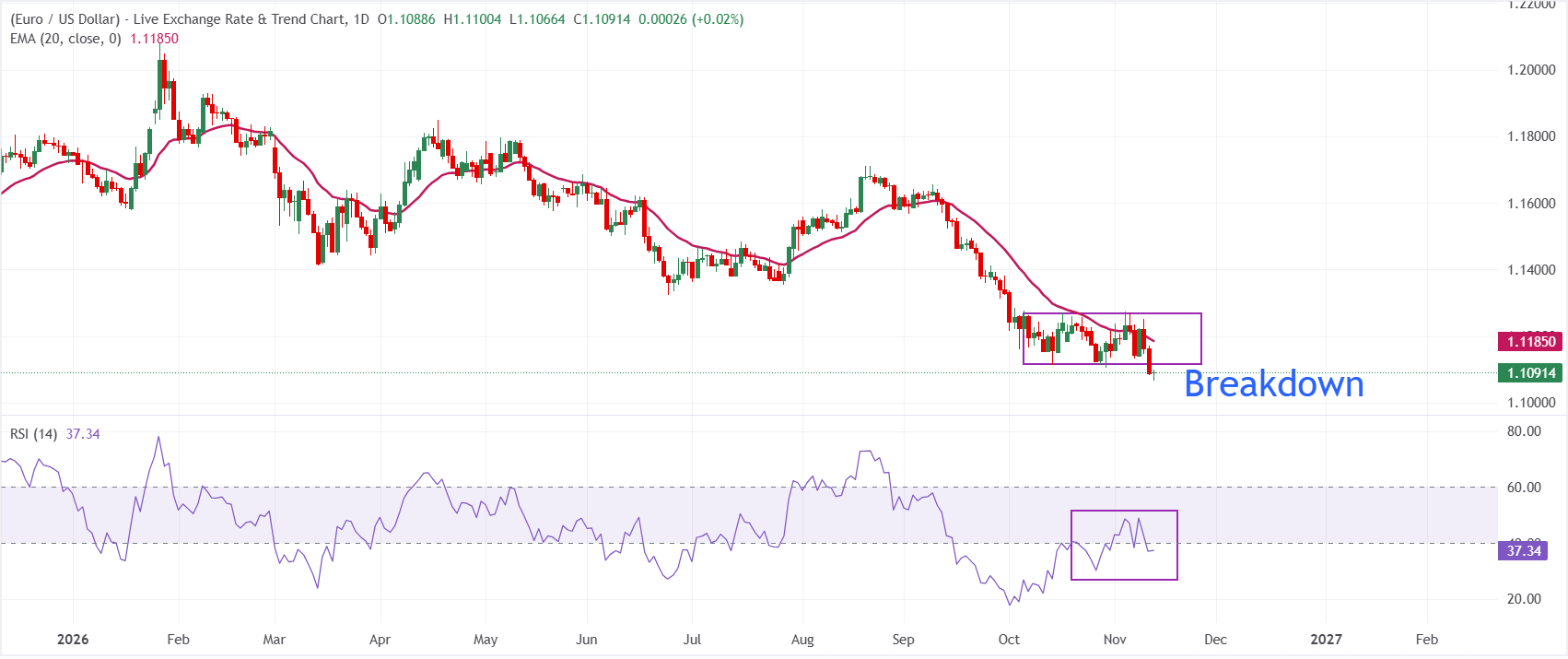
Trading at 1.1091 on the daily chart, EUR/USD retains a bearish near-term outlook below the 20-day Exponential Moving Average (EMA) of 1.1185. This dynamic resistance continues to constrain the pair. Meanwhile, a Relative Strength Index (RSI) reading of 37 remains bearish without reaching oversold territory, suggesting continued downside pressure rather than exhaustion.
A daily close above the 20-day EMA near 1.1185, the immediate resistance level, would be required to soften the prevailing bearish bias. Until EUR/USD clears that moving average, recoveries are likely to attract selling, keeping the pair exposed to new lows in areas where the chart offers no established support levels.
(The technical analysis of this story was written with the help of an AI tool. Know more.)
Euro: Common Questions Answered
Used by the 20 European Union countries within the Eurozone, the Euro ranks as the world’s second-most traded currency after the US Dollar. Its share of all foreign exchange transactions stood at 31% in 2022, while average daily turnover exceeded $2.2 trillion. With an estimated 30% of all transactions, EUR/USD leads global currency-pair trading. It is followed by EUR/JPY (4%), EUR/GBP (3%) and EUR/AUD (2%).
Based in Frankfurt, Germany, the European Central Bank (ECB) serves as the Eurozone’s reserve bank, setting interest rates and overseeing monetary policy. Maintaining price stability is its core mandate, whether through containing inflation or supporting growth. Interest rate increases and reductions are its main policy tools. The Euro generally benefits when rates are relatively high, or expected to rise; the reverse also holds. Monetary policy is decided at eight ECB Governing Council meetings each year. The decision-makers comprise the heads of the Eurozone’s national banks and six permanent members, among them ECB President Christine Lagarde.
The Harmonised Index of Consumer Prices (HICP), which measures Eurozone inflation, provides an important economic gauge for the Euro. An inflation reading above expectations, particularly one exceeding the ECB’s 2% target, requires the central bank to increase interest rates to regain control over price pressures. When the region’s interest rates are relatively high compared with those elsewhere, global investors find it a more attractive destination for their funds, usually supporting the Euro.
The Euro can respond to economic releases because they offer a measure of the economy’s health. GDP, Manufacturing and Services PMIs, employment figures and consumer sentiment surveys are among the indicators that can shape the single currency’s direction. Economic strength supports the Euro by drawing in additional foreign investment. It may also prompt the ECB to raise interest rates, directly strengthening the currency. Weak economic readings, by contrast, are likely to weigh on the Euro. Particular attention is paid to figures from Germany, France, Italy and Spain, the euro area’s four largest economies, which together represent 75% of the Eurozone economy.
The Trade Balance is another key release for the Euro, showing the gap between a country’s export earnings and its import spending over a specified period. Strong overseas demand for a country’s exports creates additional demand for its currency as foreign buyers seek to purchase those goods, lifting its value. A positive net Trade Balance therefore strengthens the currency, while a negative balance has the opposite effect.
POPULAR ARTICLES
1US labor market: Watching claims and wages – UBS2India: RBI seen hiking if CPI tops 6% – Commerzbank3UK GDP: Resilience in Growth Persists – UBS4USD/CHF Price Forecast: Can Support at Previous Highs Around 0.8315 Hold as Bears Test It?5WTI Price Forecast: Bias Stays Bearish as Prices Remain Below 100-SMA Resistance Near $86.806US Dollar: Upside risks find support in hawkish bias – ING7USD/JPY: Pair Approaches 160 Amid Verbal Intervention – MUFG8Can Dow Jones futures stay steady amid a hawkish Fed rate outlook and Nvidia leadership turmoil?9Global equities: How does Nvidia turmoil heighten chip and AI risks? – Rabobank


Get Started!
Sign up and access the Global Markets in less than 3 minutes

Connect With Us












The information provided on this website is of a general nature only and does not constitute personal financial advice. Before acting on any information on this website, you should consider the suitability of the information in relation to your objectives, financial situation and needs. Investing in CFDs and FX Margin Contracts carries significant risks and is not suitable for all investors. You may lose more than your initial deposit. You do not own, or have, any interest in the underlying asset. We recommend that you seek independent advice and ensure you fully understand the risks involved before trading. It is important that you read and consider the disclosure document before you acquire any product listed on the website. The information and advertisements offered on this website are not intended for use by any person in any country or jurisdiction where such use would be contrary to local laws and regulations. The Products and Services offered on this website are not intended for residents of the United States, Malaysia and Thailand.
TMGM is authorized and regulated in various jurisdictions.
Trademax Australia Limited, trading as TMGM, is regulated by the Australian Securities and Investments Commission (ASIC), AFSL no. 436416 and is located at Level 28, One International Tower, 100 Barangaroo Avenue, 2000 Sydney, NSW Australia.
Email: support@tmgm.com.au
Trademax Global Limited, trading as TMGM, is authorized and regulated by the Vanuatu Financial Services Commission (VFSC), registration number 40356 and registered at 1276, Kumul Highway, Port Vila, Vanuatu, Republic of Vanuatu.
Email: support@tmgm.com
Trademax Global Markets (SE) Limited, trading as TMGM, is authorized and regulated by the Financial Services Authority (FSA) of Seychelles, with license number SD224. The company is registered at Office No 13, Providence Estate ABIS Centre, Mahe, Seychelles.
Email: support@tmgm.com
Trademax Global Markets (International) Pty Ltd, trading as TMGM, is authorized and regulated by the Financial Services Commission, Mauritius (FSC) with license no. GB22201012, and registered at 33, Edith Cavell Street C/o IQ EQ Fund Services (Mauritius) Ltd Port Louis, 11324 Mauritius.
Email: support@tmgm.com
Copyright © TMGM. All rights reserved