

Trading
Explore a wide range of markets with competitive pricing, deep liquidity, and advanced trading tools.
Learn More 
Platform
Trade seamlessly with TMGM's powerful platform, built for speed, precision, and a superior trading experience.
Learn More Trading Platform
Academy
Learn the fundamentals of trading with beginner-friendly resources, including guides, webinars, and market insights.
Learn More News & Analysis
Get real-time market updates and expert analysis to stay ahead of trading opportunities
Learn More News & Analysis
About
Learn what sets TMGM apart — our global presence, regulatory strength, and commitment to innovation in trading.
Learn More Why Choose TMGM
Sponsorship
Yen weakens towards 160.00 as markets await Fed speakers and US PPI
- USD/JPY reaches its strongest level since 2 September after escaping a seven-week trading range.
- The interest-rate differential would remain intact if the Fed and BoJ deliver the expected December hikes.
- October producer price data from Japan precede Friday's US release.
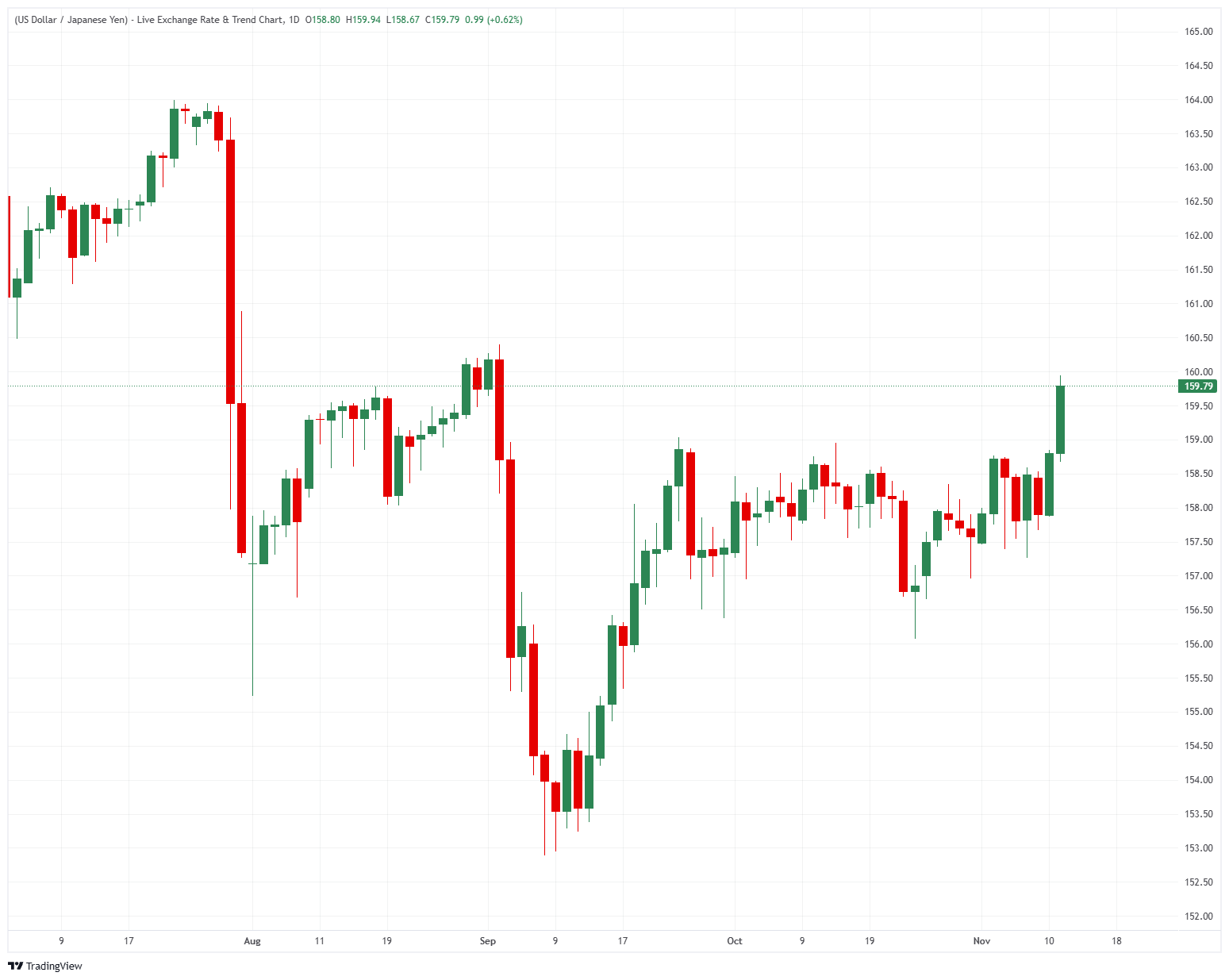
USD/JPY is within striking distance of 160.00 for the first time since early September, as markets await Fed commentary and US producer price data before the weekend. Having broken free of its seven-week trading range, the pair climbed to just below 160.00, its strongest level since 2 September. It now trades slightly off that peak, close to the upper end of Wednesday's range.

Expectations of a Fed rate hike strengthened after the October Consumer Price Index (CPI) rose 0.4%, exceeding forecasts, and Fed Governor Waller described an increase at the 8-9 December meeting as likely. Futures markets now assign a probability of nearly 90% to a quarter-point hike at that meeting. With the Fed's rate at 3.75%-4.00% and the Bank of Japan's (BoJ) at 1.25%, the differential of at least two and a half points rewards investors holding Dollars rather than Yen.
Expectations also point to a BoJ hike. In October's 8-1 decision, BoJ board member Takata voted for a rate of 1.50%; most economists anticipate that the remaining members will back that level at the 17-18 December meeting. If both central banks raise rates by a quarter-point, nine days apart, neither the differential nor the incentive to hold Dollars instead of Yen would change.
Which releases are next on the calendar?
Two Japanese releases will inform the BoJ's December decision, which determines the Japanese side of the rate differential. October corporate goods prices are scheduled for 23:50 GMT on Wednesday, followed by third-quarter Gross Domestic Product (GDP) at 23:50 GMT on Sunday.
Thursday's US jobless claims release is due at 13:30 GMT, with a forecast of 195K compared with 189K. At 14:00 GMT, Cleveland Fed President Hammack begins a sequence of six Fed speeches that day. Friday brings October's US Producer Price Index (PPI) at the same hour; a rise of 0.4% is forecast, against September's 1.3%. A quarter-point Fed hike is already priced in, leaving both releases relevant to the possibility of a half-point increase.
What does the chart show?
Having cleared the 156.00-159.00 band that contained trading since late September, USD/JPY has retraced almost the entire decline from the 2 September high near 160.50 to September's low around 153.00. Its previous two moves above 160.00, at the end of July and the beginning of September, were each followed by a drop of more than five Yen within a week.
Daily price chart: USD/JPY
Japanese Yen: Common Questions
Among the most actively traded currencies globally, the Japanese Yen (JPY) broadly reflects the performance of Japan's economy. More specific influences include Bank of Japan policy, the gap between Japanese and US bond yields, and traders' appetite for risk, alongside other factors.
Currency control is among the Bank of Japan's mandates, making its actions important for the Yen. Although the BoJ has occasionally intervened directly in currency markets, usually to weaken the Yen, political concerns among its main trading partners discourage frequent intervention. Between 2013 and 2024, its ultra-loose monetary stance weakened the Yen against major currency peers as policy increasingly diverged from that of other leading central banks. The gradual withdrawal of this ultra-loose policy has more recently provided the Yen with some support.
By maintaining ultra-loose monetary policy over the last decade, the BoJ allowed its policy stance to diverge increasingly from those of other central banks, particularly the US Federal Reserve. That divergence helped widen the yield gap between 10-year US and Japanese bonds, supporting the US Dollar against the Japanese Yen. The differential is now narrowing following the BoJ's 2024 decision to gradually move away from ultra-loose policy, alongside interest-rate cuts by other major central banks.
Investors often regard the Japanese Yen as a safe-haven investment, making them more inclined to place funds in the currency during periods of market stress because of its perceived reliability and stability. As a result, market turbulence is likely to lift the Yen against currencies viewed as riskier investments.
POPULAR ARTICLES
1Gold drops below $4,000 amid mounting bets on a Fed rate hike2Widening Fed-RBA policy divergence pushes Australian Dollar below 0.68503Yen weakens towards 160.00 as markets await Fed speakers and US PPI4What will the next UK growth figures mean for a Pound at a three-week low?5NASDAQ 100 hits a one-week high as AI stocks recover6Why is the Mexican Peso resisting Fed hike bets as Banxico signals a longer pause?7Bitcoin Bull Score slides to 20 amid contraction in USDT supply – CryptoQuant8GBP/JPY Price Forecast: Can a bullish harami break through 213.00 resistance?9Ethereum Price Forecast: ETH Edges Higher After AI Stocks Recover


Get Started!
Sign up and access the Global Markets in less than 3 minutes

Connect With Us












The information provided on this website is of a general nature only and does not constitute personal financial advice. Before acting on any information on this website, you should consider the suitability of the information in relation to your objectives, financial situation and needs. Investing in CFDs and FX Margin Contracts carries significant risks and is not suitable for all investors. You may lose more than your initial deposit. You do not own, or have, any interest in the underlying asset. We recommend that you seek independent advice and ensure you fully understand the risks involved before trading. It is important that you read and consider the disclosure document before you acquire any product listed on the website. The information and advertisements offered on this website are not intended for use by any person in any country or jurisdiction where such use would be contrary to local laws and regulations. The Products and Services offered on this website are not intended for residents of the United States, Malaysia and Thailand.
TMGM is authorized and regulated in various jurisdictions.
Trademax Australia Limited, trading as TMGM, is regulated by the Australian Securities and Investments Commission (ASIC), AFSL no. 436416 and is located at Level 28, One International Tower, 100 Barangaroo Avenue, 2000 Sydney, NSW Australia.
Email: support@tmgm.com.au
Trademax Global Limited, trading as TMGM, is authorized and regulated by the Vanuatu Financial Services Commission (VFSC), registration number 40356 and registered at 1276, Kumul Highway, Port Vila, Vanuatu, Republic of Vanuatu.
Email: support@tmgm.com
Trademax Global Markets (SE) Limited, trading as TMGM, is authorized and regulated by the Financial Services Authority (FSA) of Seychelles, with license number SD224. The company is registered at Office No 13, Providence Estate ABIS Centre, Mahe, Seychelles.
Email: support@tmgm.com
Trademax Global Markets (International) Pty Ltd, trading as TMGM, is authorized and regulated by the Financial Services Commission, Mauritius (FSC) with license no. GB22201012, and registered at 33, Edith Cavell Street C/o IQ EQ Fund Services (Mauritius) Ltd Port Louis, 11324 Mauritius.
Email: support@tmgm.com
Copyright © TMGM. All rights reserved