

Trading
Explore a wide range of markets with competitive pricing, deep liquidity, and advanced trading tools.
Learn More 
Platform
Trade seamlessly with TMGM's powerful platform, built for speed, precision, and a superior trading experience.
Learn More Trading Platform
Academy
Learn the fundamentals of trading with beginner-friendly resources, including guides, webinars, and market insights.
Learn More News & Analysis
Get real-time market updates and expert analysis to stay ahead of trading opportunities
Learn More News & Analysis
About
Learn what sets TMGM apart — our global presence, regulatory strength, and commitment to innovation in trading.
Learn More Why Choose TMGM
Sponsorship
Bitcoin Bull Score slides to 20 amid contraction in USDT supply – CryptoQuant
- Fears of a deeper Bitcoin correction mount as several market indicators shift into bearish territory and its Bull Score Index drops to 20.
- Demand for the leading cryptocurrency weakens, with apparent demand shrinking by 284,000 BTC over 30 days, the steepest decline since March 2025.
- Tether's USDT records its biggest market-cap contraction since mid-2022, shedding $6.6 billion over 60 days.
Concerns over a deeper correction in Bitcoin (BTC) have intensified as its market indicators turn bearish simultaneously. The warning signs persist despite historical parallels with earlier market bottoms for the leading cryptocurrency.

What does Bitcoin's lowest Bull Score Index since April 2025 signal?
A sharp weakening in market conditions has pushed CryptoQuant's Bull Score Index down from 90 on 13 October to 20 in less than four weeks, the firm said in a report released on Wednesday.
April 2025 saw the most recent comparable fall, after markets sold off on tariff concerns. The index sank to 20 then as well, but rebounded to 80 within two months as Bitcoin formed a local bottom.
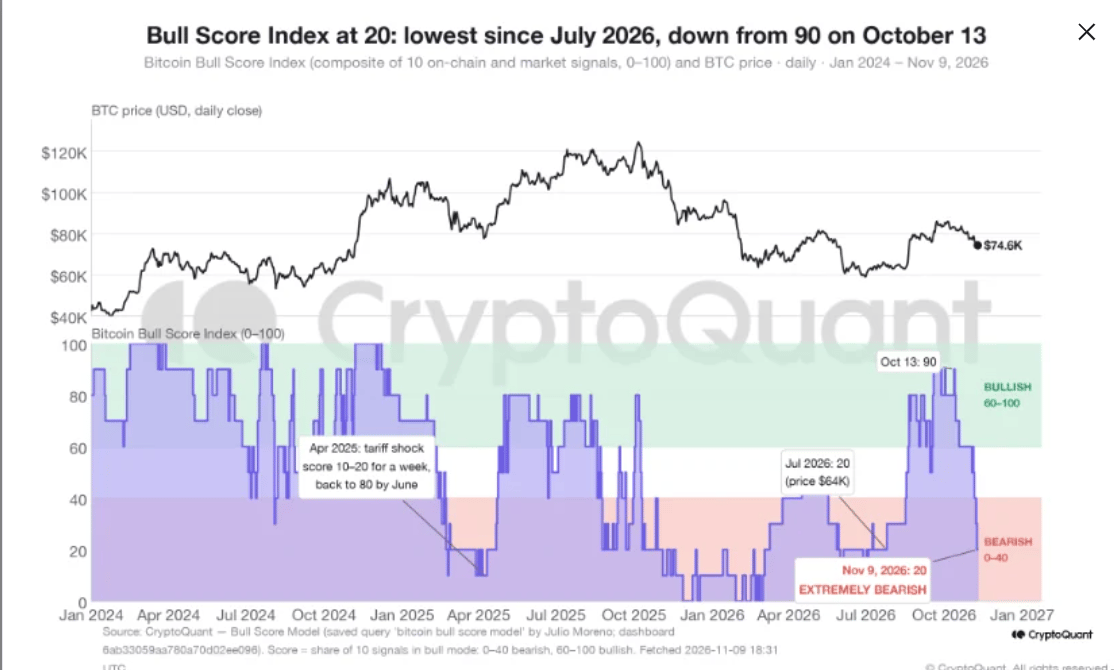
Several forces are driving the latest downturn, the firm cautioned. These include profit-booking after September's rally, a more hawkish outlook for the Federal Reserve (Fed), the Binance hack and the Republicans' midterm defeat.
The report stated: "The April 2025 collapse had a single cause and reversed as soon as the tariff news faded. This one is broader, which argues for a slower repair."
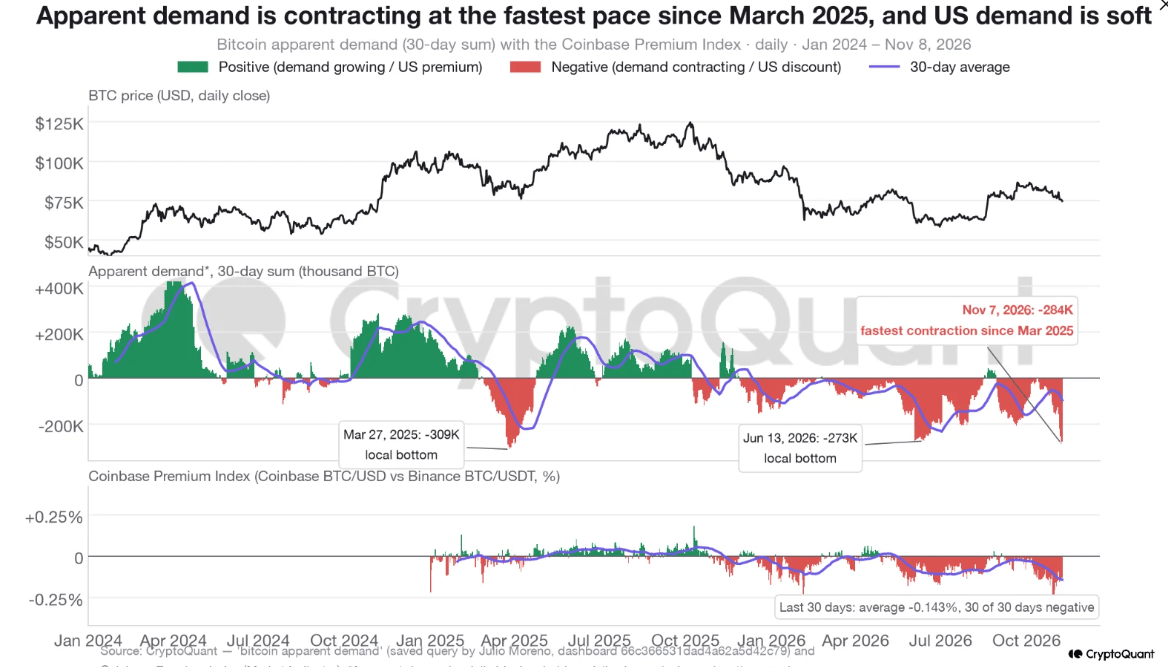
A 284,000 BTC contraction in Bitcoin's apparent demand over 30 days was also the sharpest since 28 March 2025. According to CryptoQuant, comparable declines in March 2025 and June-July 2026 occurred alongside local market bottoms. Apparent demand shrank by 309,000 BTC in March 2025, compared with 273,000 BTC in June 2026.
Weak buying pressure from the US could stand in the way of a recovery, the firm highlighted. The Coinbase Premium Index has stayed below zero over the past 30 days, averaging -0.14%.
CryptoQuant wrote: "In both earlier episodes the premium turned positive before or as demand recovered; US buyers led the bottom. That has not happened yet."
Liquidity in stablecoins is weakening too. Tether's USDT market capitalisation has declined by $6.6 billion over 60 days, which CryptoQuant described as the largest contraction in its available data going back to mid-2022.
Even the $3.2 billion contraction in December 2022 after the FTX collapse was smaller than the latest decline.
The firm noted: "This is the first time in the current cycle that USDT supply, apparent demand and the Bull Score have all been at or near their lows at once."
With rallies in the current cycle depending on stablecoin expansion to provide fresh liquidity, shrinking stablecoin supply could reduce the likelihood of a Bitcoin recovery, CryptoQuant cautioned.
As CryptoQuant noted, “Stablecoin supply is the dry powder of the crypto market; when it shrinks, new demand for Bitcoin has to come from somewhere else,”
Can Bitcoin regain its key 365-day moving average?
The next major support for Bitcoin is now its 200-day moving average at $73,200, after the cryptocurrency slipped beneath the 365-day moving average of $76,400. CryptoQuant regards that breach as a bearish signal. A recovery above the 365-day average would help re-establish Bitcoin's bullish market structure, the firm said.
CryptoQuant wrote: “The 365-day average is itself declining, falling about $40 a day, so reclaiming it gets slightly easier each week the price holds,”
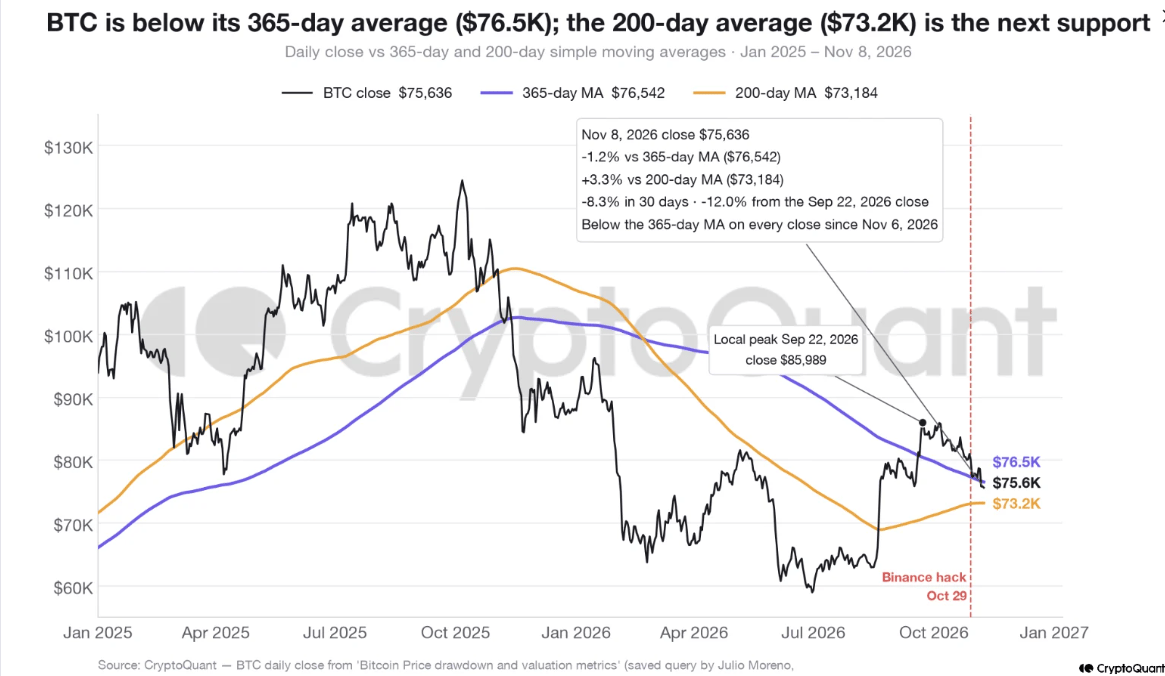
Should Bitcoin continue to slide towards or below the 200-day average, the argument for a deeper correction could become stronger, CryptoQuant warned.
The report added: “The 200-day moving average at $73.2K is the level that separates a shallow correction from a deeper one,”
At the time of writing, Bitcoin trades at $74,400 after gaining 1.3% over the past 24 hours.
POPULAR ARTICLES
1Bitcoin Bull Score slides to 20 amid contraction in USDT supply – CryptoQuant2GBP/JPY Price Forecast: Can a bullish harami break through 213.00 resistance?3Ethereum Price Forecast: ETH Edges Higher After AI Stocks Recover4EUR/USD Price Forecast: Is 1.1000 next after the break below 1.1100?5High US yields lift December Fed hike odds as gold edges below $4,0006Forex Today: UK hard data and Fedspeak move into focus7Swiss Franc Loses Nearly 1% as US Dollar Reaches New Yearly High8US Dollar Index Price Forecast: Can DXY extend gains after bullish flag breakout drives fresh yearly high?9Why is the New Zealand Dollar losing ground as Fed hawks reassert control?


Get Started!
Sign up and access the Global Markets in less than 3 minutes

Connect With Us












The information provided on this website is of a general nature only and does not constitute personal financial advice. Before acting on any information on this website, you should consider the suitability of the information in relation to your objectives, financial situation and needs. Investing in CFDs and FX Margin Contracts carries significant risks and is not suitable for all investors. You may lose more than your initial deposit. You do not own, or have, any interest in the underlying asset. We recommend that you seek independent advice and ensure you fully understand the risks involved before trading. It is important that you read and consider the disclosure document before you acquire any product listed on the website. The information and advertisements offered on this website are not intended for use by any person in any country or jurisdiction where such use would be contrary to local laws and regulations. The Products and Services offered on this website are not intended for residents of the United States, Malaysia and Thailand.
TMGM is authorized and regulated in various jurisdictions.
Trademax Australia Limited, trading as TMGM, is regulated by the Australian Securities and Investments Commission (ASIC), AFSL no. 436416 and is located at Level 28, One International Tower, 100 Barangaroo Avenue, 2000 Sydney, NSW Australia.
Email: support@tmgm.com.au
Trademax Global Limited, trading as TMGM, is authorized and regulated by the Vanuatu Financial Services Commission (VFSC), registration number 40356 and registered at 1276, Kumul Highway, Port Vila, Vanuatu, Republic of Vanuatu.
Email: support@tmgm.com
Trademax Global Markets (SE) Limited, trading as TMGM, is authorized and regulated by the Financial Services Authority (FSA) of Seychelles, with license number SD224. The company is registered at Office No 13, Providence Estate ABIS Centre, Mahe, Seychelles.
Email: support@tmgm.com
Trademax Global Markets (International) Pty Ltd, trading as TMGM, is authorized and regulated by the Financial Services Commission, Mauritius (FSC) with license no. GB22201012, and registered at 33, Edith Cavell Street C/o IQ EQ Fund Services (Mauritius) Ltd Port Louis, 11324 Mauritius.
Email: support@tmgm.com
Copyright © TMGM. All rights reserved