Key Takeaways (RSI Indicator)
The RSI is a momentum oscillator that indicates when assets are overbought or oversold.
It assists in identifying trend reversals, trend strength, and optimal entry and exit points.
Best applied alongside tools such as moving averages, Fibonacci retracement levels, MACD, and trendlines.
Traders should always consider market context and implement risk management strategies.
The RSI performs effectively across forex, equities, and commodities, making it a versatile instrument for all traders.
How the RSI Indicator Works
The Relative Strength Index (RSI) is a widely utilized momentum oscillator that quantifies the velocity and magnitude of price movements. It calculates the ratio of recent average gains to average losses over a specified period, typically 14 periods. This straightforward yet powerful indicator aids traders in spotting overbought and oversold conditions, potential reversals, and trend confirmation signals.

Here’s the methodology:
RSI Calculation Formula:
RSI = 100 - (100 / (1 + RS))
Where RS (Relative Strength) = Average Gain over N periods / Average Loss over N periods
This calculation yields a value between 0 and 100:
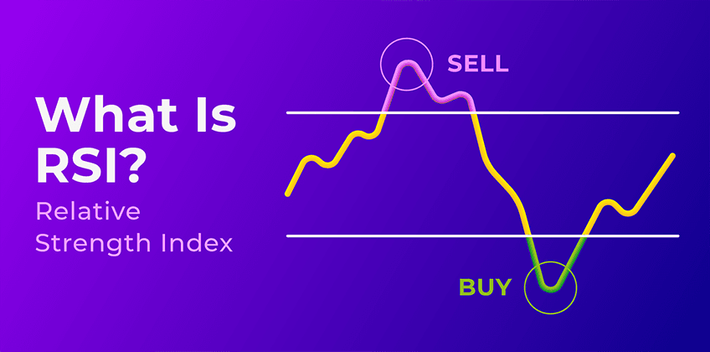
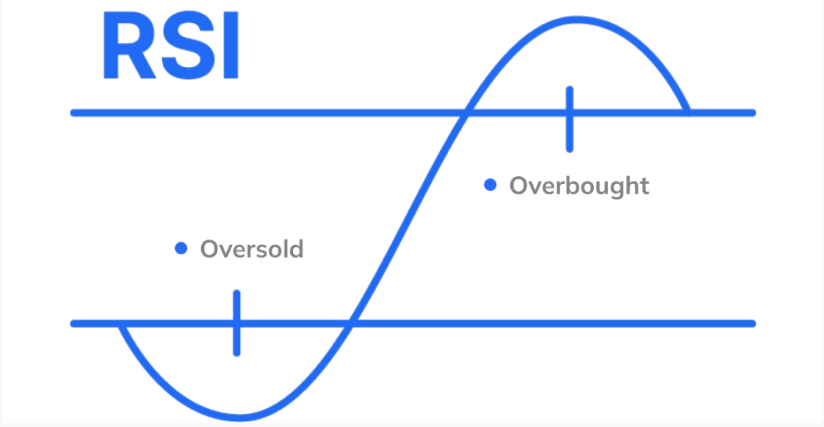
Above 70: Indicates the asset may be overbought , suggesting a potential price correction.
Below 30: Suggests the asset may be oversold, indicating a possible upward price adjustment.
Between 30–and 70: Considered a neutral zone where traders typically await further confirmation.
Example: If a stock’s RSI surpasses 70, it may be deemed overbought, increasing the probability of a price decline. Conversely, an RSI below 30 could indicate oversold conditions and a potential rebound.
RSI Indicator Application in Forex, Equities, and Commodities
The RSI indicator is effective across various asset classes:
Forex Trading:
Forex markets exhibit continuous price fluctuations. RSI assists in identifying when currency pairs are overbought (above 70) or oversold (below 30).
Equity Trading:
RSI helps identify stocks that are overextended or undervalued based on recent price movements.
A stock consistently showing RSI above 70 may indicate overheating, while below 30 could signal undervaluation and buying opportunities.
Commodity Trading:
Commodities such as gold, Brent crude oil, and silver follow pronounced cycles. RSI helps identify potential turning points in these cycles.
Example: An RSI above 70 during a gold rally may signal an opportune moment to secure profits.
Confirming Trends with the RSI Indicator
The RSI is valuable not only for timing entries and exits but also for confirming trend strength.
In Uptrends: RSI generally remains above 50, reinforcing bullish momentum.
In Downtrends: RSI typically stays below 50, confirming bearish momentum.
Example: During a sustained EUR/USD uptrend, if RSI holds above 50, it supports maintaining long positions.
RSI Divergence: A Strong Signal
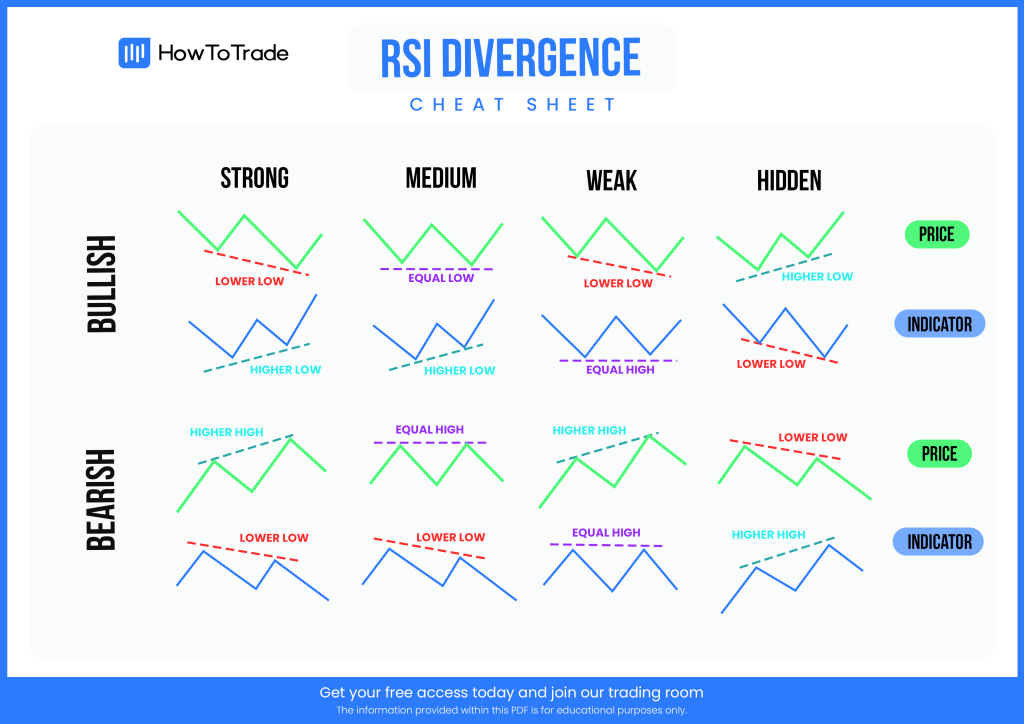
Divergences between price action and RSI can signal weakening trends or imminent reversals.
- Bearish Divergence: Price records higher highs while RSI forms lower highs, indicating waning momentum and a potential sell-off.
Bullish Divergence: Price makes lower lows while RSI forms higher lows, suggesting diminishing bearish momentum and a possible reversal.
Example: If GBP/USD hits a new low but RSI fails to do so, traders might anticipate a bullish reversal setup.
Combining the RSI Indicator with Other Indicators
How to integrate RSI with other indicators?
The RSI’s effectiveness increases when combined with complementary technical tools.
RSI + Moving Averages: An overbought RSI signal near a 200-day moving average resistance can reinforce a short trade setup.
RSI + Fibonacci Retracement: An oversold RSI at the 61.8% Fibonacci retracement level may indicate a high-probability buying opportunity.
RSI + Trendlines: Confirm RSI signals with bounces or breaks of well-defined trendlines.
RSI + Bollinger Bands: Identify volatility expansions or contractions alongside RSI levels.
RSI + MACD: Use RSI to gauge momentum strength and MACD (Moving Average Convergence Divergence) for crossover confirmation.
Common RSI Indicator Pitfalls to Avoid
Overreliance on RSI:
Relying solely on RSI can lead to false signals. It should be integrated within a comprehensive strategy that includes trend analysis, support and resistance levels, and volume confirmation.
Ignoring Market Context:
In strong trending markets, RSI may remain in overbought or oversold zones for prolonged periods. Context is crucial——don’t automatically sell just because RSI crosses 70 during a bullish trend.
Inadequate Risk Management:
RSI signals are not certainties. Always employ stop-loss orders and appropriate position sizing. For example: an overbought RSI combined with a short position should include a stop-loss above recent highs.
RSI Indicator Across Different Markets: Forex, Equities, and Commodities
The RSI’’s adaptability makes it suitable for various markets beyond forex. Here’’s how it can be effectively applied in equity and commodity trading:
Equity Trading:
Use RSI to identify exhaustion during earnings rallies or panic selling episodes.
Divergences during earnings seasons can provide early reversal signals.
Commodity Trading:
- RSI aids in navigating sharp commodity price swings driven by supply disruptions or geopolitical events.
Example: RSI divergence during an oil price spike may signal a speculative peak
The Relative Strength Index (RSI) is a fundamental tool for traders, providing a clear and straightforward method to evaluate market momentum and potential price reversals. Its simplicity and effectiveness across various markets, including forex, equities, and commodities, make it especially valuable for novice traders.
Applying the RSI Indicator on TMGM’’s Platform
Trading with TMGM, a leading global CFD provider, offers numerous benefits, particularly for beginner traders seeking to utilize technical indicators like the Relative Strength Index (RSI). TMGM’’s platform is designed for ease of use, delivering a seamless experience whether trading forex, equities, or commodities.’
Using RSI on TMGM’’s Trading Platform:
Applying the RSI indicator on TMGM is straightforward and efficient. Whether using the web or desktop platform, the RSI can be configured in just a few clicks to complement any advanced trading strategy. Whether employing day trading or swing trading across forex, equities, or commodities, the RSI is one of the most powerful indicators to master.
Here’’s how TMGM enhances RSI-based trading:
Customize RSI Periods: Adjust the RSI timeframe for scalping strategies or extend it for swing trading. TMGM allows you to tailor settings to your trading style.
Optimized for Beginners
Ready to begin trading with a platform that offers powerful tools like RSI and more? Visit TMGM today to explore their platform and elevate your trading. Whether you’’re just starting out or aiming to refine your strategy, TMGM provides the tools and support necessary for success in the markets.