

Trading
Explore a wide range of markets with competitive pricing, deep liquidity, and advanced trading tools.
Learn More 
Platform
Trade seamlessly with TMGM's powerful platform, built for speed, precision, and a superior trading experience.
Learn More Trading Platform
Academy
Learn the fundamentals of trading with beginner-friendly resources, including guides, webinars, and market insights.
Learn More News & Analysis
Get real-time market updates and expert analysis to stay ahead of trading opportunities
Learn More News & Analysis
About
Learn what sets TMGM apart — our global presence, regulatory strength, and commitment to innovation in trading.
Learn More Why Choose TMGM
Sponsorship
0.6850 area: Australian Dollar finds buyers against US Dollar, outlook still uncertain
- 0.6878 is within reach as the Australian Dollar advances against the US Dollar, despite renewed hawkish Fed bets.
- Fears of a supersized Fed interest rate rise follow stronger-than-forecast US CPI figures.
- 78.2: Australian Consumer Sentiment Index weakens in November.
0.2% is the Australian Dollar’s gain in Wednesday’s Asian trading. The Australian Dollar (AUD) strengthens against the US Dollar (USD) from around 0.6845 to near 0.6878. Outperformance against its peers is lifting the Australian currency and AUD/USD. However, concerns over aggressive monetary tightening by the Federal Reserve (Fed) leave the pair’s prospects uncertain.

Concerns that the Fed could deliver a larger interest rate increase at its December policy meeting have intensified after October’s United States (US) Consumer Price Index (CPI) exceeded expectations.
Tuesday’s Bureau of Labor Statistics (BLS) report put headline Consumer Price Index (CPI) growth at 0.4% Month-on-Month (MoM), above the 0.3% forecast. Core CPI, which strips out volatile food and energy items, registered 0.3% over the same period, exceeding expectations of 0.2%.
Before the US CPI release, Fed Governor Christopher Waller said a “half-point Fed rate hike may be needed in December, if October core CPI inflation comes in around 0.3% or higher.”
The CME FedWatch tool now puts the probability of a 50 basis points (bps) Fed rate increase to the 4.25%-4.50% range at around 9%. That outcome had not been priced in before the figures were released.
The stronger-than-expected US CPI report has also supported US Dollar outperformance. At the time of writing, the US Dollar Index (DXY) is retaining Tuesday’s gains around 102.25.
In Australia, November’s Westpac-Melbourne Institute Consumer Sentiment Index fell to 78.2 from October’s 80.4, marking its lowest reading since late 2022. Higher interest rates and elevated inflationary pressures have eroded Australian consumer sentiment.
0.6881: AUD/USD Technical Analysis Points to Bearish Bias
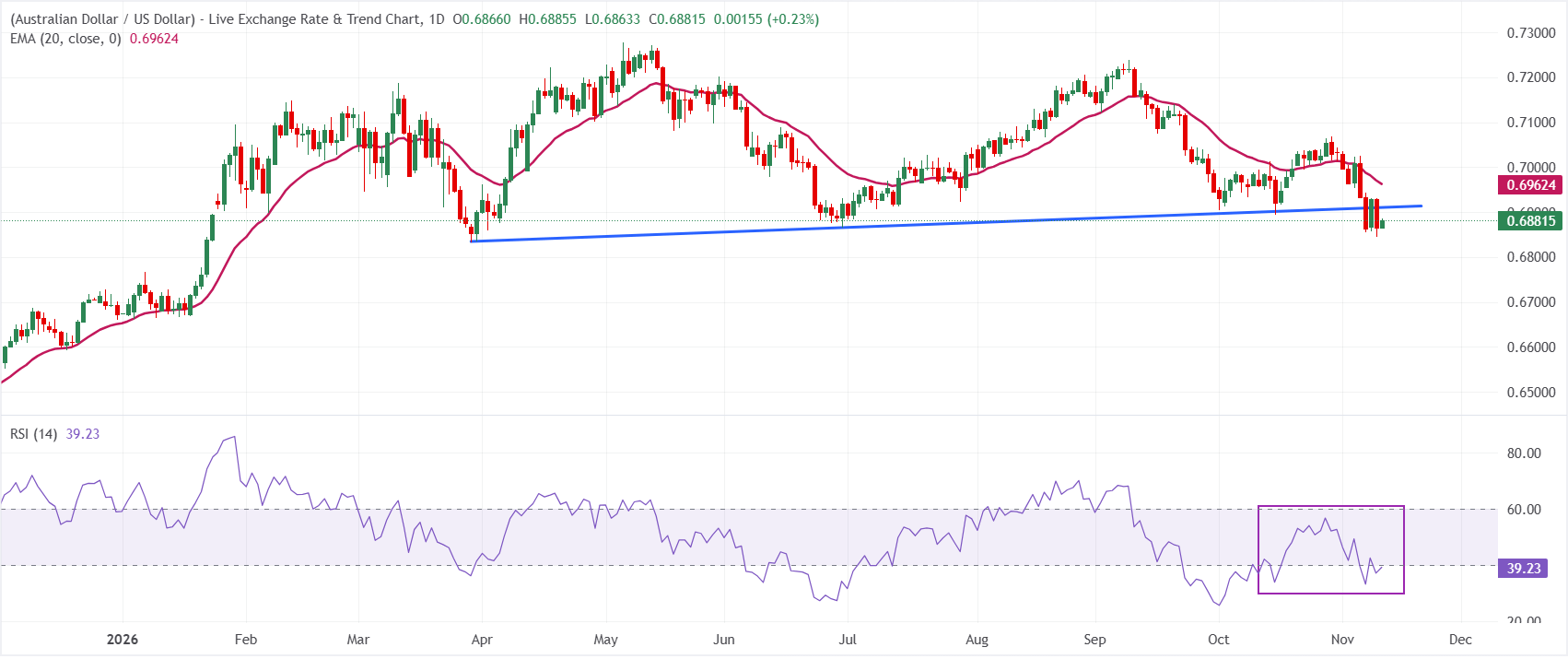
At 0.6881 on the daily chart, AUD/USD retains a bearish short-term bias. The pair has broken below former rising trend-line support at 0.6910, while the 20-day Exponential Moving Average (EMA) near 0.6962 continues to cap gains. Trading beneath both reference levels suggests rebounds are likely to encounter selling. Meanwhile, the Relative Strength Index (RSI), around 39, remains below the neutral 50 threshold. This signals easing downward momentum, although sellers still hold the advantage.
The former trend-line support around 0.6910 now provides initial resistance. Above it, the 20-day EMA near 0.6962 represents a stronger barrier; a daily close beyond that level would be required to relieve immediate bearish pressure. Below the current price, the absence of clearly defined indicator-based support leaves AUD/USD exposed to additional losses. Traders are likely to look for new price-action support near recent lows to assess whether sellers can strengthen their grip or a corrective rebound is beginning to develop.
(The technical analysis of this story was written with the help of an AI tool. Know more.)
Economic Data Indicator
MoM Consumer Price Index Excluding Food & Energy
The Consumer Price Index (CPI) tracks inflationary or deflationary trends by periodically aggregating prices across a representative basket of goods and services. Compiled monthly, the figures are published by the US Department of Labor Statistics. The MoM reading compares goods prices in the reference month with those in the preceding month. By removing the more volatile food and energy components, CPI Ex Food & Energy aims to measure price pressures more accurately. A higher reading is generally regarded as supportive of the US Dollar (USD), whereas a lower reading is viewed as negative for the currency.
Find out more.Latest release: Tue 10 Nov 2026 13:30
Release schedule: Every month
Reported figure: 0.3%
Market consensus: 0.2%
Prior reading: 0.3%
Data source: US Bureau of Labor Statistics
Around 2% YoY is the inflation rate envisaged under the US Federal Reserve’s mandate. The central bank has two objectives: price stability and maximum employment. Since the onset of the pandemic, which continues to this day, inflation has become the weakest pillar of that mandate. Supply-chain disruptions and bottlenecks continue to drive price pressures higher, while the Consumer Price Index (CPI) remains at multi-decade highs. Having already acted to curb inflation, the Fed is expected to retain an aggressive stance for the foreseeable future.
POPULAR ARTICLES
1$1,000 Support Test: Zcash (ZEC) Price Forecast as Hot US CPI Data Counters Grayscale’s Marketing2$53.00 Pivotal Resistance: Silver Price Forecast favours XAG/USD bears below this level3Fed rate-hike prospects keep United States Dollar Index steady4$4,050: Gold advances as USD pauses rally fuelled by hot CPI; Fed hike bets set to limit gains53 Top Price Predictions: Bitcoin, Ethereum, Ripple – BTC, ETH and XRP Fall Further as Inflation Accelerates60.6850 area: Australian Dollar finds buyers against US Dollar, outlook still uncertain7Canadian Dollar falls even as oil prices climb899th percentile for Bitcoin leverage as Nasdaq correlation strengthens9USD/JPY gains as Fed rate hike expectations pressure Japanese Yen


Get Started!
Sign up and access the Global Markets in less than 3 minutes

Connect With Us












The information provided on this website is of a general nature only and does not constitute personal financial advice. Before acting on any information on this website, you should consider the suitability of the information in relation to your objectives, financial situation and needs. Investing in CFDs and FX Margin Contracts carries significant risks and is not suitable for all investors. You may lose more than your initial deposit. You do not own, or have, any interest in the underlying asset. We recommend that you seek independent advice and ensure you fully understand the risks involved before trading. It is important that you read and consider the disclosure document before you acquire any product listed on the website. The information and advertisements offered on this website are not intended for use by any person in any country or jurisdiction where such use would be contrary to local laws and regulations. The Products and Services offered on this website are not intended for residents of the United States, Malaysia and Thailand.
TMGM is authorized and regulated in various jurisdictions.
Trademax Australia Limited, trading as TMGM, is regulated by the Australian Securities and Investments Commission (ASIC), AFSL no. 436416 and is located at Level 28, One International Tower, 100 Barangaroo Avenue, 2000 Sydney, NSW Australia.
Email: support@tmgm.com.au
Trademax Global Limited, trading as TMGM, is authorized and regulated by the Vanuatu Financial Services Commission (VFSC), registration number 40356 and registered at 1276, Kumul Highway, Port Vila, Vanuatu, Republic of Vanuatu.
Email: support@tmgm.com
Trademax Global Markets (SE) Limited, trading as TMGM, is authorized and regulated by the Financial Services Authority (FSA) of Seychelles, with license number SD224. The company is registered at Office No 13, Providence Estate ABIS Centre, Mahe, Seychelles.
Email: support@tmgm.com
Trademax Global Markets (International) Pty Ltd, trading as TMGM, is authorized and regulated by the Financial Services Commission, Mauritius (FSC) with license no. GB22201012, and registered at 33, Edith Cavell Street C/o IQ EQ Fund Services (Mauritius) Ltd Port Louis, 11324 Mauritius.
Email: support@tmgm.com
Copyright © TMGM. All rights reserved