

Trading
Explore a wide range of markets with competitive pricing, deep liquidity, and advanced trading tools.
Learn More 
Platform
Trade seamlessly with TMGM's powerful platform, built for speed, precision, and a superior trading experience.
Learn More Trading Platform
Academy
Learn the fundamentals of trading with beginner-friendly resources, including guides, webinars, and market insights.
Learn More News & Analysis
Get real-time market updates and expert analysis to stay ahead of trading opportunities
Learn More News & Analysis
About
Learn what sets TMGM apart — our global presence, regulatory strength, and commitment to innovation in trading.
Learn More Why Choose TMGM
Sponsorship
Q3 UK GDP is expected to point to continued economic growth
- Q3 UK GDP growth is forecast to accelerate.
- Robust manufacturing activity is expected to lift Gross Domestic Product growth further in the three months to September.
- The 1.3500 area remains the target for Pound Sterling bulls as the currency retains a positive near-term trend against the US Dollar.
0.7% growth is expected in the three months to September. The preliminary third-quarter Gross Domestic Product (GDP) estimate, due from the Office for National Statistics on Thursday, is this week’s main economic release in the United Kingdom (UK). Markets anticipate an acceleration from 0.5% in the second quarter of 2026, alongside a rise in annual growth to 1.9% from 1.4% in the previous month.

Industrial Production is forecast to rise 3% in the 12 months to September, up from 1.6% in August. This strength is considered a key contributor to UK economic growth. Confirmation would create favourable conditions for the Bank of England (BoE) to prolong the monetary tightening cycle it began last week.
UK GDP forecast: Growth figures and their implications
Despite uncertainty surrounding the Middle East war and higher oil prices, recent UK macroeconomic releases have proved unexpectedly resilient. That performance has lifted market expectations for third-quarter growth.
Released last month, August’s monthly GDP figures exceeded forecasts, showing economic expansion of 0.1% rather than the 0.1% contraction markets had expected. Manufacturing provided the support: factory output rose 0.8% in August, largely compensating for stagnant services activity and a 0.2% fall in construction output.
Further evidence of resilience came from the UK Manufacturing and Services Purchasing Managers’ Index (PMI) readings, which indicated continued business expansion in October. Unemployment also fell to its lowest level since July last year. This broadly healthy macroeconomic backdrop prompted the International Monetary Fund to upgrade its UK growth forecast for 2026 from 1% to 1.3%.
A neutral UK budget has also supported the favourable economic backdrop and the British Pound. For now, it has eased concerns over the substantial public debt. Higher taxes on banks and gambling companies are expected to fund lower charges on food and energy bills, and the much-feared bond markets have registered no significant opposition to these proposals.
Against this backdrop, last week’s Bank of England rate increase gives the third-quarter GDP report particular significance. Although economic growth is not an explicit objective within the BoE’s mandate, a healthy GDP reading would undoubtedly simplify its rate-setting decisions while consumer inflation remains stubbornly high.
The BoE delivered its first monetary tightening in three years last week. Governor Bailey was among the policymakers signalling that further rate increases might be required to return inflation to target. On Tuesday, Deputy Governor Clare Lombardelli took that message further, stating that she “would not rule out rate hike possibility in December”. A robust GDP release on Thursday would reinforce those views and could encourage speculative buying of the Pound.
07:00 GMT Thursday: UK Q2 GDP release and GBP/USD implications
Thursday at 07:00 GMT is the scheduled release time for the UK’s preliminary Q2 GDP estimate. Moderate expansion is forecast for the three months to June. Risks for GBP/USD lean upwards: an above-forecast result would strengthen expectations of another BoE rate rise, most likely in February.
At the time of writing, GBP/USD is trading around 1.3320 after reversing sharply on Tuesday. Strong US inflation figures and hawkish remarks from Fed speakers had lifted the US Dollar broadly. Sellers have driven the pair beneath the lower boundary of the ascending channel in place since October. Momentum signals on the 4-hour chart have also shifted into bearish territory: the Relative Strength Index (14) is nearing oversold levels, while red bars on the Moving Average Convergence Divergence (MACD) histogram are widening.
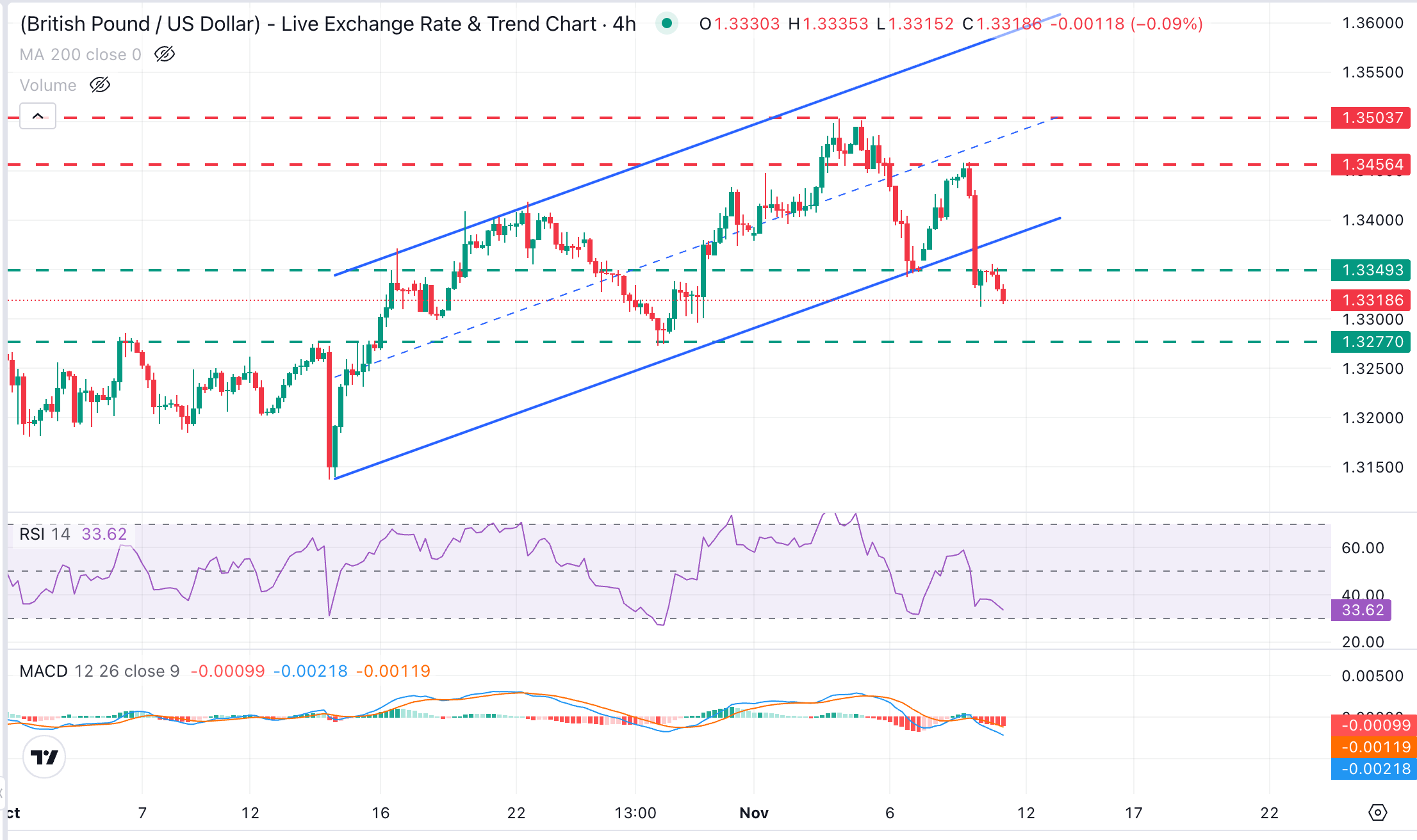
FXStreet FX Analyst Guillermo Alcalá describes the outlook as follows: “Recent GBP/USD price action suggests that the corrective recovery from mid-October lows might have come to an end, and that the pair is ready to resume the broader bearish trend.”
Alcalá outlines the downside scenario: “While below the channel bottom and the November 6 low, near 1.3340, bears are likely to be tempted to revisit the late October lows near 1.3270, with their gaze on the key resistance area near 1.3130,”
For an upside shift, Alcalá sets out this requirement: “The pair would need to return above the broken trendline support, now around 1.3380, to ease bearish pressure, and shift the focus back towards the November 10 high near 1.3460 and the November peak, in the 1.3500 area.”
Economic data indicator
Quarter-on-quarter Gross Domestic Product (QoQ)
Published monthly and quarterly by the Office for National Statistics, Gross Domestic Product (GDP) captures the total value of goods and services produced in the UK over a specified period. It serves as the principal gauge of UK economic activity. The QoQ figure measures activity in the reporting quarter against the preceding quarter. An increase in the indicator is generally positive for the Pound Sterling (GBP), whereas a low reading is regarded as negative.
View more details.Upcoming release: Thu 12 Nov 2026 07:00 (Prel)
Release frequency: Every quarter
Market consensus: 0.7%
Prior reading: 0.5%
Data source: Office for National Statistics
BoE: Key Questions Answered
2% is the Bank of England’s target for a steady inflation rate. Achieving this ‘price stability’ is the primary objective of the Bank of England (BoE), which determines monetary policy for the United Kingdom. It pursues that objective by adjusting base lending rates. By setting the rate at which it lends to commercial banks and at which banks lend to one another, the BoE determines interest rates across the wider economy. The value of the Pound Sterling (GBP) is also affected.
Higher interest rates support the Pound Sterling by making the UK a more attractive destination for global investors’ funds. The Bank of England raises rates in response to inflation exceeding its target, increasing borrowing costs for households and businesses. Conversely, below-target inflation signals slowing economic growth. In that situation, the BoE will consider cutting rates to reduce credit costs, hoping businesses will borrow to fund projects that generate growth. This is negative for the Pound Sterling.
A weaker Pound Sterling is the usual outcome of Quantitative Easing (QE), a policy the Bank of England can deploy in extreme circumstances. As a last resort when interest rate cuts will not deliver the required result, QE substantially expands the flow of credit through a stalled financial system. To implement it, the BoE prints money and buys assets from banks and other financial institutions. These assets are usually government bonds or AAA-rated corporate bonds.
The Pound Sterling usually benefits from Quantitative tightening (QT). This reversal of QE is implemented as the economy strengthens and inflation begins to rise. Under QE, the Bank of England (BoE) buys government and corporate bonds from financial institutions to encourage lending. Under QT, it ceases further bond purchases and no longer reinvests principal repaid as its existing bond holdings mature.
POPULAR ARTICLES
1177.00 gives way: EUR/JPY price forecast as pair slips near nine-day EMA2Ripple and Stellar outlook: XRP consolidates after losses as XLM recovery gains ground3Larger Fed rate hike in focus as traders put New Zealand Dollar under pressure against US Dollar4Q3 UK GDP is expected to point to continued economic growth510-month lows in view as Australian Dollar retreats6Above 103.00: US Dollar Index (DXY) climbs to highest since April 2025 amid Fed bets and Iran risks7Near 1.1100: Euro edges higher as traders weigh ECB's rate outlook8Two-month low: Japanese Yen rebounds as BoJ rate hike bets and intervention risk converge9BoJ's Asada says expected economic impact of earlier rate rises must be taken into account


Get Started!
Sign up and access the Global Markets in less than 3 minutes

Connect With Us












The information provided on this website is of a general nature only and does not constitute personal financial advice. Before acting on any information on this website, you should consider the suitability of the information in relation to your objectives, financial situation and needs. Investing in CFDs and FX Margin Contracts carries significant risks and is not suitable for all investors. You may lose more than your initial deposit. You do not own, or have, any interest in the underlying asset. We recommend that you seek independent advice and ensure you fully understand the risks involved before trading. It is important that you read and consider the disclosure document before you acquire any product listed on the website. The information and advertisements offered on this website are not intended for use by any person in any country or jurisdiction where such use would be contrary to local laws and regulations. The Products and Services offered on this website are not intended for residents of the United States, Malaysia and Thailand.
TMGM is authorized and regulated in various jurisdictions.
Trademax Australia Limited, trading as TMGM, is regulated by the Australian Securities and Investments Commission (ASIC), AFSL no. 436416 and is located at Level 28, One International Tower, 100 Barangaroo Avenue, 2000 Sydney, NSW Australia.
Email: support@tmgm.com.au
Trademax Global Limited, trading as TMGM, is authorized and regulated by the Vanuatu Financial Services Commission (VFSC), registration number 40356 and registered at 1276, Kumul Highway, Port Vila, Vanuatu, Republic of Vanuatu.
Email: support@tmgm.com
Trademax Global Markets (SE) Limited, trading as TMGM, is authorized and regulated by the Financial Services Authority (FSA) of Seychelles, with license number SD224. The company is registered at Office No 13, Providence Estate ABIS Centre, Mahe, Seychelles.
Email: support@tmgm.com
Trademax Global Markets (International) Pty Ltd, trading as TMGM, is authorized and regulated by the Financial Services Commission, Mauritius (FSC) with license no. GB22201012, and registered at 33, Edith Cavell Street C/o IQ EQ Fund Services (Mauritius) Ltd Port Louis, 11324 Mauritius.
Email: support@tmgm.com
Copyright © TMGM. All rights reserved