

Trading
Explore a wide range of markets with competitive pricing, deep liquidity, and advanced trading tools.
Learn More 
Platform
Trade seamlessly with TMGM's powerful platform, built for speed, precision, and a superior trading experience.
Learn More Trading Platform
Academy
Learn the fundamentals of trading with beginner-friendly resources, including guides, webinars, and market insights.
Learn More News & Analysis
Get real-time market updates and expert analysis to stay ahead of trading opportunities
Learn More News & Analysis
About
Learn what sets TMGM apart — our global presence, regulatory strength, and commitment to innovation in trading.
Learn More Why Choose TMGM
Sponsorship
160.00: Yen stalls as Tokyo issues warning before Japan’s growth data
- 160.00 reached: USD/JPY stalls after its first touch since early September.
- 5% surpassed by US 10-year yields as Tokyo warns of excessively rapid Yen moves.
- Friday brings US producer price data; Japan's growth release follows on Sunday.
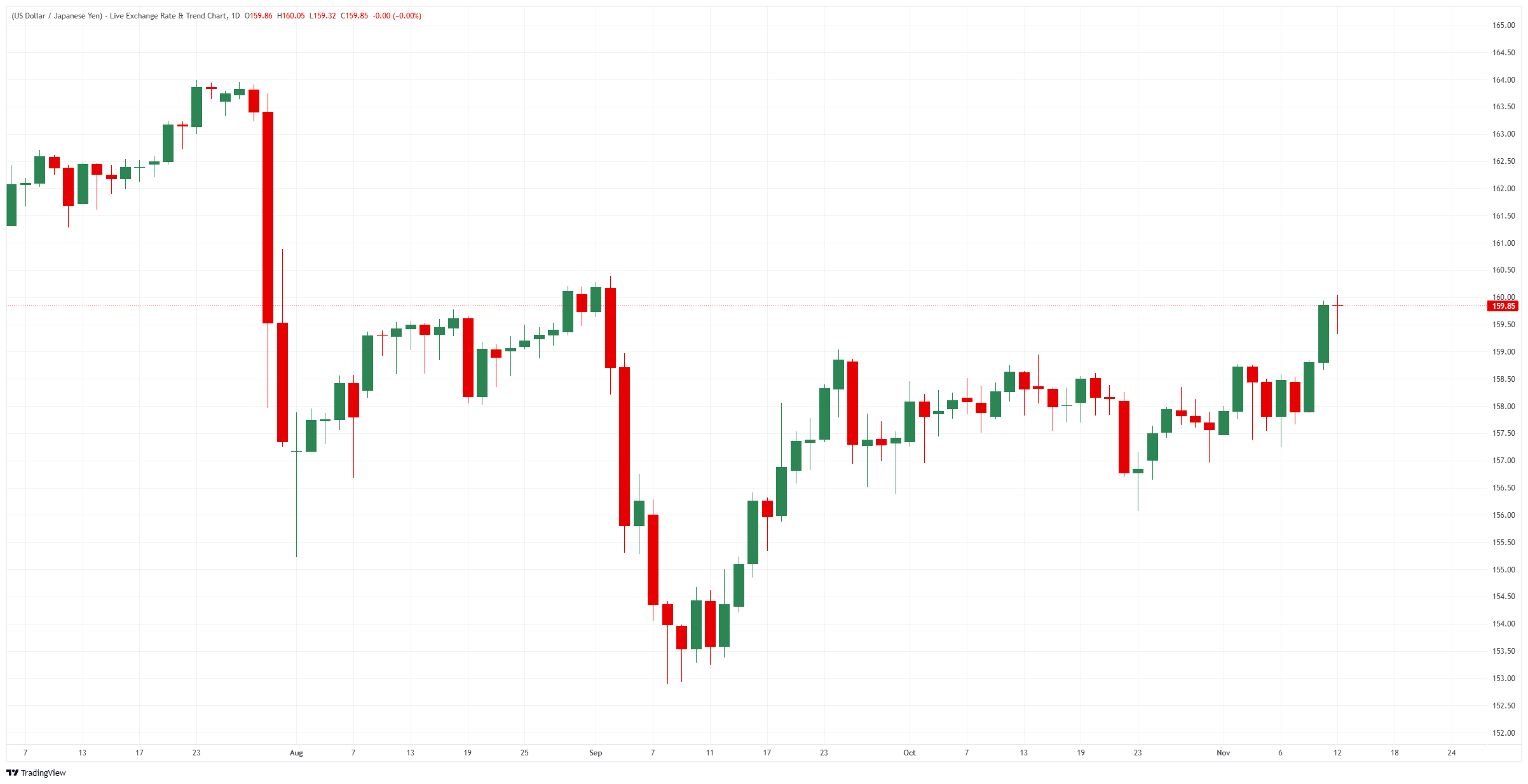
USD/JPY reached 160.00 on Thursday. It was the first touch since early September of a level at which Japan has bought Yen twice this year. The pair failed to hold above it: after a session high marginally over that mark, it is trading just below, almost unchanged from its opening price. The last sizeable move remains Wednesday's breakout from its range.

Recent currency moves have been too rapid, Japan's Vice Finance Minister for International Affairs Mimura said on Thursday, warning that the summer's intervention should not be forgotten. Between July 30 and August 3, Japan spent a record JPY 15.4 trillion. On Thursday, the New York Fed confirmed that the US Treasury had purchased Yen in the third quarter. The intervention drove USD/JPY from close to 164.00 to around 155.00; the pair has since returned to within about four Yen of its starting point.
Markets have fully priced in a Fed rate increase on December 9. Following weak demand at a 30-year auction, the 10-year Treasury yield climbed to around 5.12% on Thursday. Although the Dollar strengthened against the Euro, the Pound and the Kiwi, USD/JPY was unchanged. The Bank of Japan (BoJ) rate stands at 1.25%, compared with the Fed's 3.75%-4.00%.
0.4% producer price forecast leads the calendar
Thursday's schedule includes a speech by New York Fed President Williams at 23:30 GMT. Attention then turns to Friday's US producer price data at 13:30 GMT. A monthly increase of 0.4% is forecast, following 1.3%, with implications for the size of the Fed's December rate rise.
At 23:50 GMT on Sunday, Japan releases preliminary third-quarter Gross Domestic Product (GDP). Quarterly growth is forecast at 0.1%, down from 0.4%. A speech by BoJ board member Takata follows at 04:00 GMT on Monday; he voted for a rate increase on October 30. October national inflation is then due at 23:30 GMT on Thursday, November 19. These three events all precede the BoJ's December 18 decision, at which a rate rise is widely expected.
157.00-159.00 range gives way on the charts
The 157.00-159.00 range had contained USD/JPY since late September before Wednesday's advance took it higher. The pair has retraced about three-fifths of its decline from the late-July peak to the September trough near 153.00. Thursday's narrow trading bar has a low slightly below 159.50, while the opening and latest prices are almost the same.
USD/JPY: daily price chart
Japanese Yen: key questions answered
Among the world's most actively traded currencies, the Japanese Yen (JPY) takes its broad direction from Japan's economic performance. More specific influences include Bank of Japan policy, the gap between Japanese and US bond yields, and traders' appetite for risk, alongside other factors.
Currency control forms part of the Bank of Japan's mandate, making its actions important for the Yen. Direct intervention in currency markets has occasionally been used by the BoJ, usually to weaken the Yen. It avoids frequent intervention, however, because of political concerns among Japan's main trading partners. Between 2013 and 2024, its ultra-loose monetary policy widened the policy gap with other major central banks, weakening the Yen against its principal currency peers. The gradual withdrawal of that policy has more recently provided the Yen with some support.
Over the past decade, continued ultra-loose policy at the BoJ increased its policy divergence from other central banks, notably the US Federal Reserve. As a result, the yield gap between 10-year US and Japanese bonds widened, supporting the US Dollar against the Japanese Yen. That gap is now narrowing as the BoJ gradually moves away from ultra-loose policy following its 2024 decision, while other major central banks cut interest rates.
Investors often regard the Japanese Yen as a safe-haven asset. During periods of market stress, its perceived reliability and stability make investors more likely to shift funds into the currency. Consequently, market turbulence is likely to lift the Yen against currencies viewed as riskier investments.
POPULAR ARTICLES
1Below $3,900: Gold drops to over one-year low on inflation concerns ahead of US PPI data2New Zealand Dollar slide faces RBNZ inflation expectations test30.68 test for Australian Dollar as Fed hawks propel USD to 19-month high4160.00: Yen stalls as Tokyo issues warning before Japan’s growth data518-month low: Euro awaits Eurozone growth and US price data6Three-day slide: Pound awaits upcoming UK jobs and inflation data7$2,000 breached: Ethereum price forecast as ETH drops on Jensen Huang's resignation from Nvidia8Banxico rate cut sends wrong signal on inflation, Heath warns9Bitcoin and crypto market losses deepen after Jensen Huang's resignation


Get Started!
Sign up and access the Global Markets in less than 3 minutes

Connect With Us












The information provided on this website is of a general nature only and does not constitute personal financial advice. Before acting on any information on this website, you should consider the suitability of the information in relation to your objectives, financial situation and needs. Investing in CFDs and FX Margin Contracts carries significant risks and is not suitable for all investors. You may lose more than your initial deposit. You do not own, or have, any interest in the underlying asset. We recommend that you seek independent advice and ensure you fully understand the risks involved before trading. It is important that you read and consider the disclosure document before you acquire any product listed on the website. The information and advertisements offered on this website are not intended for use by any person in any country or jurisdiction where such use would be contrary to local laws and regulations. The Products and Services offered on this website are not intended for residents of the United States, Malaysia and Thailand.
TMGM is authorized and regulated in various jurisdictions.
Trademax Australia Limited, trading as TMGM, is regulated by the Australian Securities and Investments Commission (ASIC), AFSL no. 436416 and is located at Level 28, One International Tower, 100 Barangaroo Avenue, 2000 Sydney, NSW Australia.
Email: support@tmgm.com.au
Trademax Global Limited, trading as TMGM, is authorized and regulated by the Vanuatu Financial Services Commission (VFSC), registration number 40356 and registered at 1276, Kumul Highway, Port Vila, Vanuatu, Republic of Vanuatu.
Email: support@tmgm.com
Trademax Global Markets (SE) Limited, trading as TMGM, is authorized and regulated by the Financial Services Authority (FSA) of Seychelles, with license number SD224. The company is registered at Office No 13, Providence Estate ABIS Centre, Mahe, Seychelles.
Email: support@tmgm.com
Trademax Global Markets (International) Pty Ltd, trading as TMGM, is authorized and regulated by the Financial Services Commission, Mauritius (FSC) with license no. GB22201012, and registered at 33, Edith Cavell Street C/o IQ EQ Fund Services (Mauritius) Ltd Port Louis, 11324 Mauritius.
Email: support@tmgm.com
Copyright © TMGM. All rights reserved