

Giao dịch
Khám phá đa dạng thị trường với mức giá cạnh tranh, thanh khoản sâu và các công cụ giao dịch tiên tiến.
Tìm hiểu thêm 
Nền tảng
Giao dịch mượt mà với nền tảng mạnh mẽ của TMGM, được xây dựng để đảm bảo tốc độ, độ chính xác và trải nghiệm giao dịch vượt trội.
Tìm hiểu thêm Nền tảng Giao dịch
Công cụ Giao dịch
Học viện
Học các kiến thức cơ bản về giao dịch với các tài nguyên thân thiện cho người mới bắt đầu, bao gồm hướng dẫn, hội thảo trực tuyến và nhận định thị trường.
Tìm hiểu thêm Học viện TMGM
Tin tức & Phân tích
Nhận cập nhật thị trường theo thời gian thực và phân tích chuyên gia để luôn dẫn đầu các cơ hội giao dịch
Tìm hiểu thêm Tin tức & Phân tích
Giới thiệu
Tìm hiểu điều gì làm nên sự khác biệt của TMGM — sự hiện diện toàn cầu, sức mạnh quy định và cam kết đổi mới trong giao dịch.
Tìm hiểu thêm Tại sao chọn TMGM
British Pound sells off hard as US surveys outpace the UK's
- GBP/USD sells off to its lowest since early July as US surveys beat forecasts.
- UK services PMI slips to a three-month low of 51.7.
- Thursday's three BoE speakers all voted to hold on September 17.
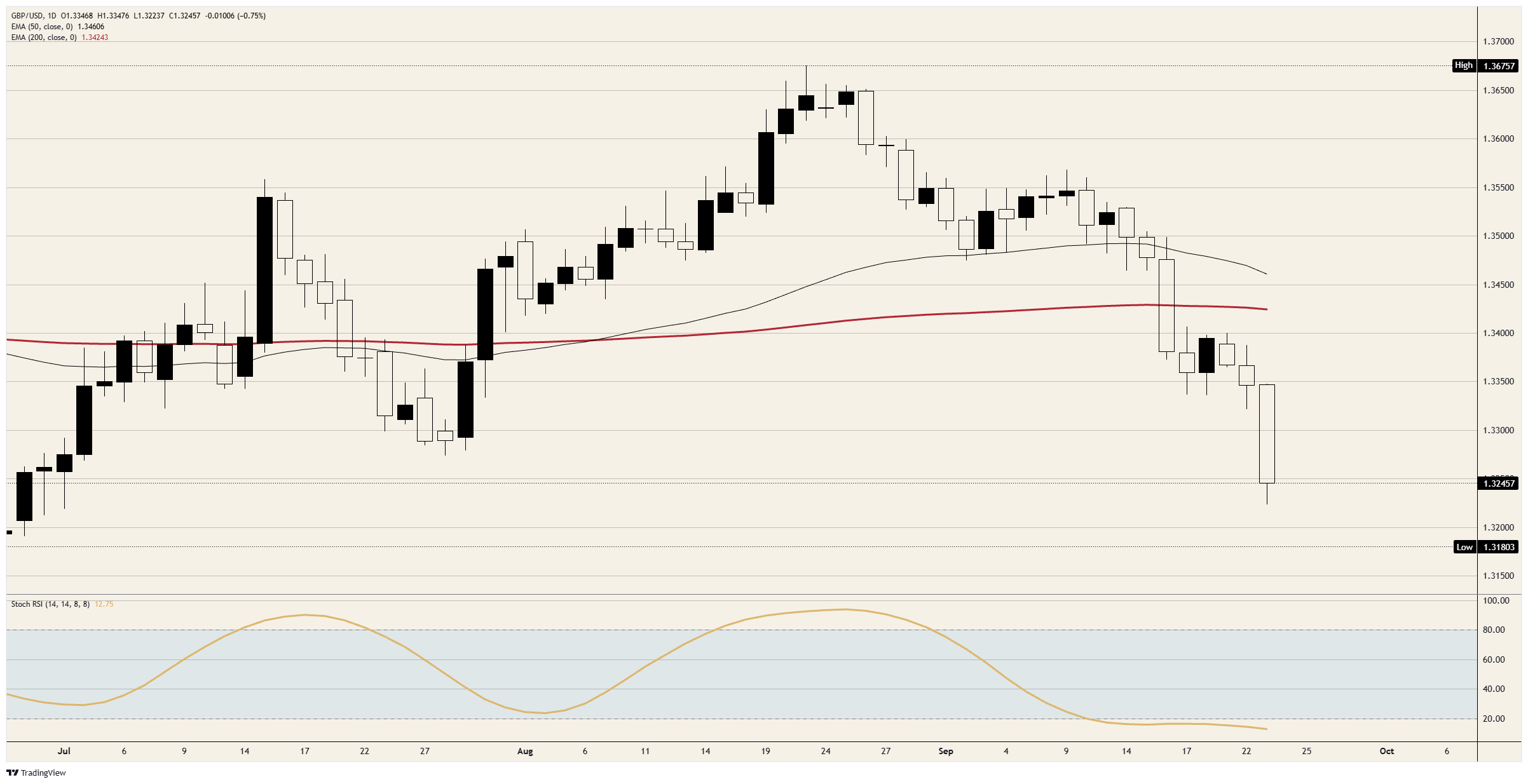
Wednesday's flash Purchasing Managers Index (PMI) surveys showed US business growing at its fastest pace since July 2021 and British business slowing. US services came in at 58.7 against a 56 forecast and UK services at 51.7 against 52, so the American beat was nine times the size of the British miss. GBP/USD is trading just under 1.3250, its lowest since early July.

Money tends to follow the higher interest rate, and US rates are already above the UK's. The Fed lifted its rate to 3.75-4.00% on September 16, against 3.75% for the UK's Bank Rate. Fed Governor Barr said on Wednesday that further increases are likely to be needed, and the surveys point the same way.
Thursday's BoE speakers all voted to wait
The Bank of England (BoE) held the Bank Rate at 3.75% on September 17 in a 6-3 vote, with Chief Economist Pill and external members Greene and Mann voting for 4%. UK services firms raised their prices at the fastest pace in four months, according to Wednesday's survey.
BoE Deputy Governor Breeden and external member Dhingra speak on Thursday at 09:30 GMT, and Deputy Governor Lombardelli at 14:00 GMT. All three were among the six who voted to hold, so any hint of a November hike on Thursday would have to come from people who voted against one in September.
One British release left, against four American ones
The UK's last release of the week is GfK consumer confidence on Thursday at 23:01 GMT, forecast at -16 from -14. The US has jobless claims and new home sales on Thursday, then durable goods orders and consumer sentiment from the University of Michigan (UoM) on Friday. The one British number left measures how gloomy households feel, and the forecast is for gloomier.
Levels and bias
Resistance: 1.3300 gave way on Wednesday after lows just above it held from September 17 to Tuesday. Above that, the 1.3400 area has capped every session since the Fed's September 16 hike.
Support: 1.3200 is the first floor, with Wednesday's low just above it and the late-June low just below it. A break of both opens 1.3150.
Bias: The lean is short below 1.3300, with 1.3200 as the first objective and 1.3150 as the second. The daily Stochastic Relative Strength Index (Stoch RSI), near 13, is still falling. A daily close back above 1.3350 ends the short.
GBP/USD daily chart
Pound Sterling FAQs
The Pound Sterling (GBP) is the oldest currency in the world (886 AD) and the official currency of the United Kingdom. It is the fourth most traded unit for foreign exchange (FX) in the world, accounting for 12% of all transactions, averaging $630 billion a day, according to 2022 data. Its key trading pairs are GBP/USD, also known as ‘Cable’, which accounts for 11% of FX, GBP/JPY, or the ‘Dragon’ as it is known by traders (3%), and EUR/GBP (2%). The Pound Sterling is issued by the Bank of England (BoE).
The single most important factor influencing the value of the Pound Sterling is monetary policy decided by the Bank of England. The BoE bases its decisions on whether it has achieved its primary goal of “price stability” – a steady inflation rate of around 2%. Its primary tool for achieving this is the adjustment of interest rates. When inflation is too high, the BoE will try to rein it in by raising interest rates, making it more expensive for people and businesses to access credit. This is generally positive for GBP, as higher interest rates make the UK a more attractive place for global investors to park their money. When inflation falls too low it is a sign economic growth is slowing. In this scenario, the BoE will consider lowering interest rates to cheapen credit so businesses will borrow more to invest in growth-generating projects.
Data releases gauge the health of the economy and can impact the value of the Pound Sterling. Indicators such as GDP, Manufacturing and Services PMIs, and employment can all influence the direction of the GBP. A strong economy is good for Sterling. Not only does it attract more foreign investment but it may encourage the BoE to put up interest rates, which will directly strengthen GBP. Otherwise, if economic data is weak, the Pound Sterling is likely to fall.
Another significant data release for the Pound Sterling is the Trade Balance. This indicator measures the difference between what a country earns from its exports and what it spends on imports over a given period. If a country produces highly sought-after exports, its currency will benefit purely from the extra demand created from foreign buyers seeking to purchase these goods. Therefore, a positive net Trade Balance strengthens a currency and vice versa for a negative balance.
BÀI VIẾT PHỔ BIẾN
1Gold falls below $4,300 on Fed hawkish signals2Australian Dollar tumbles amid soaring US yields, ahead of jobs data3New Zealand Dollar slides toward its range floor as US yields climb4Japanese Yen gives back most of its rally as Fed hike talk grows5Euro extends its slide as US surveys top Europe's strong reading6British Pound sells off hard as US surveys outpace the UK's7Ethereum Price Forecast: ETH takes a breather at $2,700 as activity, leverage stays calm8GBP/JPY Price Forecast: Bears press 209.00 as downtrend deepens9Australia unemployment rate expected to remain unchanged at 4.5% in August
GIÁ TRỰC TIẾP


Bắt đầu ngay!
Đăng ký và truy cập Thị trường Toàn cầu trong vòng chưa đầy 3 phút

Kết nối với chúng tôi









Liên hệ
Điện thoại: +61 2 8036 8388
Fax: +61 2 8036 8388
Email: support@tmgm.com
Website: https://www.tmgm.com



Thông tin được cung cấp trên trang web này chỉ mang tính chất chung và không cấu thành lời khuyên tài chính cá nhân. Trước khi hành động dựa trên bất kỳ thông tin nào trên trang web này, bạn nên cân nhắc mức độ phù hợp của thông tin đó với mục tiêu, tình hình tài chính và nhu cầu của mình. Đầu tư vào CFD và Hợp đồng Ký quỹ FX tiềm ẩn rủi ro đáng kể và không phù hợp với tất cả nhà đầu tư. Bạn có thể mất nhiều hơn khoản tiền nạp ban đầu của mình. Bạn không sở hữu hoặc có bất kỳ quyền lợi nào đối với tài sản cơ sở. Chúng tôi khuyến nghị bạn tìm kiếm tư vấn độc lập và đảm bảo rằng bạn hiểu đầy đủ các rủi ro liên quan trước khi giao dịch. Điều quan trọng là bạn phải đọc và cân nhắc tài liệu công bố thông tin trước khi mua bất kỳ sản phẩm nào được liệt kê trên trang web. Thông tin và quảng cáo được cung cấp trên trang web này không nhằm mục đích sử dụng bởi bất kỳ cá nhân nào tại bất kỳ quốc gia hoặc khu vực pháp lý nào mà việc sử dụng đó sẽ trái với luật pháp và quy định địa phương. Các Sản phẩm và Dịch vụ được cung cấp trên trang web này không dành cho cư dân Hoa Kỳ, Malaysia và Thái Lan.
TMGM được ủy quyền và quản lý tại nhiều khu vực pháp lý khác nhau.
Trademax Australia Limited, giao dịch dưới tên TMGM, được quản lý bởi Ủy ban Chứng khoán và Đầu tư Úc (ASIC), AFSL số 436416 và có trụ sở tại Tầng 28, One International Tower, 100 Barangaroo Avenue, 2000 Sydney, NSW Australia.
Email: support@tmgm.com.au
Trademax Global Limited, giao dịch dưới tên TMGM, được ủy quyền và quản lý bởi Ủy ban Dịch vụ Tài chính Vanuatu (VFSC), số đăng ký 40356 và được đăng ký tại 1276, Kumul Highway, Port Vila, Vanuatu, Cộng hòa Vanuatu.
Email: support@tmgm.com
Trademax Global Markets (SE) Limited, hoạt động dưới tên TMGM, được ủy quyền và điều chỉnh bởi Cơ quan Dịch vụ Tài chính (FSA) của Seychelles, với số giấy phép SD224. Công ty đăng ký tại Văn phòng số 13, Providence Estate ABIS Centre, Mahe, Seychelles.
Email: support@tmgm.com
Trademax Global Markets (International) Pty Ltd, giao dịch dưới tên TMGM, được ủy quyền và quản lý bởi Ủy ban Dịch vụ Tài chính, Mauritius (FSC) với giấy phép số GB22201012, và được đăng ký tại 33, Edith Cavell Street C/o IQ EQ Fund Services (Mauritius) Ltd Port Louis, 11324 Mauritius.
Email: support@tmgm.com
Bản quyền © TMGM. Tất cả quyền được bảo lưu