The 5 Major Ways to Buy Gold
Gold can be accessed through multiple instruments, each serving a different role.
Gold CFDs
Gold CFDs are a beginner-friendly instrument that tracks gold prices without owning physical gold. Highly liquid and flexible, allowing leverage and short selling (profit when prices go down).
Physical Gold
Jewellery, coins, or bars held directly. Suitable for long-term holding but inefficient due to storage, insurance, and resale costs.Digital Gold
Digital Gold is a kind of fractional gold held through fintech platforms. Convenient but dependent on platform custody and redemption integrity.Sovereign Gold Bonds (SGBs)
Sovereign Gold Bonds are a kind of government-issued bonds linked to gold prices with fixed interest. Strong tax treatment but limited exit flexibility.Gold ETFs
Gold ETFs are Exchange-traded funds backed by physical gold. The Best Gold ETFs in India usually have High liquidity, transparent pricing, and efficient for portfolio allocation.Gold Mining Stocks and Mutual Funds
Equity exposure to companies that produce gold. Returns depend on gold prices and corporate execution.
What Are Some Gold Investing Strategies?
Gold investing strategies focus less on timing tops and bottoms, and more on allocation discipline and relative value.
🛡️ Strategic Allocation (Core Holding)
The Approach: Gold is held as 10–15% of a diversified portfolio to reduce volatility during inflationary periods. Results are driven by rebalancing, not trading frequency.
📈 Cost Averaging (Phased Accumulation)
The Approach: Deploying capital gradually over time rather than a lump sum. This smooths entry prices and avoids buying at cyclical peaks.
⚖️ Relative Value (Gold–Silver Ratio)
The Approach: Rotating exposure based on extreme deviations in the Gold-Silver ratio.
High Ratio: Gold is expensive (Buy Silver).
Low Ratio: Silver is expensive (Buy Gold).
⚡ Tactical Allocation (Cycle-Based)
The Approach: Actively adjusting exposure based on macro cycles.
Increase: Real rate uncertainty, currency debasement.
Decrease: Strong equity bull markets (High opportunity cost).
Prerequisites to Start (Checklist)
To start investing efficiently, ensure you have the following infrastructure:
KYC Compliance: PAN Card and Aadhar linking is mandatory.
Demat Account: Essential for holding Gold ETFs, SGBs, and Mining Stocks.
Bank Account: Linked to your Demat for seamless fund transfer and dividend/interest payouts.
Comparison: Physical vs Paper vs Digital vs Mining Stocks
| Feature | Physical Gold | Paper Gold (ETF, SGB) | Digital Gold | Gold Mining Stocks |
|---|---|---|---|---|
| Exposure Type | Direct gold | Gold-linked | Gold-backed claim | Equity to producers |
| Correlation to Gold | High | High | High | Medium to high |
| Equity Market Risk | None | Low | Low | High |
| Liquidity | Low to medium | High (ETF), low (SGB) | Medium | High |
| Income Generation | None | Interest (SGB) | None | Dividends possible |
| Volatility | Low | Low to medium | Medium | High |
| Role in Portfolio | Preservation | Hedge | Convenience | Return amplification |
Core Difference: Are you a Trader or an Investor?
Before allocating capital, you must define your market role to avoid strategy drift.
The Investor: Your timeline is multi-years to multi-decades. You are buying gold to protect purchasing power against inflation. You are not concerned with daily price fluctuation. Your primary tools are SGBs and ETFs.
The Trader: Your timeline is Intraday to Weeks. You are speculating on volatility using leverage. You profit from both rising and falling markets. Your primary tools are MCX Futures and Options.
Time Horizon (Fast vs. Slow)
Fast (Liquidity Priority): If you need to liquidate funds within days, Gold ETFs or Mining Stocks are superior due to exchange trading.
Slow (Wealth Priority): If you can hold for >5 years, SGBs are the only logical choice due to the tax exemption and interest payout.
By Effort (Active vs. Passive)
Active (Stock Picking): If you can analyze balance sheets and sector trends, Gold Mining Stocks offer the highest potential upside. You must track mine output, labor strikes, and government regulations.
Why Invest in Gold? The Pro Argument
Gold is a low-correlation asset that often behaves independently from equities during periods of market stress. This means that while stocks rely on earnings growth, relies on currency debasement, declining real yields, and risk aversion, making it the perfect counter-weight during economic downturns. Below shows expert reasoning as to why gold is a good investment to many investors.
1. The Inflation Hedge Historically, gold preserves purchasing power. Over long horizons, gold has broadly tracked or exceeded CPI inflation in India, helping preserve purchasing power across cycles, effectively neutralizing the erosion of the Rupee.
According to World Bank CPI data, India’s inflation rate has moved over time, and when compared with long-term gold price increases, gold has broadly kept pace with or exceeded the real purchasing power erosion measured by CPI.
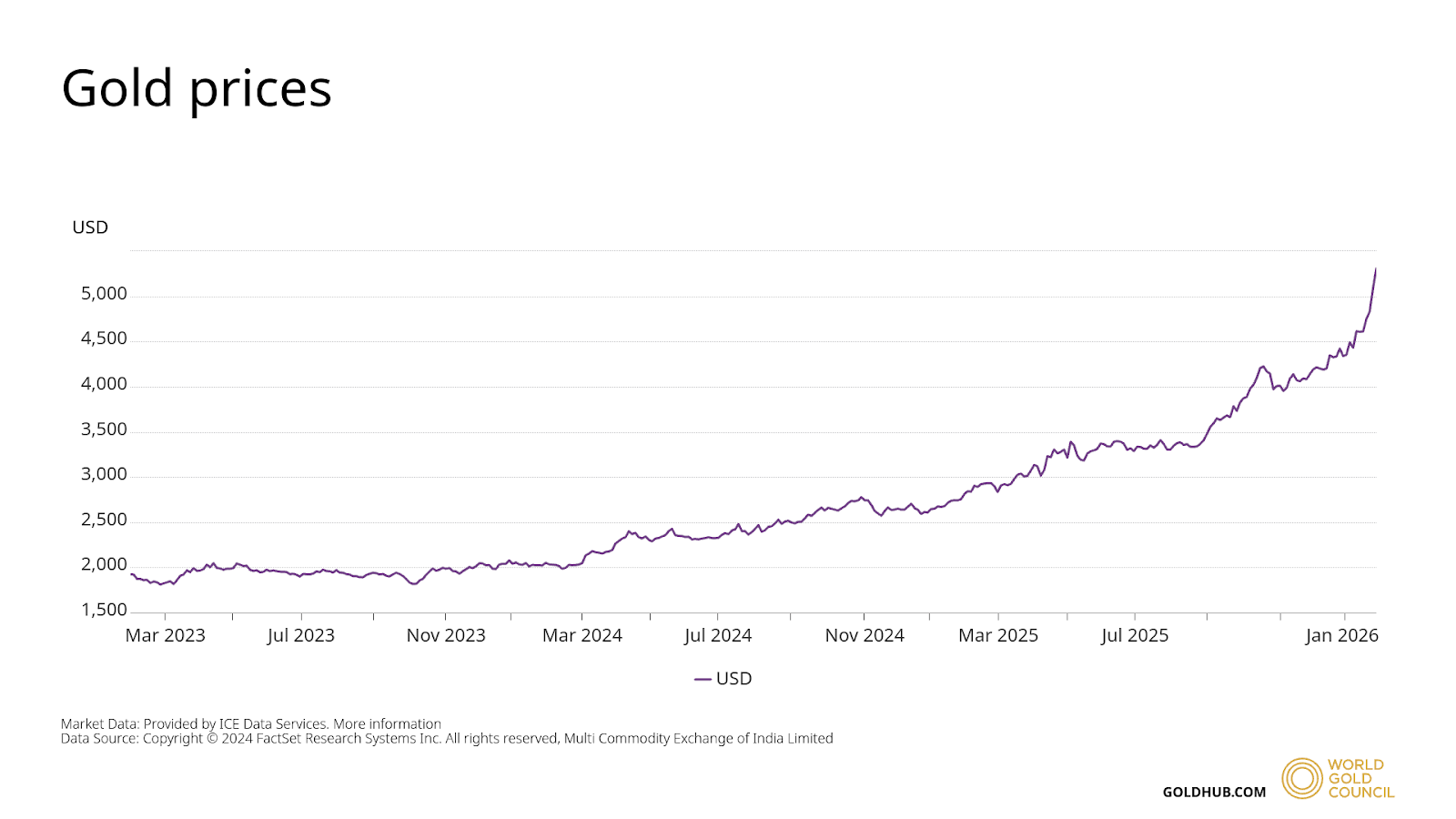
On the other hand, historical gold price data compiled by the World Gold Council shows multi-decade growth in gold prices that has generally outpaced inflation over long investment horizons.
2. Portfolio Diversification (The Negative Correlation) Gold often moves inversely to equities. When the Nifty 50 crashes due to geopolitical fear, capital flees to safety, causing gold prices to rise. This "negative correlation" smooths out the volatility of your overall portfolio, preventing panic selling.
3. The Sovereign Validation: RBI’s "Vote of Confidence" Perhaps the strongest argument for gold is sovereign demand for gold. It is not just individuals who trust gold; nations do too.
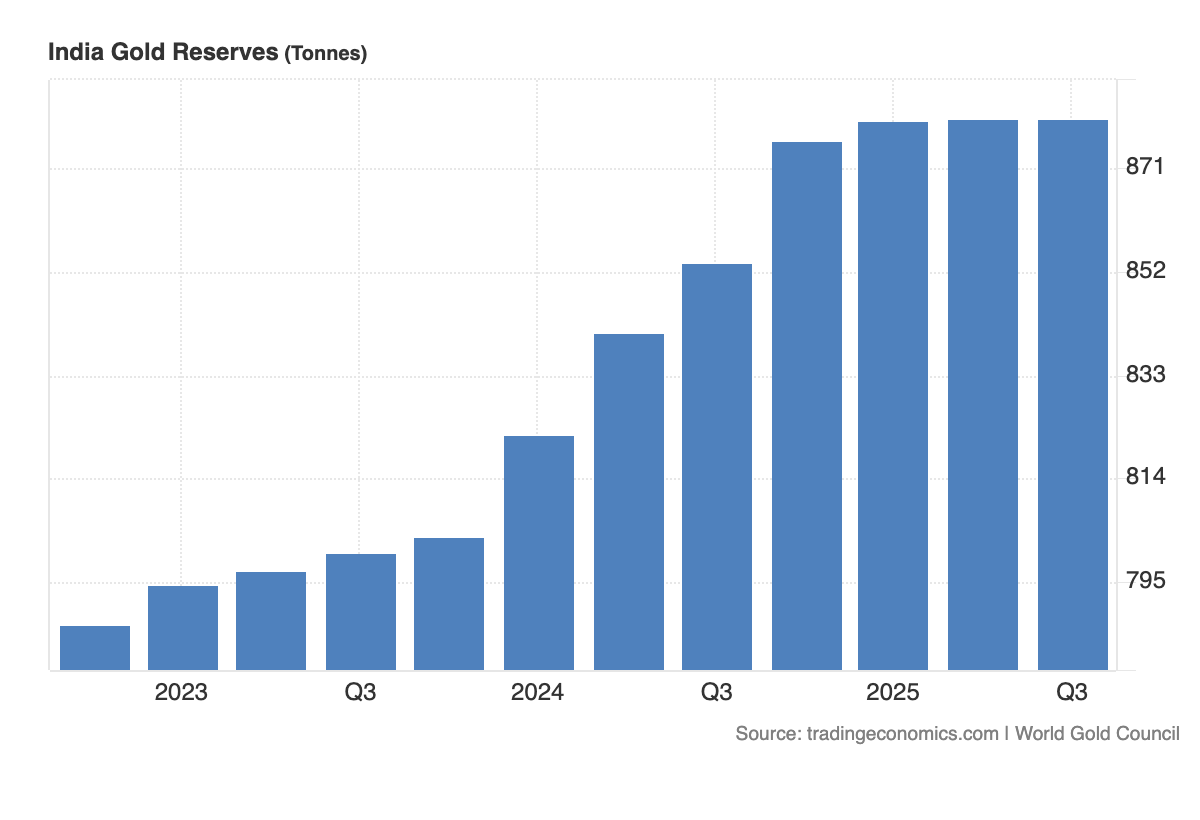
As per India’s National Gold Reserves disclosures, according to Trading Economics, the RBI holds over 800 tonnes of gold in Q3 2025. India has since been steadily increasing its Gold Reserve allocation to diversify the country’s foreign exchange reserves.
This massive accumulation of central bank gold holdings directly reinforces gold’s role in monetary stability. In times of balance-of-payment stress or currency volatility, gold serves as a Tier-1 asset that can be liquidated instantly to stabilize the Rupee.
By investing in gold, you are essentially mirroring the strategy of the central bank: holding a crisis stabilizer that carries zero counterparty risk.
The Dark Side of Gold Investing. The Cons.
Gold is not a guaranteed compounding machine; it is a store of value with distinct risks.
Operational Risk (Mining Stocks): Unlike bullion, a mining company can go bankrupt. They face labor strikes, mine collapses, and government royalty hikes. This is why mining stocks are more volatile than gold itself.
Operational Risk (Mining Stocks): Unlike bullion, a mining company can go bankrupt. They face labor strikes, mine collapses, and government royalty hikes. This is why mining stocks are more volatile than gold itself.
Market Risk: Gold can go through long periods (5-7 years) of zero returns.
The "Liquidity Trap" (SGB): While SGBs are listed on exchanges, liquidity is often low, forcing you to sell at a discount if you exit early.
The "Making Charge" Erosion: Physical jewelry incurs non-recoverable making charges (15-30%) and GST (3%), putting you in a deep hole instantly.
Expert Tips: Monitoring & Rebalancing Your Portfolio
Effective gold investing isn't about watching daily prices; it's about managing portfolio weightage.
1. The "5% Drift" Rule (Rebalancing) Ideally, gold should be 10-15% of your total portfolio.
The Rule: If Gold rallies and becomes 20% of your portfolio, sell 5% to buy undervalued stocks. If Gold crashes to 5%, buy more. This forces you to "buy low, sell high."
2. Treat Mining Stocks as "Equity," Not "Gold"
The Rule: Gold Mining Stocks often correlate with the Stock Market in the short term. If the Nifty crashes, mining stocks might crash too (due to liquidity crunches), even if gold prices are stable. Do not count Mining Stocks as your "safe haven" allocation; count them as part of your Equity allocation.