

Trading
Explore a wide range of markets with competitive pricing, deep liquidity, and advanced trading tools.
Learn More 
Platform
Trade seamlessly with TMGM's powerful platform, built for speed, precision, and a superior trading experience.
Learn More Trading Platform
Academy
Learn the fundamentals of trading with beginner-friendly resources, including guides, webinars, and market insights.
Learn More News & Analysis
Get real-time market updates and expert analysis to stay ahead of trading opportunities
Learn More News & Analysis
About
Learn what sets TMGM apart — our global presence, regulatory strength, and commitment to innovation in trading.
Learn More Why Choose TMGM
Sponsorship
AUD/USD Price Forecast: Why Does the H&S Breakdown Keep the Pair Under Pressure?
- Australian Dollar weakness pulls AUD/USD down towards 0.6833.
- A rate increase by the Fed at its December meeting is certain.
- RBA monetary policy minutes and Governor Michele Bullock's speech are firmly in investors' focus.
Pressure on the Australian Dollar (AUD) leaves it lagging its currency peers on Thursday, as market experts question whether the Reserve Bank of Australia’s (RBA) monetary tightening cycle will continue. During European trading, the currency is down 0.15% against the US Dollar (USD), at around 0.6833.

How Is the Australian Dollar Performing Today?
Today's percentage moves in the Australian Dollar (AUD) against the major currencies listed are set out in the table below. Its weakest performance was against the Swiss Franc.
| USD | EUR | GBP | JPY | CAD | AUD | NZD | CHF | |
|---|---|---|---|---|---|---|---|---|
| USD | -0.02% | 0.03% | -0.13% | -0.03% | 0.30% | 0.00% | -0.17% | |
| EUR | 0.02% | 0.06% | -0.11% | -0.01% | 0.33% | 0.03% | -0.14% | |
| GBP | -0.03% | -0.06% | -0.15% | -0.08% | 0.28% | -0.03% | -0.20% | |
| JPY | 0.13% | 0.11% | 0.15% | 0.09% | 0.43% | 0.12% | -0.04% | |
| CAD | 0.03% | 0.01% | 0.08% | -0.09% | 0.33% | 0.04% | -0.13% | |
| AUD | -0.30% | -0.33% | -0.28% | -0.43% | -0.33% | -0.29% | -0.46% | |
| NZD | -0.01% | -0.03% | 0.03% | -0.12% | -0.04% | 0.29% | -0.14% | |
| CHF | 0.17% | 0.14% | 0.20% | 0.04% | 0.13% | 0.46% | 0.14% |
Percentage movements between major currencies are displayed in the heat map. Select the base currency in the left-hand column and the quote currency in the top row. For instance, choosing the Australian Dollar on the left and following that row across to the US Dollar gives the percentage change for AUD (base)/USD (quote) in the corresponding box.
The latest RBA decision sent mixed signals, according to analysts at OCBC Group Research. To explain the rate increase, the statement said that “inflation remains elevated and recent data indicate that it is broadly based”. Yet it also recognised that “the increases in the cash rate target since the beginning of the year have tightened financial conditions. The economy is slowing, housing prices have fallen significantly and the unemployment rate has risen”.
The removal of the phrase “including increasing the cash rate target further if needed” also signals softer RBA forward guidance, OCBC notes. Taking these developments together, OCBC says: “We expect no more hike in this cycle, and the next policy move is likely to be a cut.”
Tuesday's release of the minutes from the RBA's October monetary policy meeting, alongside Governor Michele Bullock's scheduled speech, will be watched by investors for fresh signals on the policy outlook.
Broader US Dollar strength is adding to pressure on the Aussie pair. Having surrendered its early gains, the US Dollar Index (DXY) is trading flat near 102.86 at the time of writing. Earlier in the session, it reached a new 18-month high of 103.08.
Why is the Dollar index at a fresh high as year-end Fed hike expectations strengthen?
A move in the Dollar Index to “a fresh year-to-date high of 103.08.” follows a US Dollar that has “continued to strengthen overnight,” according to MUFG analysts. In their assessment, the Dollar’s “renewed upward momentum has been encouraged by expectations that the Fed is likely to speed up the pace of rate hikes in response to the recent run of stronger US inflation data.” Turning to rates, MUFG observes that “the yield on the 2-year US Treasury has jumped high by around 33bps from the low at the end of last week although still remains below the peak set in September at 4.96%.”
MUFG describes the policy pricing as follows: “a 25bps rate hike at the next FOMC meeting in December is now fully priced in, and market participants have moved further to price in small probability of larger 50bps hike.” The analysts further note that “there are currently around 28bps of hikes priced by December, and 43bps of hikes priced by the following meeting in January indicating that even if the Fed hikes by 25bps in December it is now expected to quickly follow up with another 25bps hike at the start of next year.”
Hawkish remarks from Fed officials have supported expectations of quicker tightening, MUFG says, describing those expectations as “encouraged by hawkish comments this week by Fed officials.” Among the officials cited is Governor Christopher Waller, who “stated he would consider voting for a larger 50bps hike in December,”. They also refer to Dallas Fed President Lorie Logan, a current voting member, who said “the FOMC needs to implement at least two more 25bps rate increases” and “it may be possible to move more rapidly this winter than the FOMC has moved this fall.” Meanwhile, Chicago Fed President Austan Goolsbee, who gains voting rights next year, called the October CPI release “another distressing report, borderline disturbing,” and singled out services inflation, which “has remained persistently high.”
Particular importance could attach to New York Fed President John Williams, with MUFG emphasising that “the updated views of New York Fed President John Williams could carry more weight.” The analysts refer back to his recent comment that this is an “appropriate time to accumulate more information to help us determine what the appropriate stance of policy is to make sure we achieve a timely return to our 2% target.” Although MUFG does not anticipate “a larger 50bps hike to be delivered in December,” its assessment is that “it is more likely now that the Fed could hike rates back-to-back in December and January.”
For the US currency, MUFG sees the changing policy outlook as “a development that will encourage the US dollar to trade at stronger levels heading into year end.” Countering the current rate expectations would, in its view, require a substantial shift: “a sharp tightening of US financial conditions and/or ongoing drop in energy prices would likely be required to significantly push back against market expectations for faster Fed hikes at the current juncture.”
AUD/USD Technical Analysis: Can the Pair Ease Selling Pressure?
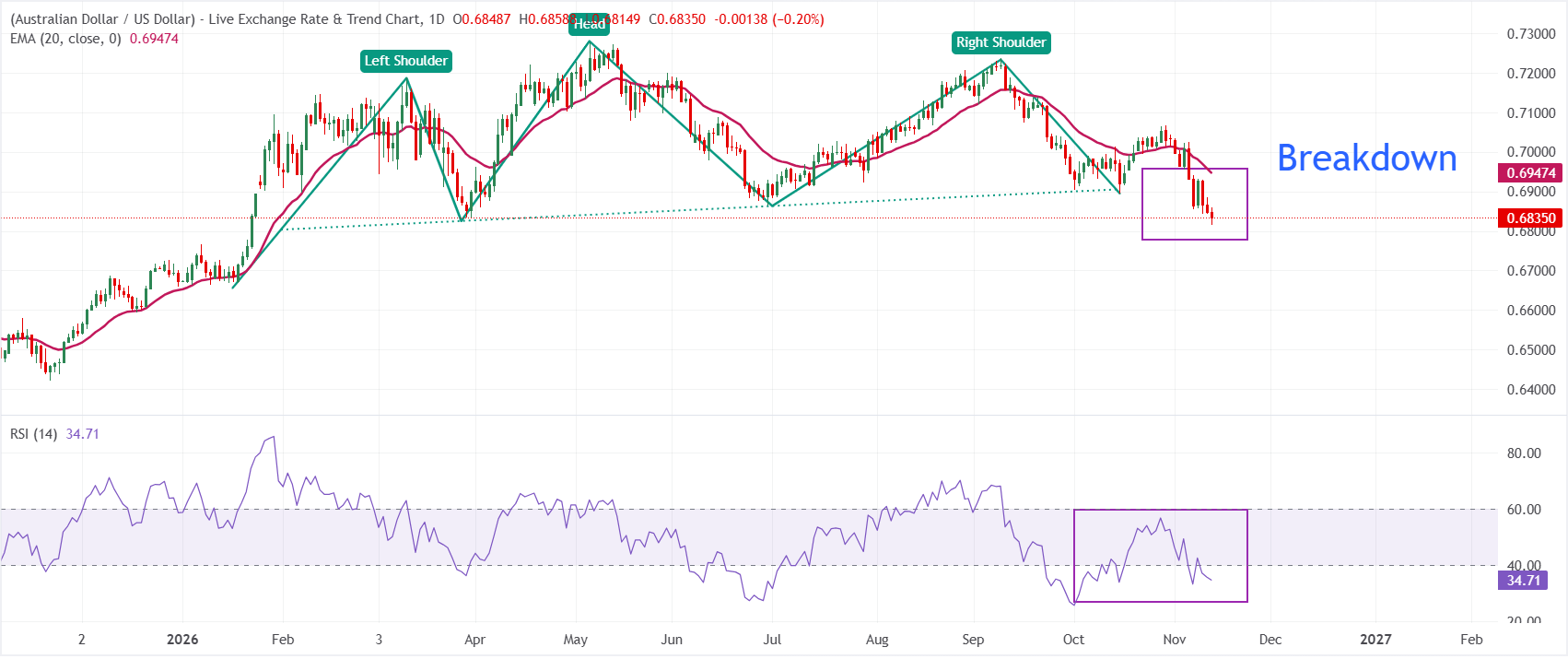
A bearish short-term bias persists on the daily chart, where AUD/USD is trading at 0.6835, well below its 20-period exponential moving average (EMA) of 0.6947. Trading beneath this important trend gauge, together with the breakdown of the Head and Shoulder (H&S) chart pattern, suggests that recent recoveries remain constrained. At around 35, the Relative Strength Index (14) is still in weak territory, pointing to modest downward momentum rather than outright oversold conditions.
The first upside hurdle is the neckline of the H&S pattern at 0.6900, with the 20-period EMA at 0.6947 marking the next resistance. Only a decisive recovery above that barrier would relieve immediate selling pressure and create scope for a broader corrective rebound. On the downside, further losses could take the pair towards 0.6800.
(The technical analysis of this story was written with the help of an AI tool. Know more.)
Economic Release
What Will RBA Governor Bullock Say in Her Speech?
The ninth Governor of the Reserve Bank of Australia, Michele Bullock, took up her current role in September 2023, succeeding Philip Lowe. Before this appointment, she served as the Reserve Bank of Australia's Assistant Governor (Financial System), a role she had held since October 2016.
Continue reading.POPULAR ARTICLES
1New Zealand Dollar holds near 0.5550 amid a pause by US Dollar bulls2US Dollar: Rally loses steam with Fed commentary in focus – BBH3Reuters poll: Economists agree ECB will raise rates to 2.75% in December4Top Altcoins Price Forecast: What next for Ripple, Cardano and Solana as declines pause amid exhaustion signals?5British Pound: Why do resilient data bolster the case for BoE hikes? – BBH6Can Official Warnings Against Rapid Currency Moves Sustain the Japanese Yen’s Relief?7EUR/GBP Price Forecast: Can the pair sustain consolidation above 0.8350 after rejection at 0.8370?8Ripple Price Forecast: Despite muted investor interest, XRP trims losses above $1.009AUD/USD Price Forecast: Why Does the H&S Breakdown Keep the Pair Under Pressure?

Get Started!
Sign up and access the Global Markets in less than 3 minutes

Connect With Us












The information provided on this website is of a general nature only and does not constitute personal financial advice. Before acting on any information on this website, you should consider the suitability of the information in relation to your objectives, financial situation and needs. Investing in CFDs and FX Margin Contracts carries significant risks and is not suitable for all investors. You may lose more than your initial deposit. You do not own, or have, any interest in the underlying asset. We recommend that you seek independent advice and ensure you fully understand the risks involved before trading. It is important that you read and consider the disclosure document before you acquire any product listed on the website. The information and advertisements offered on this website are not intended for use by any person in any country or jurisdiction where such use would be contrary to local laws and regulations. The Products and Services offered on this website are not intended for residents of the United States, Malaysia and Thailand.
TMGM is authorized and regulated in various jurisdictions.
Trademax Australia Limited, trading as TMGM, is regulated by the Australian Securities and Investments Commission (ASIC), AFSL no. 436416 and is located at Level 28, One International Tower, 100 Barangaroo Avenue, 2000 Sydney, NSW Australia.
Email: support@tmgm.com.au
Trademax Global Limited, trading as TMGM, is authorized and regulated by the Vanuatu Financial Services Commission (VFSC), registration number 40356 and registered at 1276, Kumul Highway, Port Vila, Vanuatu, Republic of Vanuatu.
Email: support@tmgm.com
Trademax Global Markets (SE) Limited, trading as TMGM, is authorized and regulated by the Financial Services Authority (FSA) of Seychelles, with license number SD224. The company is registered at Office No 13, Providence Estate ABIS Centre, Mahe, Seychelles.
Email: support@tmgm.com
Trademax Global Markets (International) Pty Ltd, trading as TMGM, is authorized and regulated by the Financial Services Commission, Mauritius (FSC) with license no. GB22201012, and registered at 33, Edith Cavell Street C/o IQ EQ Fund Services (Mauritius) Ltd Port Louis, 11324 Mauritius.
Email: support@tmgm.com
Copyright © TMGM. All rights reserved