

Trading
Explore a wide range of markets with competitive pricing, deep liquidity, and advanced trading tools.
Learn More 
Platform
Trade seamlessly with TMGM's powerful platform, built for speed, precision, and a superior trading experience.
Learn More Trading Platform
Academy
Learn the fundamentals of trading with beginner-friendly resources, including guides, webinars, and market insights.
Learn More News & Analysis
Get real-time market updates and expert analysis to stay ahead of trading opportunities
Learn More News & Analysis
About
Learn what sets TMGM apart — our global presence, regulatory strength, and commitment to innovation in trading.
Learn More Why Choose TMGM
Sponsorship
Ripple Price Forecast: Despite muted investor interest, XRP trims losses above $1.00
- Recovery prospects for XRP remain constrained, even as the token appears to be consolidating above crucial support at $1.00.
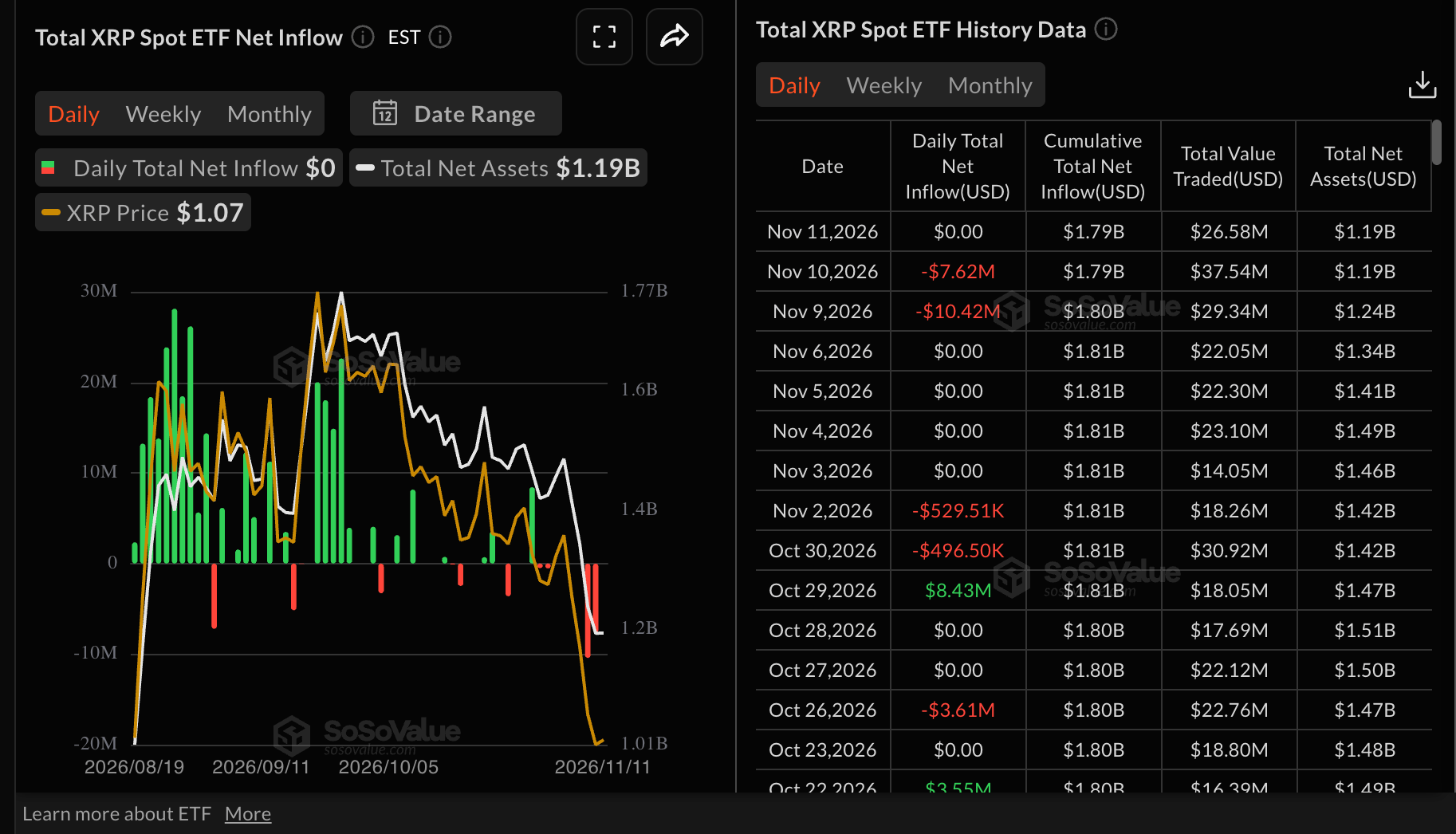
- With risk aversion still prevailing, XRP spot ETFs recorded subdued activity on Wednesday following two straight days of outflows.
- Falling moving averages reinforce a weak technical picture, leaving bears in control of XRP.
A sluggish mood across the broader cryptocurrency market accompanies Ripple’s (XRP) move to trim losses on Thursday, with the token trading near $1.05. Since the steep correction on November 5, bulls have seen no respite. They are relying on the $1.00 to $1.05 support zone to establish range-bound trading before making renewed attempts at recovery.

Can XRP Recover as ETF Demand Cools?
Institutional demand through XRP spot Exchange-Traded Funds (ETFs) remains lacklustre. Wednesday saw little activity after outflows of $7.6 million on the preceding day and approximately $10.4 million on Monday. Even as ETF demand dries up, cumulative inflows total $1.8 billion and net assets under management average $1.2 billion. These figures highlight a positive long-term institutional view of the underlying XRP token.
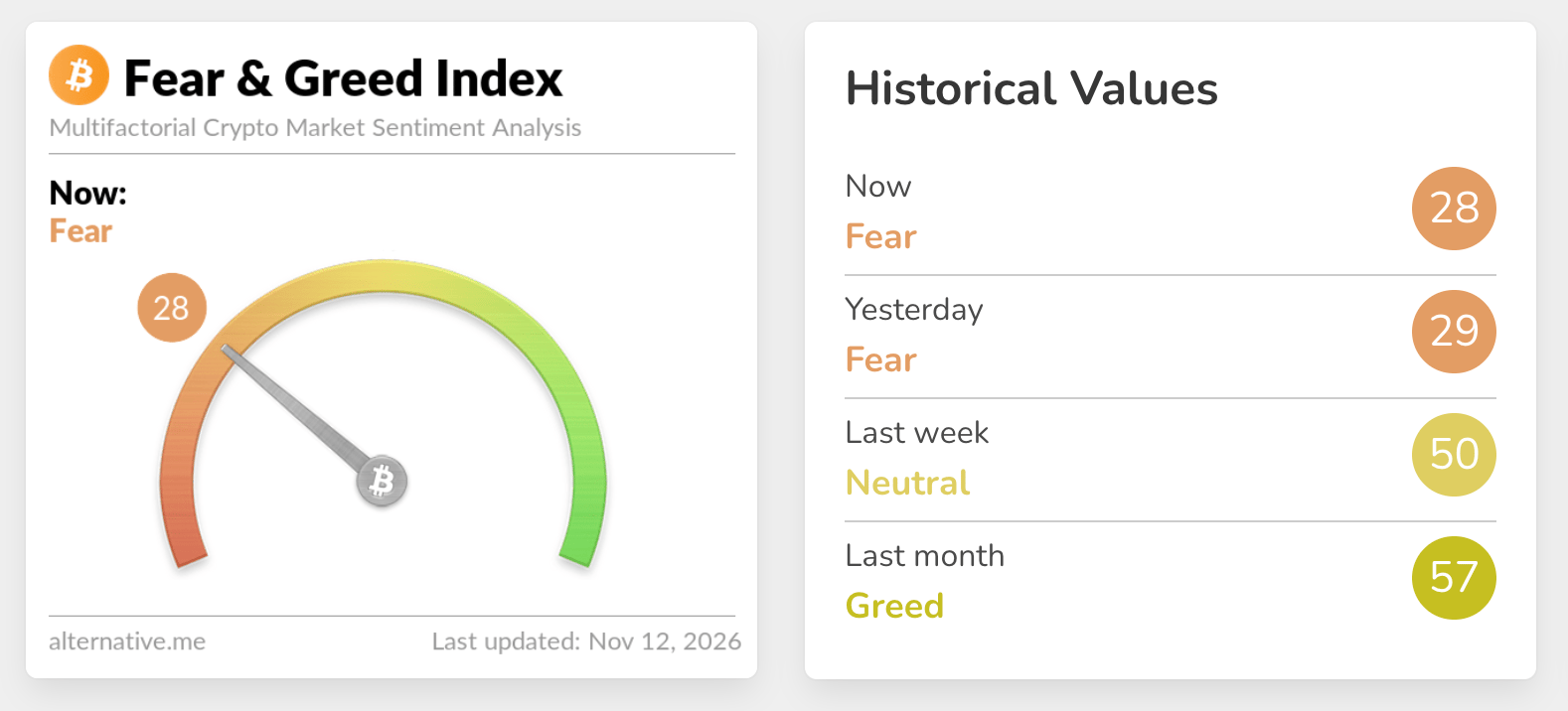
Risk appetite remains weak: the crypto Fear & Greed gauge reads 28 in Fear territory on Wednesday, only marginally below the previous day’s 29. The broader sentiment picture is much weaker than when the index stood at 57 in the Greed region. Alongside waning ETF demand, this backdrop reduces the likelihood of a recovery.
A greater likelihood of a December interest rate increase by the Federal Reserve (Fed) is also being priced in by investors. Risk assets seldom benefit from tighter monetary policy. Investors may therefore be adjusting their positions or staying out of the market ahead of the meeting.
Technical analysis: Can XRP hold crucial support?
At $1.05, XRP remains in a bearish phase beneath its 50-day, 100-day and 200-day Exponential Moving Averages (EMAs), which stand at $1.27, $1.29 and $1.34, respectively. With these averages stacked above the price, near-term upside appears constrained. The SuperTrend, now above the spot price at $1.21, presents the first technical hurdle bulls must clear to relieve downward pressure.
Although the Relative Strength Index (RSI), near 24 in oversold territory, suggests bearish momentum is stretched, the trend remains dominated by sellers.
The SuperTrend line near $1.21 provides the first resistance, followed by the 50-day EMA at $1.27 and the 100-day EMA at $1.29. Further up, the 200-day EMA at $1.34 strengthens the wider supply zone. Recovery moves are likely to remain corrective while XRP trades below this moving-average cluster. The balance of risk continues to favour further declines until buyers decisively lift the token above at least $1.21.
(An AI tool assisted in preparing the technical analysis for this article. Learn more.)
Ripple: Common Questions
Specialising in cross-border remittances, payments company Ripple uses blockchain technology to carry out these transfers. Its payments transfer network, RippleNet, was developed by Ripple Labs Inc. and is available to financial institutions around the world. Ripple also makes use of the XRP token.
The decentralised XRPLedger blockchain has XRP as its native token. Ripple Labs uses XRP to enable transactions on the XRPLedger, allowing financial institutions to transfer value across borders. By enabling instant, trustless payments on the XRPLedger chain, XRP helps financial firms reduce the cost of transactions worldwide.
Built on distributed ledger technology and blockchain, XRPLedger uses XRP to power transactions. A built-in inflammatory protocol distinguishes the ledger from other blockchains and helps counter spam and distributed denial-of-service (DDOS) attacks. Maintenance of the XRPL is handled by a peer-to-peer network called the global XRP Ledger community.
The interledger standard used by XRP is a blockchain protocol that enables payments between different networks. XRP’s blockchain can, for example, link the ledgers of two or more banks, effectively eliminating intermediaries and the system’s need for centralisation. Within the XRPLedger blockchain, engineered by Jed McCaleb, Arthur Britto and David Schwartz, XRP serves as the native token.
POPULAR ARTICLES
1USD/CAD Price Forecast: Strong buying interest evident as RSI hovers near 662Can the US Dollar Index Extend Gains After Hitting a Fresh Year-to-Date High of 103.08 as Fed Rate Hike Bets Rise?3New Zealand Dollar holds near 0.5550 amid a pause by US Dollar bulls4US Dollar: Rally loses steam with Fed commentary in focus – BBH5Reuters poll: Economists agree ECB will raise rates to 2.75% in December6Top Altcoins Price Forecast: What next for Ripple, Cardano and Solana as declines pause amid exhaustion signals?7British Pound: Why do resilient data bolster the case for BoE hikes? – BBH8Can Official Warnings Against Rapid Currency Moves Sustain the Japanese Yen’s Relief?9EUR/GBP Price Forecast: Can the pair sustain consolidation above 0.8350 after rejection at 0.8370?


Get Started!
Sign up and access the Global Markets in less than 3 minutes

Connect With Us












The information provided on this website is of a general nature only and does not constitute personal financial advice. Before acting on any information on this website, you should consider the suitability of the information in relation to your objectives, financial situation and needs. Investing in CFDs and FX Margin Contracts carries significant risks and is not suitable for all investors. You may lose more than your initial deposit. You do not own, or have, any interest in the underlying asset. We recommend that you seek independent advice and ensure you fully understand the risks involved before trading. It is important that you read and consider the disclosure document before you acquire any product listed on the website. The information and advertisements offered on this website are not intended for use by any person in any country or jurisdiction where such use would be contrary to local laws and regulations. The Products and Services offered on this website are not intended for residents of the United States, Malaysia and Thailand.
TMGM is authorized and regulated in various jurisdictions.
Trademax Australia Limited, trading as TMGM, is regulated by the Australian Securities and Investments Commission (ASIC), AFSL no. 436416 and is located at Level 28, One International Tower, 100 Barangaroo Avenue, 2000 Sydney, NSW Australia.
Email: support@tmgm.com.au
Trademax Global Limited, trading as TMGM, is authorized and regulated by the Vanuatu Financial Services Commission (VFSC), registration number 40356 and registered at 1276, Kumul Highway, Port Vila, Vanuatu, Republic of Vanuatu.
Email: support@tmgm.com
Trademax Global Markets (SE) Limited, trading as TMGM, is authorized and regulated by the Financial Services Authority (FSA) of Seychelles, with license number SD224. The company is registered at Office No 13, Providence Estate ABIS Centre, Mahe, Seychelles.
Email: support@tmgm.com
Trademax Global Markets (International) Pty Ltd, trading as TMGM, is authorized and regulated by the Financial Services Commission, Mauritius (FSC) with license no. GB22201012, and registered at 33, Edith Cavell Street C/o IQ EQ Fund Services (Mauritius) Ltd Port Louis, 11324 Mauritius.
Email: support@tmgm.com
Copyright © TMGM. All rights reserved