

Trading
Explore a wide range of markets with competitive pricing, deep liquidity, and advanced trading tools.
Learn More 
Platform
Trade seamlessly with TMGM's powerful platform, built for speed, precision, and a superior trading experience.
Learn More Trading Platform
Academy
Learn the fundamentals of trading with beginner-friendly resources, including guides, webinars, and market insights.
Learn More News & Analysis
Get real-time market updates and expert analysis to stay ahead of trading opportunities
Learn More News & Analysis
About
Learn what sets TMGM apart — our global presence, regulatory strength, and commitment to innovation in trading.
Learn More Why Choose TMGM
Sponsorship
Zcash Price Forecast: How is retail speculation countering ETF outflows as ZEC rebounds?
- Following a 7% advance in the previous session, Zcash adds 5% on Wednesday, building on its gains above the 50-day EMA at $1,208.
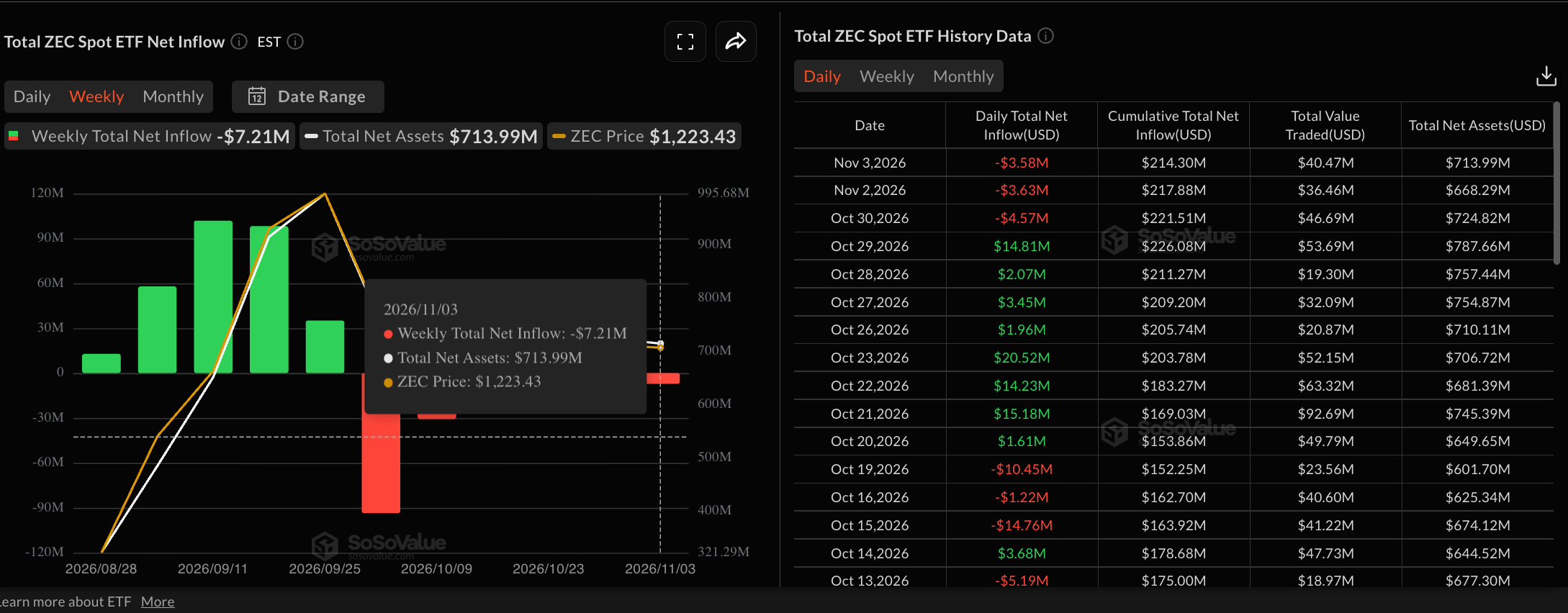
- Fresh selling pressure hits the ZEC-focused ETF, with Tuesday’s outflows exceeding $3 million.
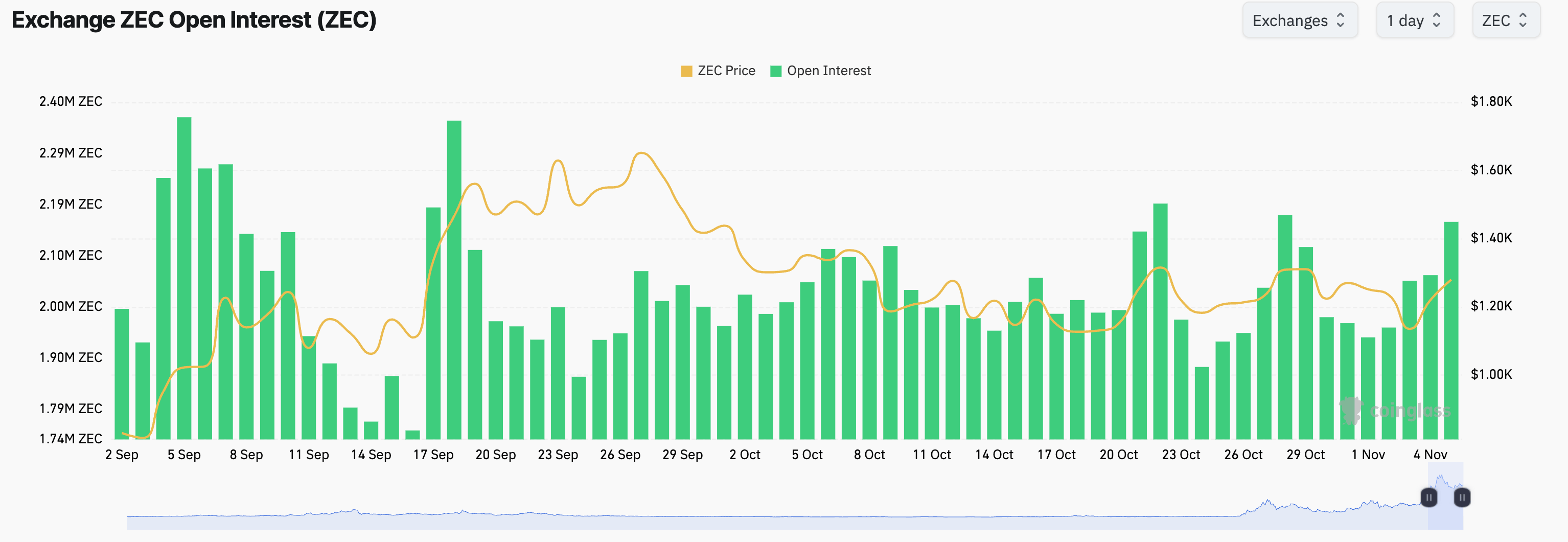
- As spot prices recover, steadily increasing Zcash futures Open Interest above 2 million ZEC points to a build-up in positions.
Risk-sensitive assets, including cryptocurrencies, are finding support on Wednesday as the Democrats’ victory in the US midterm elections puts considerable pressure on the US Dollar (USD), helping Zcash (ZEC) gain momentum. Institutional investors have remained defensive so far this week, with redemptions exceeding $7 million. Meanwhile, Open Interest has reached a seven-day high, with derivatives data pointing to a return of retail participation.
A strongly bullish bias remains evident in ZEC’s technical outlook, as the recovery signals a possible breakout from its trading range ahead of the NU7 upgrade.
Are US midterms and the upcoming NU7 upgrade strengthening Zcash’s retail interest?
Retail interest in Zcash appears to be picking up alongside a recovery across the broader cryptocurrency market. The rebound coincides with Democrats gaining control of Congress, while Friday’s Zcash Network Upgrade 7 (NU7) offers an additional, coin-specific boost.
Position-building alongside the price recovery suggests growing bullish speculation among traders. According to CoinGlass, ZEC Open Interest (OI) increased from 1.96 million ZEC on Sunday to 2.17 million ZEC on Wednesday.
Institutional activity, by contrast, reflected profit-taking earlier this week, with successive daily outflows of $3.58 million and $3.63 million. The withdrawals suggest that uncertainty over the US midterms prompted institutional investors to sell. With the results now available, however, political gridlock is weighing on the US Dollar and offering some relief to risk-sensitive assets such as Zcash.
Technical outlook: Can Zcash’s recovery trigger a breakout rally?
After recovering 7% in the previous session, Zcash extends its advance to trade at $1,282 at the time of writing on Wednesday. Having regained the 50-day Exponential Moving Average (EMA) at $1,209, the privacy coin remains comfortably above the longer-term 200-day EMA at $850, reinforcing a constructive long-term bias.
For almost a month, ZEC has consolidated within the range defined by the October 8 low of $1,112 and high of $1,340. A daily close above $1,340 could confirm a bullish breakout as the recovery continues, potentially clearing the way towards the September 26 peak of $1,698.
Buyers appear to be gradually regaining control: on the daily chart, the Moving Average Convergence Divergence (MACD) moves above its signal line, while the Relative Strength Index (RSI), at around 53, carries a modest bullish bias.
On the downside, the first support level lies near $1,209 at the 50-day EMA. Below this, deeper structural demand is located at $1,112, identified as the October 8 low and high.
(The technical analysis of this story was written with the help of an AI tool. Know more.)
POPULAR ARTICLES
1Pi Network Price Forecast: PI nears record lows as hopes of a bullish breakout weaken2Eurozone October flash HICP growth accelerates by 4% YoY, in line with expectations3Swedish Krona: SEK draws support from Riksbank rate hikes – Societe Generale4Silver Price Forecast: Why Is XAG/USD Rallying to $52.00 as Yields Fall and the US Dollar Weakens?5Swiss Franc: Is the risk of a hawkish SNB lending support to the franc? – ING6Silver price today: FXStreet data show a rise in Silver7Will the ADP Employment Report show the expected slowdown in October job growth?8Bitcoin Price Forecast: Could US midterm elections trigger a volatility shock for BTC?9Can Euro sustain gains against Canadian Dollar ahead of Eurozone HICP inflation data?

Get Started!
Sign up and access the Global Markets in less than 3 minutes

Connect With Us












The information provided on this website is of a general nature only and does not constitute personal financial advice. Before acting on any information on this website, you should consider the suitability of the information in relation to your objectives, financial situation and needs. Investing in CFDs and FX Margin Contracts carries significant risks and is not suitable for all investors. You may lose more than your initial deposit. You do not own, or have, any interest in the underlying asset. We recommend that you seek independent advice and ensure you fully understand the risks involved before trading. It is important that you read and consider the disclosure document before you acquire any product listed on the website. The information and advertisements offered on this website are not intended for use by any person in any country or jurisdiction where such use would be contrary to local laws and regulations. The Products and Services offered on this website are not intended for residents of the United States, Malaysia and Thailand.
TMGM is authorized and regulated in various jurisdictions.
Trademax Australia Limited, trading as TMGM, is regulated by the Australian Securities and Investments Commission (ASIC), AFSL no. 436416 and is located at Level 28, One International Tower, 100 Barangaroo Avenue, 2000 Sydney, NSW Australia.
Email: support@tmgm.com.au
Trademax Global Limited, trading as TMGM, is authorized and regulated by the Vanuatu Financial Services Commission (VFSC), registration number 40356 and registered at 1276, Kumul Highway, Port Vila, Vanuatu, Republic of Vanuatu.
Email: support@tmgm.com
Trademax Global Markets (SE) Limited, trading as TMGM, is authorized and regulated by the Financial Services Authority (FSA) of Seychelles, with license number SD224. The company is registered at Office No 13, Providence Estate ABIS Centre, Mahe, Seychelles.
Email: support@tmgm.com
Trademax Global Markets (International) Pty Ltd, trading as TMGM, is authorized and regulated by the Financial Services Commission, Mauritius (FSC) with license no. GB22201012, and registered at 33, Edith Cavell Street C/o IQ EQ Fund Services (Mauritius) Ltd Port Louis, 11324 Mauritius.
Email: support@tmgm.com
Copyright © TMGM. All rights reserved