

Trading
Explore a wide range of markets with competitive pricing, deep liquidity, and advanced trading tools.
Learn More 
Platform
Trade seamlessly with TMGM's powerful platform, built for speed, precision, and a superior trading experience.
Learn More Trading Platform
Academy
Learn the fundamentals of trading with beginner-friendly resources, including guides, webinars, and market insights.
Learn More News & Analysis
Get real-time market updates and expert analysis to stay ahead of trading opportunities
Learn More News & Analysis
About
Learn what sets TMGM apart — our global presence, regulatory strength, and commitment to innovation in trading.
Learn More Why Choose TMGM
Sponsorship
103.08: US Dollar Index Sets New Year-to-Date High as Fed Rate Hike Expectations Strengthen
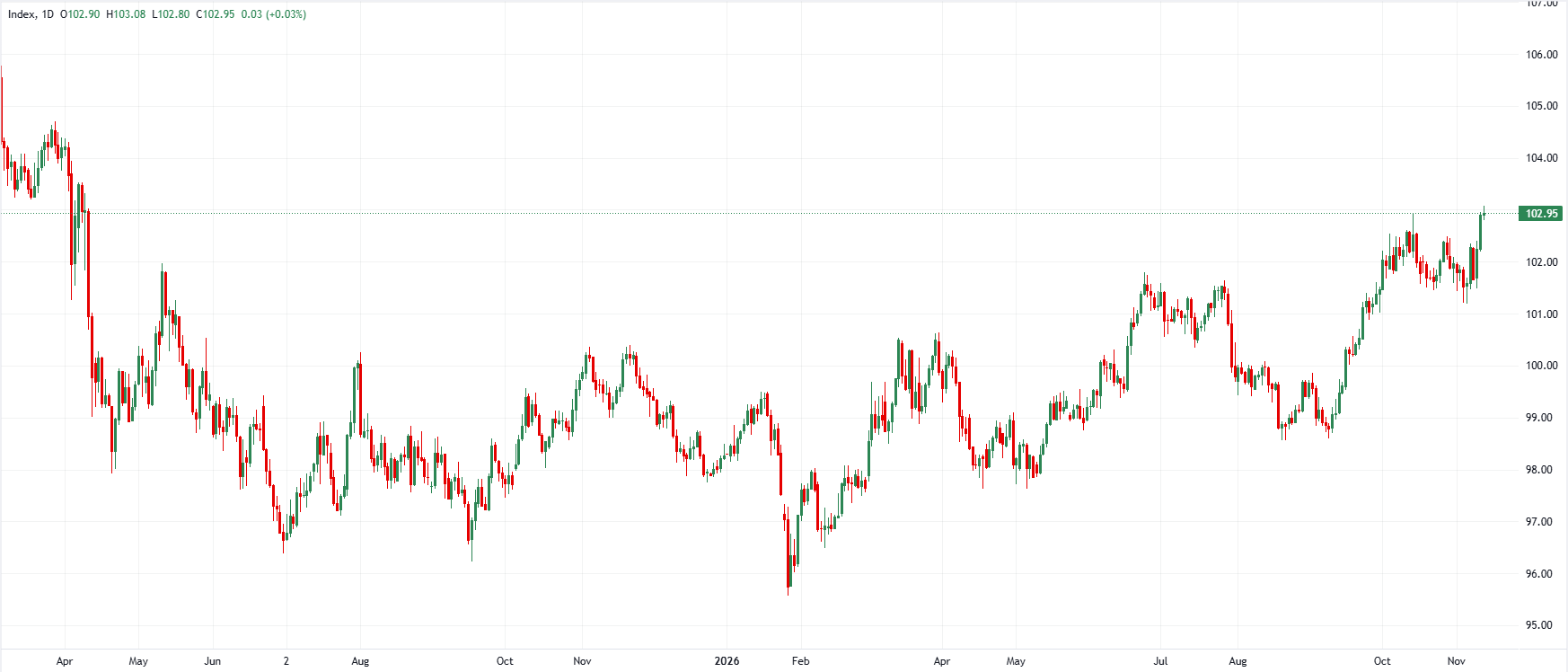
Further gains in the US Dollar (USD) have pushed the US Dollar Index (DXY) to a year-to-date high of 103.08. The advance across global foreign exchange markets takes the currency back to April 2025 levels. Real front-end rate differentials underpin the rally. Stronger-than-expected US inflation figures and hawkish Federal Reserve (Fed) commentary have led traders to price in faster monetary tightening. Easing fears of political interference at the Fed and sustained safe-haven inflows provide additional support for the Greenback’s valuation. For institutional strategists at MUFG, ING, and Rabobank, near-term inflation releases and Fed guidance suggest further gains. Over the medium term, however, US fiscal deficit pressures remain a key variable in the US Dollar’s broader outlook.

December and January Fed hikes to support US Dollar: MUFG
Expectations of faster Federal Reserve tightening have lifted the US Dollar Index DXY to a year-to-date peak of 103.08, according to Lee Hardman at MUFG. Recent strong US inflation readings have driven that shift. Hardman does not expect a 50 bps increase in December, but futures prices indicate consecutive 25 bps rises in December and January. Forthcoming remarks from New York Fed President John Williams will therefore be pivotal in confirming the rate trajectory.
"The US dollar has continued to strengthen overnight resulting in the dollar index hitting a fresh year-to-date high of 103.08. The US dollar’s renewed upward momentum has been encouraged by expectations that the Fed is likely to speed up the pace of rate hikes in response to the recent run of stronger US inflation data... There are currently around 28bps of hikes priced by December, and 43bps of hikes priced by the following meeting in January indicating that even if the Fed hikes by 25bps in December it is now expected to quickly follow up with another 25bps hike at the start of next year... While we don’t expect a larger 50bps hike to be delivered in December, it is more likely now that the Fed could hike rates back-to-back in December and January."
Front-end rate differentials and PPI could extend US Dollar gains: ING
Real front-end yield differentials, rather than excessive speculative positioning, explain the US Dollar’s recovery to April 2025 levels, according to Francesco Pesole and the FX strategy team at ING. They view the advance as fundamentally justified and driven by rates. Fed Governor Chris Waller has raised the possibility of a 50 bps December increase, while markets still price in 28 bps. That gap leaves clear room for hawkish repricing, in ING’s assessment. The forthcoming Producer Price Index (PPI) release could provide the trigger for another USD advance.
"The combination of hawkish Fedspeak and a US CPI beat earlier this week continues to pay dividends for the dollar. DXY is now back at Liberation Day (April 2025) levels, with real front-end rate differentials continuing to fuel strong dollar momentum. Importantly, this remains a rates-driven move, with contained excessive USD strength relative to short-term fair value currently built in... We continue to see upside risks for the dollar in the coming days. The Fed's Chris Waller has put a 50bp December move on the radar, and that should keep markets biased towards hawkish interpretations of incoming data. December pricing remains at 28bp, leaving scope for further adjustment... Today’s home sales data are unlikely to matter, but tomorrow’s PPI will. That may be the catalyst for another USD leg higher."
Fed credibility and safe-haven demand counter US Dollar debasement fears: Rabobank
Reduced fears of political interference at the Federal Reserve, alongside sustained safe-haven inflows, have rebuilt confidence in the Greenback, argues the FX Strategy team at Rabobank. This leaves the currency better placed to benefit from robust US economic growth and forthcoming pressures on the Eurozone. The team nevertheless flags medium-term risks: a US budget deficit exceeding 6% of GDP and indications that the Treasury market’s "exorbitant privilege" is eroding could weigh on the USD. Despite those concerns, Rabobank considers earlier fears of US Dollar debasement overstated.
"Diminished fears about political interference on the Fed is a supportive factor for the USD. In addition, at the start of the Gulf war, strong demand for the USD undermined last year’s claims that the USD’s had lost at least part of its safe haven value. In our view the USD’s safe haven appeal is linked to its embedded position in global payments systems, which could take decades to shake... Reduced concerns over the credibility of the greenback should allow it more opportunity to benefit from the US’s robust economic growth performance... There is still a risk that concerns related to the US’s unwieldly budget deficit could weigh on the USD over the medium-term. The US budget deficit at over 6% of GDP is wider than that of France... Either way, last year’s dollar debasement fears appear exaggerated."
US Dollar outlook: near-term support, medium-term fiscal risks
A new year-to-date peak for the US Dollar Index at 103.08 reflects the combined strength of front-end rate repricing, institutional credibility and structural safe-haven demand. In the assessments of MUFG and ING, persistent inflation and hawkish Fed signals keep near-term risks tilted towards further US Dollar appreciation around the forthcoming PPI release. Markets have priced in 28 bps to 43 bps of tightening across December and January, while discussion of a possible 50 bp increase adds to that backdrop. For Rabobank, medium-term fiscal risks remain, with the deficit above 6% of GDP. Even so, the Greenback’s established position in global financial markets leaves it well placed to outperform its major peers.
(This article was created with the help of an Artificial Intelligence tool and reviewed by an editor. Learn more.)
POPULAR ARTICLES
1“We don’t need a deal with Iran”, US President Donald Trump says on Truth Social2200K: US Initial Jobless Claims Climbed Last Week3USD/JPY: Intervention risk limits gains – BBH4RSI near 66: Strong buying interest indicated in USD/CAD Price Forecast5103.08: US Dollar Index Sets New Year-to-Date High as Fed Rate Hike Expectations Strengthen60.5550 area: New Zealand Dollar holds steady as US Dollar bulls pause7US Dollar: Focus turns to Fed commentary as rally slows – BBH82.75% in December: Economists agree ECB will raise rates, Reuters poll shows9Ripple, Cardano and Solana Price Forecast: Top Altcoins Stem Losses as Exhaustion Signals Emerge


Get Started!
Sign up and access the Global Markets in less than 3 minutes

Connect With Us












The information provided on this website is of a general nature only and does not constitute personal financial advice. Before acting on any information on this website, you should consider the suitability of the information in relation to your objectives, financial situation and needs. Investing in CFDs and FX Margin Contracts carries significant risks and is not suitable for all investors. You may lose more than your initial deposit. You do not own, or have, any interest in the underlying asset. We recommend that you seek independent advice and ensure you fully understand the risks involved before trading. It is important that you read and consider the disclosure document before you acquire any product listed on the website. The information and advertisements offered on this website are not intended for use by any person in any country or jurisdiction where such use would be contrary to local laws and regulations. The Products and Services offered on this website are not intended for residents of the United States, Malaysia and Thailand.
TMGM is authorized and regulated in various jurisdictions.
Trademax Australia Limited, trading as TMGM, is regulated by the Australian Securities and Investments Commission (ASIC), AFSL no. 436416 and is located at Level 28, One International Tower, 100 Barangaroo Avenue, 2000 Sydney, NSW Australia.
Email: support@tmgm.com.au
Trademax Global Limited, trading as TMGM, is authorized and regulated by the Vanuatu Financial Services Commission (VFSC), registration number 40356 and registered at 1276, Kumul Highway, Port Vila, Vanuatu, Republic of Vanuatu.
Email: support@tmgm.com
Trademax Global Markets (SE) Limited, trading as TMGM, is authorized and regulated by the Financial Services Authority (FSA) of Seychelles, with license number SD224. The company is registered at Office No 13, Providence Estate ABIS Centre, Mahe, Seychelles.
Email: support@tmgm.com
Trademax Global Markets (International) Pty Ltd, trading as TMGM, is authorized and regulated by the Financial Services Commission, Mauritius (FSC) with license no. GB22201012, and registered at 33, Edith Cavell Street C/o IQ EQ Fund Services (Mauritius) Ltd Port Louis, 11324 Mauritius.
Email: support@tmgm.com
Copyright © TMGM. All rights reserved